

Jewelry Journeys with Robin Gambhir
The content of this article is the opinion of the writer and was written for The Source
The following conversation has been edited for content and clarity.
Robin Gambhir is Fair Trade Jewellery Co.'s (FTJCo) co-founder and manages finance, governance, technology and sourcing. Robin holds an M.A. in Literature from the University of Toronto.
Prior to his twenty five years in the wholesale gem trade, he worked as a software developer with Apple and was a writer for the National Post newspaper. FTJCo is proud to have launched Fairtrade Certified Gold in North America. (Robin was on the Board of Directors for Ethical Metalsmiths for several years, and recently assumed a role on EM’s Board of Advisors.)

FTJCo. jeweler Isabel Gertler at work in the studio. Credit: Robin Gambhir
Chloe Beaumont (CB): How did you get involved in the jewelry industry and what inspired you to start FTJCo with your co-founder Ryan Taylor?
Robin Gambhir (RG): My glib answer is poor career decisions, but there’s also some truth to that answer. My family had been in the gem business since the 1960s which included, at one point, a cutting factory in Jaipur, India. There was an expectation that I would join the family business, but it was also my choice. My low marks coming out of high school meant I had to go to summer school to get my grades up and then basically talk my way into a university admission and a spot in residence a month before classes started.
My highest (and that’s a relative description) grade coming out of high school was English, and so that became my major in university. For two years I had a great time and more mediocre academics ensued. But the friends I made there were bright, ambitious and did well academically. I needed to prove to them and myself that I was capable of academic success similar to theirs and I did, while simultaneously working for Apple for three years. That academic effort led me to graduate school at the University of Toronto while also starting work in the family business. (To be clear, I am sharing this to illustrate to others who may not do well in school that sometimes it just takes a little longer or a different path to find your way).
Ryan Taylor was the impetus behind what would become FTJCo. He is a goldsmith, and I invested in his first company because I wanted my family business to have manufacturing capabilities. We closed that company because it was directed towards the trade, and nobody at that time was interested in what would come to be known as responsible sourcing. We then decided to take our product directly to consumers through retail.
In those early years, I was very much a “padawan” to Ryan; to this day, he is probably only one of a handful of people in the industry who has field, maker and policy experience. I am still learning from him. With FTJCo, he doesn’t get nearly the recognition he deserves—mostly because he doesn’t want it, as it mainly sucks up time that could be spent tackling complex supply chain problems. That’s what occupies him these days.
In any partnership that works, you need to have complementary skill-sets. At FTJCo, the business part of the business was always my area, and over time, as I learned more, I became more proficient in sourcing. These days, our head goldsmith Kesha Frank is the company’s responsible sourcing manager, and she is heading up our work to align everything we do with the United Nations’ Sustainable Development Goals.
CB: What were some of the first challenges you faced in starting FTJCo, and how did you overcome them?
RG: Well, we didn’t have any money. FTJCo was financed by my internet company OpenBlue Networks which ran Canada’s largest network of retail jewellery websites and generated some of the industry’s first consumer-generated business intelligence data. As subscription income came into OpenBlue, I was writing loan checks to FTJCo to keep it afloat. We started in a co-working space, but people didn’t have confidence in meeting a jeweller with no location—the optics read sketchy, and we realized we needed our own location. I wanted to rent an office to save money, but Ryan pushed for a high street retail location—a real store.

Fair Trade Jewellery Co. storefront. Credit: Robin Gambhir
Eventually, we found something we could afford in a sometimes dodgy but also very charming part of Toronto called Cabbagetown. That original store is where we are today, but we’ve grown a lot since then, and we are moving up the street to a building that my family owns. Money is always a problem, even when you grow, (maybe especially when you grow). But we still own our own company and didn’t sell to investors. In the coming years, FTJCo will implement employee ownership, so that the people who work for the company share in its success and growth. This is an important part of our values as a certified BCORP.
CB: How important is Chain of Custody (CoC) traceability and what should consumers know about it?
RG: CoC is important because then you know where the goods have been. The sort of transparency required for CoC means that you automatically exclude bad actors because they will not want a light shined upon them. CoC—with evidence-based data to support it—is crucial for getting past the lies and misrepresentations made by otherwise well-meaning jewelers who repeat what they’ve been told by their suppliers without any data, context or accountability.
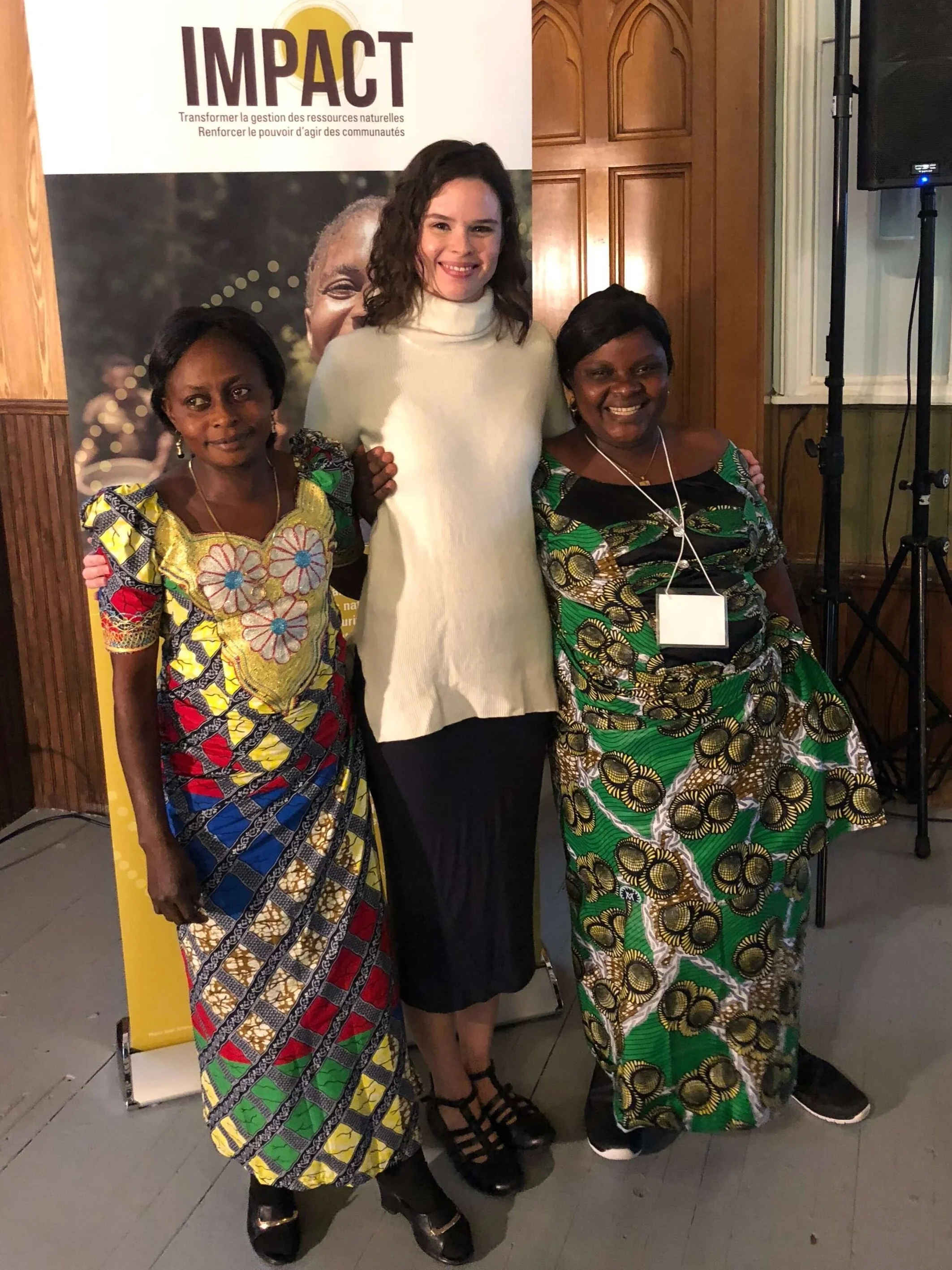
Just Gold miners with Kesha Frank, head of production at FTJCo, Ottawa 2018. Credit: Robin Gambhir
CB: Consensas, the technology platform that FTJCo uses in partnership with IMPACT’s Just Gold project, allows for complete CoC transparency. Did your co-founder Ryan work to build this technology in response to a lack of pre-existing technology that would adequately do the job?
RG: Yes. People in the industry who don’t understand technology seem to think that putting information on a blockchain system makes it true. It doesn’t. There’s a dangerous lack of understanding; leading with technology as if it alone solves the problem is wrong. All of these solutions fall prey to the “garbage in, garbage out” problem that computers have always had.
CB: I think there is a common fear in the jewelry industry that if a business were to publish any and all information they have on the materials that they source or the vendors they do business with, that it would only be detrimental to their business because it would highlight where provenance and chain of custody traceability is deficient or non-existent. FTJCo doesn’t claim to be perfect, nor do you claim that all your suppliers are perfect. You choose to publish everything you know as well as what you don’t know. What made you and your company decide to do this? How has it benefited your business?
RG: FTJCo is an activist company and I can assure you that (monetarily) the Congo gold project, working to make the industry better, developing software systems and publishing data have all been expensive and objectively unprofitable in terms of time and money. However, doing that work and asking those questions means that we have a more in-depth knowledge of these things than any of our competitors. A culture of learning, activism and technical excellence means that the people who want to work here are usually the best and the brightest.
A company is really just the people and you build the best teams with culture. It doesn’t matter at all if our competitors know who we deal with—the responsible sourcing community is so small, we all know each other anyway. For consumers, publishing data builds trust, and we are ultimately in the business of trust.

Co-Founder Ryan Taylor (middle) with Madagascar Miners. Credit: Robin Gambhir
CB: Can you tell us about AKARA sapphires and how your sourcing in Madagascar works?
RG: AKARA is FTJCo’s brand and we source from different mines with different data sets. If we can competently speak to origin about a material, then it is branded under our AKARA label. The Madagascar sapphires are sourced from KAT sapphires and they are cut in Madagascar and Mauritius. That partnership began over LinkedIn, and then we visited the mine and cutting facilities. We shot a lot of content while we were contemplating a documentary that we never finished. Some of the footage is on our Instagram page and shows the sorting and tracking system for the sapphires.
CB: You not only work with mining companies that share your value of responsible sourcing, but also use recycled and lab-grown gemstones in your jewelry. Even FTJCo’s “house blend of gold” is half recycled and half newly mined. What would you say to people who may think that solely using lab-grown or recycled gems is the only way to be “ethical?”
RG: I would say, Go with God. If that’s your idea of what ethical is and you can find a bunch of customers who agree with you, then that is awesome. We, by contrast, recognize that different people have different values and so we offer people choices so that they can choose materials that best fit their values. The fact that a jeweller is even thinking about these things is excellent--many don’t.
CB: Why did you initially decide to be a part of Ethical Metalsmiths? What do you appreciate most about what EM offers?
RG: Well, the responsible sourcing part of the industry is a pretty small neighborhood, and it’s good to get to know your neighbors. Christina Miller asked me to join the board, and I think I was able to bring some of my knowledge and experience to the table that helped my colleagues and the organization. I also made some dear friends and also learned from others’ experiences.
I appreciate the community because EM is that in every sense of the word.
CB: What has FTJCo specifically been able to accomplish through this partnership?
I think we’ve been able to share what we know with our colleagues and be a contributing member of the community. I don’t see the relationship as corporate; what I put in or learn from the community will be different for my colleagues at FTJCo.

What do beekeeping and fish ponds have to do with diamond mining?