

What Constitutes “Recycled” Gold?

The content of this article is the opinion of the writer and was written for The Source
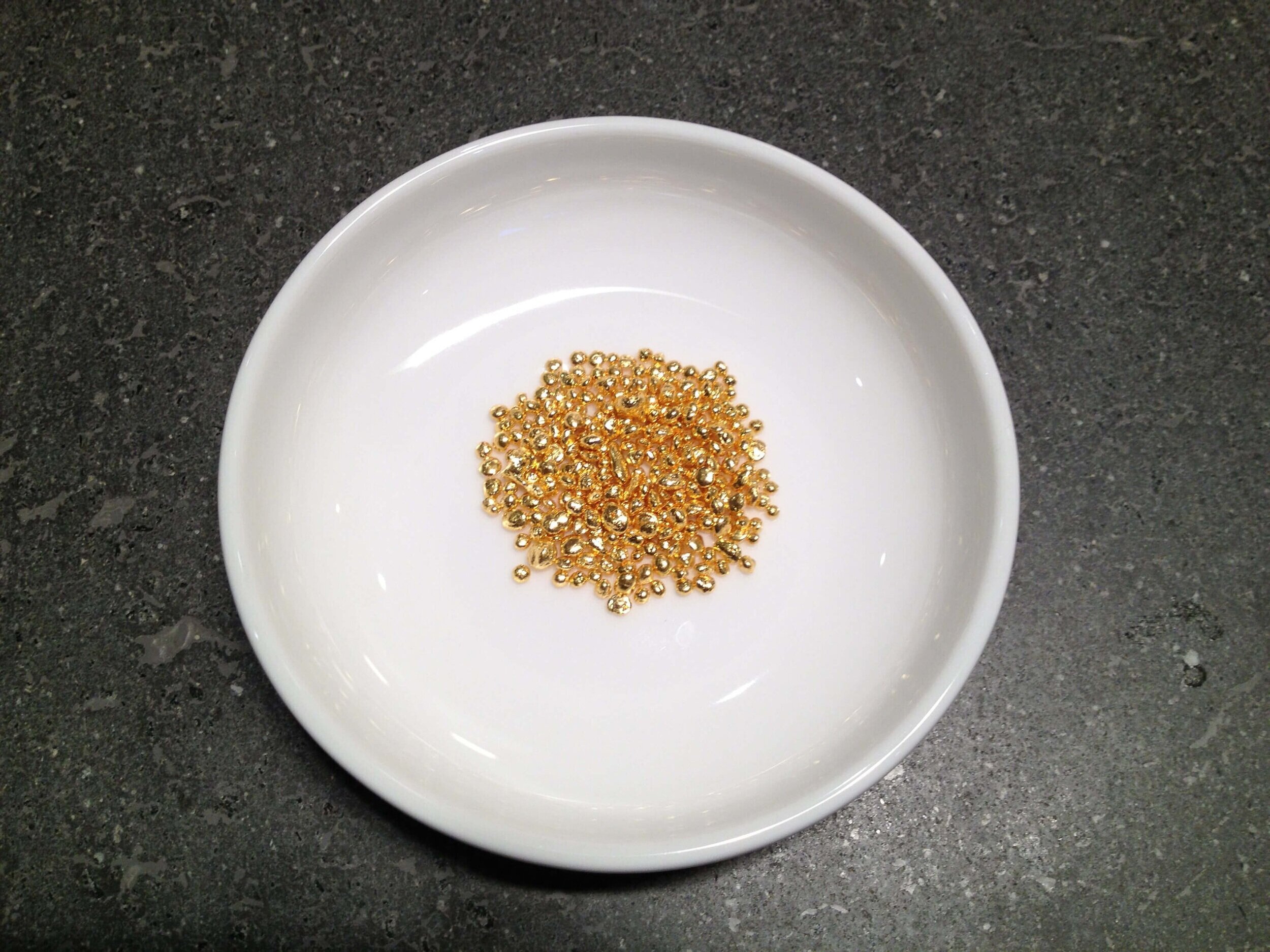
Granules of pure Gold. Where does the gold come from? How do I know?
Photo Credit: Christina Malle
Have you seen conflicting assertions about what exactly constitutes “recycled” gold?
Does it give you a headache just thinking about it? There are definitely many strong opinions out there. My intention is to encourage you to pose your own questions and research some answers, not to declare definitively that I know what is right. Since this topic is complicated, and is linked to other, equally complex topics, future posts may focus on some of these related topics.
“To most people, the word “recycled” conjures the notion that the thing - in this case, the gold - has been used before, and is now being presented in its re-utilized state.”
Since gold is an element, it keeps its gorgeous properties no matter how many times it is melted and re-formed. If a refiner is simply cutting off sprues and other excess material and is re-using it, that does not constitute “recycled” in the lay person’s common understanding of the word. This hypothetical lay person probably considers “recycled” to mean post-consumer melted and re-used. There is a difference between reusing scraps and overstock within the refinery itself and re-forming gold that was previously used by a consumer in jewelry (or in art, dental fillings, cell phones and tech gadgets). If you work at the bench as a metalsmith, then you are already familiar with the joys of repurposing existing pieces into new ones. Yet even smiths who are accustomed to repurposing gold themselves will surely need to buy gold sometimes (in the form of granules, wire, castings, findings, etc).
Is the gold newly mined? Post-consumer recycled? How do we know?
I’ve been to several jewelry industry meetings where this topic of recycled gold has come up. One thing I notice is that commodities traders and most large refiners (people who think in terms of gold bullion) are generally not part of the conversation. I understand that the LBMA (London Bullion Marketing Association) and others who talk and think in terms of bullion are tackling some of the same questions we jewelry people are pondering, and yet we seem to operate in separate silos. Perhaps we can have a dialogue with one another. Many of us bench jewelers are agonizing over where to buy gold, and the conditions under which it was mined, processed, traded and transported; yet many of us purchase gold in measures of pennyweights, mere fractions of ounces. Yes, collectively, jewelry accounts for the lion’s share of gold consumption, and yet, wouldn’t we make more progress towards transparency and traceability if we worked in tandem with the bullion folks? After all, the large refiners are often the ones selling gold to still other refiners, casters and vendors.
How Can We Verify a Refiner’s Own Statements?
Start with the vendor’s website and see what the refiner alleges about the origin of its gold. If they say they buy ‘recycled’ gold, keep reading to find out how they support this assertion. The refiner may have links in its website to reports written by their own employees, but this does not necessarily provide any degree of comfort. If they include links to reports written by independent, third-party auditors, that would be more helpful.
Here are some questions to research:
Does the independent audit and any ‘recycled’ claim cover all of the gold handled by this refiner or just some of it?
Who is the independent third-party auditor?
When a refiner does invoke the name of a third-party auditor (for example, supply chain audit companies like SGS, Underwriters Laboratories (UL) or others), against which system was the audit conducted? If the audit states that the refiner uses “recycled” gold, which definition of “recycled” was used by the auditor?
Are gold deliveries kept separate during processing and milling within the refinery itself, or is all gold processed there blended together? Can you see documentation?
How far back in time and in the supply chain does the audit reach?
Even if a refiner buys gold jewelry from another source, there can still be provenance issues. There has been a great deal of attention lately on gold processed in the United Arab Emirates (UAE). According to a report by the Carnegie Endowment for International Peace,
"An analysis of the UAE’s imports in 2016 showed that at least 46 percent of its gold supply came from countries that would be “red-flagged” by the OECD as being conflict-affected or high-risk countries had their country of origin been recorded rather than the country through which the gold transited. For example, gold from the Democratic Republic of Congo (DRC) and South Sudan are both commonly trafficked through Uganda, thus disguising its origins and resulting in it being considered Ugandan gold from a regulatory standpoint.
The process of reselling ASGM gold freely exported from red-flagged sources to Dubai jewelers and refiners (via the emirate’s bustling souk) essentially launders illicit ASGM gold into a refined product that is acceptable to the world’s most reputable gold hubs. "
Not only is the gold being brought in illegally or laundered, but apparently, some is inexpensively manufactured into various objects and jewelry and shipped from the UAE to refiners around the world, including to refiners in Switzerland. A Swiss refiner receives the gold in the form of jewelry, and claims - or tacitly assumes - that it had already been in the hands of consumers; the Swiss refiner may then melt it down and simply label it “recycled.” Yet that very gold may have been mined under awful and illegal circumstances, and/or have been recently in the custody of bad actors.
“Basically, if the refiner makes blanket statements about its own gold sourcing, without any supporting, independent and verifiable documentation, the statement is toothless.”
Some refiners clearly disclose which of their products are post-consumer recycled and which are not. They may even detail which products are available in Fairmined gold (more on that topic another day). To me, if a refiner lists products that are not post-consumer recycled, it lends greater credibility to the statements about the products that actually are recycled. The EU has regulations going into effect in January 2021, which will require most gold refiners to trace their own supply chain, but of course this does not apply to Switzerland.
If you still have the energy to ponder this a bit more, here are some definitions of the word “recycled.”
These definitions are from online searches conducted in August 2020; please know that the sites referenced below may subsequently change their statements and/or policies.
“Recycled” Gold Definitions
Recycled – A term applied to metals and gemstones purchased or used by consumers (post-consumer), or are a byproduct of manufacturing (pre-consumer) or finished goods that were never in circulation (pre-consumer) that are reused in the manufacturing of new products. Bullion containing any non-recycled metal or manufacturing byproduct reintroduced back into the same production line are not recycled.
LBMA Responsible Sourcing Programme, Responsible Gold Guidance, V8, 11.12.2018:
Recycled Gold – Gold that has been previously refined. This term traditionally encompasses anything that is gold-bearing and has not come directly from a mine in its first gold life cycle. In practical terms, recyclable material includes end-user, post-consumer products, scrap and waste metals, and materials arising during refining and product manufacturing, and investment gold and gold-bearing products. This category may also include fully refined gold that has been fabricated into grain, good delivery bars, medallions and coins that have previously been sold by a refinery to a manufacturer, bank or consumer market, and that may thereafter need to be returned to a refinery to reclaim their financial value, or for transformation into other products (e.g. 1 Kilo bars). [Parentheses in original]
OECD Due Diligence Guidelines, Supplement on Gold:
Recyclable Gold – Gold that has been previously refined, such as end-user, post-consumer and investment gold and gold-bearing products, and scrap and waste metals and materials arising during refining and product manufacturing, which is returned to a refiner or other downstream intermediate processor to begin a new life cycle as “recycled gold”. The origin of Recyclable Gold is considered to be the point in the gold supply chain where the gold is returned to the refiner or other downstream intermediate processor or recycler.
Sub-categories of recyclable gold are:
Unprocessed recyclable gold – Recyclable Gold still in its original form and/or fabrication scrap, before it has been returned for processing and refining (e.g. bullion bars, pieces of jewellery, ornaments, coins, machine turnings, etc.)
Melted recyclable gold - Recyclable Gold which has been melted as the first recycling process and cast into rudimentary bars or some other form with undefined dimensions and variable fineness.
Industrial By-product – a material produced while processing another material, not the primary intended product but nevertheless a separate useful material. For example, gold refining often creates low value by-products such as furnace flue dust, spent crucibles and floor sweepings.
Grandfathered Stocks - Gold investment products (ingots, bars, coins, and grain in sealed containers) held in bullion bank vaults, central bank vaults, exchanges and refineries with a verifiable date prior to 1 January 2012, which will not require a determination of origin. This includes stocks held by a third party on behalf of the listed entities.
Where is the gold from originally?
How was it mined?
How did it get here?
How do I know?
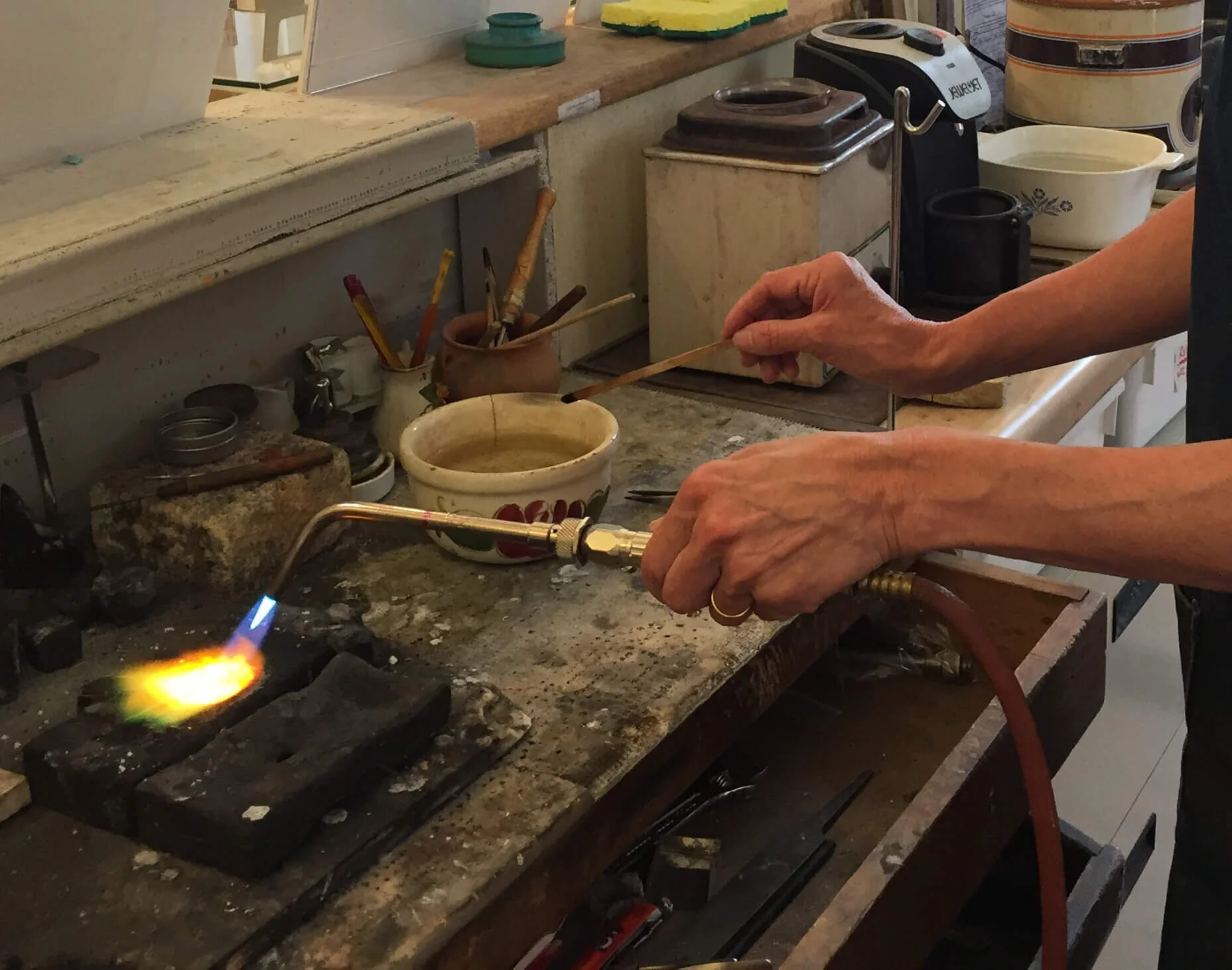
Melting the Gold; Photo Credit: Christina Malle
To wrap up, our collective and persistent questions help move our industry towards transparency and traceability. It can lead to interesting conversations with your refiners and vendors. Here are some questions to pose, in addition to all your questions to vendors about quality, price and timing: Where is the gold from originally? How was it mined? How did it get here? How do I know? If you sell grain, wire, castings or findings and claim your gold is recycled, what definition are you using? Can you share any documentation supporting the statements?
The vendors that have invested time, energy and resources to answering these questions may be very willing to share the answers with you.
Please check back for subsequent posts on adjacent topics, such as auditing systems, “Fairmined” and more.



Something we rarely talk about to the extent that it is almost taboo is what happens with a break-in, burglary or even a hold-up: How do we deal with the aftermath?