

Jewelry Conferences Recap 2023

The content of this article reflects the views of the writer, and not necessarily those of Ethical Metalsmiths. This article was written for The Source
The environmental impact – and especially carbon impact – of the jewelry industry, as well as human rights issues, are now mainstream topics. If you haven’t started educating yourself, you can start here or start elsewhere, but please start!
Three major industry - wide gatherings took place over the summer of 2023 in the United States. Of course, several took place overseas as well, and we hope someone else can fill us in about those gatherings. Each one of these three US-based conferences was memorable in its own way. Collectively, they allow us to take the pulse of the jewelry industry. Pressing topics on the agendas: the impact our industry has on climate, the environment in general and people all along the supply chain, from extraction to fabrication to the retail counter/online store. If you think these are someone else’s problems, or someone else’s issues, please think again! At least, that is this attendee’s opinion, having attended all three of the following events, as summarized below.

Members of Ethical Metalsmiths and friends gathered outside Harvard’s Geology building during the GIA/RJC/WJA conference in Cambridge, Massachusetts. Photo by Christina Malle
Would you consider joining one, two or all three conferences next year? You will learn an extraordinary amount and encounter leaders in our industry. Another bonus: when you run into questions, even long after the conference is over, you’ll have the resources to know how to answer them. You’ll know who to contact for insight and where to begin (or step up) your research. Whether these are topics near and dear to your heart, or you simply want to connect with prospective (read: younger) clients, please arm yourself with answers. Questions abound and collectively, we can actually provide some answers! Even if the response is “I don’t know, but I’ll try to find out more for you,” this honest and direct approach adds to your credibility in the eyes of consumers.

There was such a fascinating range of attendees at the inaugural State of the Art Jewelry Summit: the Future of the Industry. Perhaps it was due to the fact that there were three co-hosts. Or, perhaps it was due to the fact that it was hosted at Harvard, in the old-school, charming Geology department. The geology building at Harvard: wow! I’ve never been to a conference with this range of speakers: from Harvard Business School professors, to major jewelry companies to artist extraordinaire Wallace Chan. Who else presented? Mine-to-market gemstone suppliers, innovators, marketing specialists… and more. In addition to riveting panels, the discussions between the sessions and over the breaks were as illuminating as the formal presentations.
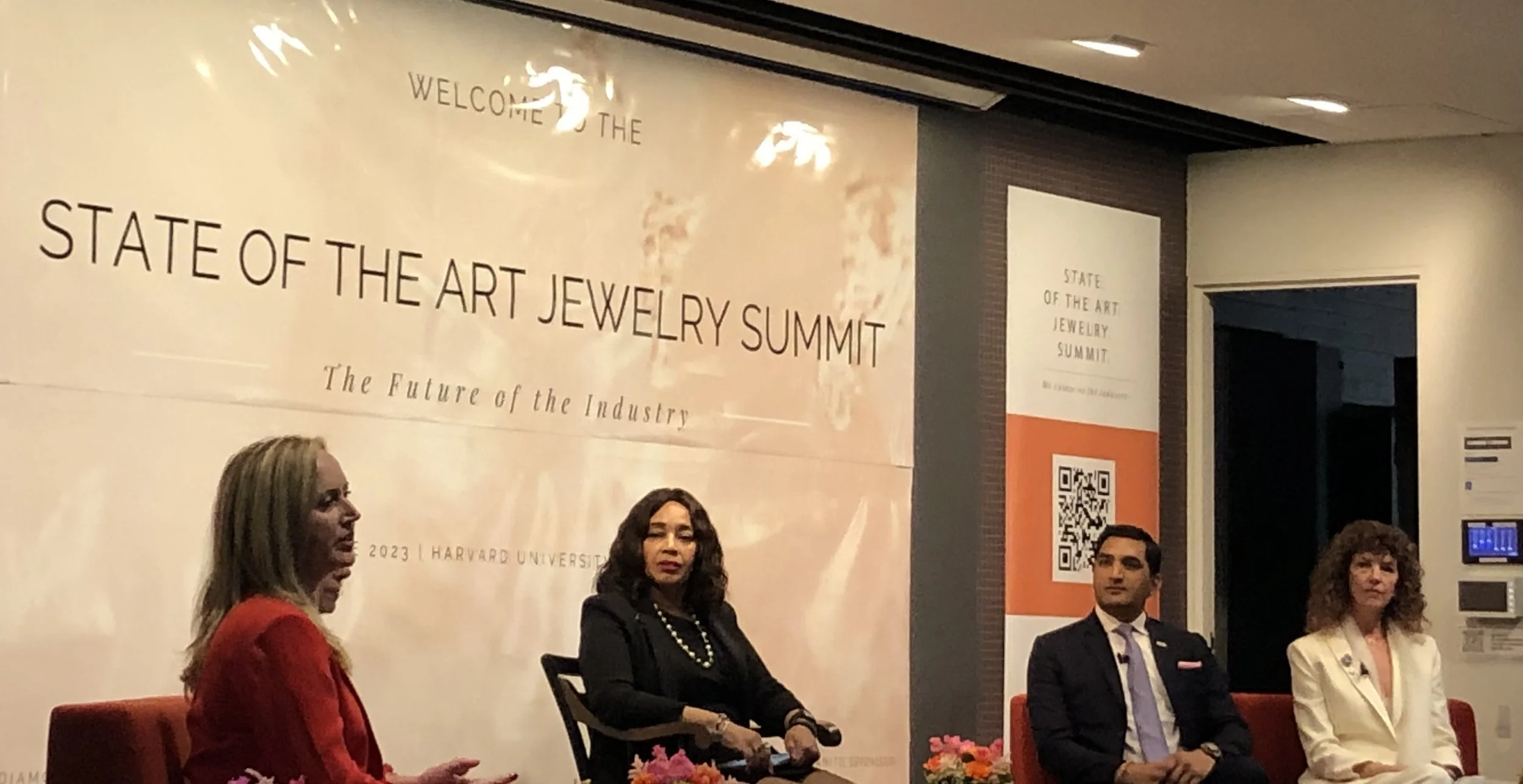
Each panel was stellar at the GIA/RJC/WJA conference held at Harvard; Tiffany Stevens of the JVC spoke on sanctions; Ethical Metalsmiths’ Monica Stephenson listens on the far right. Photo by Christina Malle.
Have you ever had lunch under a tent with geodes as center-piece conversation-starters? This was a first for me, too! Conversations were as varied and colorful as the gem specimens that graced the tables. Attendees also visited the Mineralogical & Geological Museum at Harvard, housed in the geology building. If you haven’t been yet, do go!
Some takeaways:
Data is important; know the data on our industry’s carbon footprint. Follow the research presented by Dr. Yang Shao-Horn of MIT. She stated that 95% of the jewelry industry’s carbon footprint is attributed to the extraction, processing and transport of metals. In other words, machines, equipment, buildings and vehicles using fossil fuels.
Educate yourself by reading, joining an organization and/or asking questions. This includes asking your vendors to be transparent.
It’s better to say “I don’t know” when faced with a query and offer to find out than to say “it’s impossible to know.” Consumers and industry colleagues understand that it may not be possible at this time to know every point of origin or impact on human rights, labor or the environment. Being frank when you have an answer, as well as when you do not, increases your credibility.
Consumers care about their own values deeply, and typically conduct research on a brands’ values before they make a significant purchase. The more important the occasion that prompts the jewelry purchase, the more important ethical and environmental factors are to the purchaser.
Consumers are willing to pay more for “ethical” jewelry.
When it is authentic and verifiable (by the consumer), show the positive impact your item/brand/line has on various communities and the environment. Show the provenance where possible.
Consumers would rather you be transparent where possible and say you’re working on it when you do not have an answer or cannot say the impact on people and planet. Attaching words like “sustainable” or “ethical” or “green” – without anything to back those words up – is not helpful.
Explain your values and what you’re doing about climate, the environment and more on your website
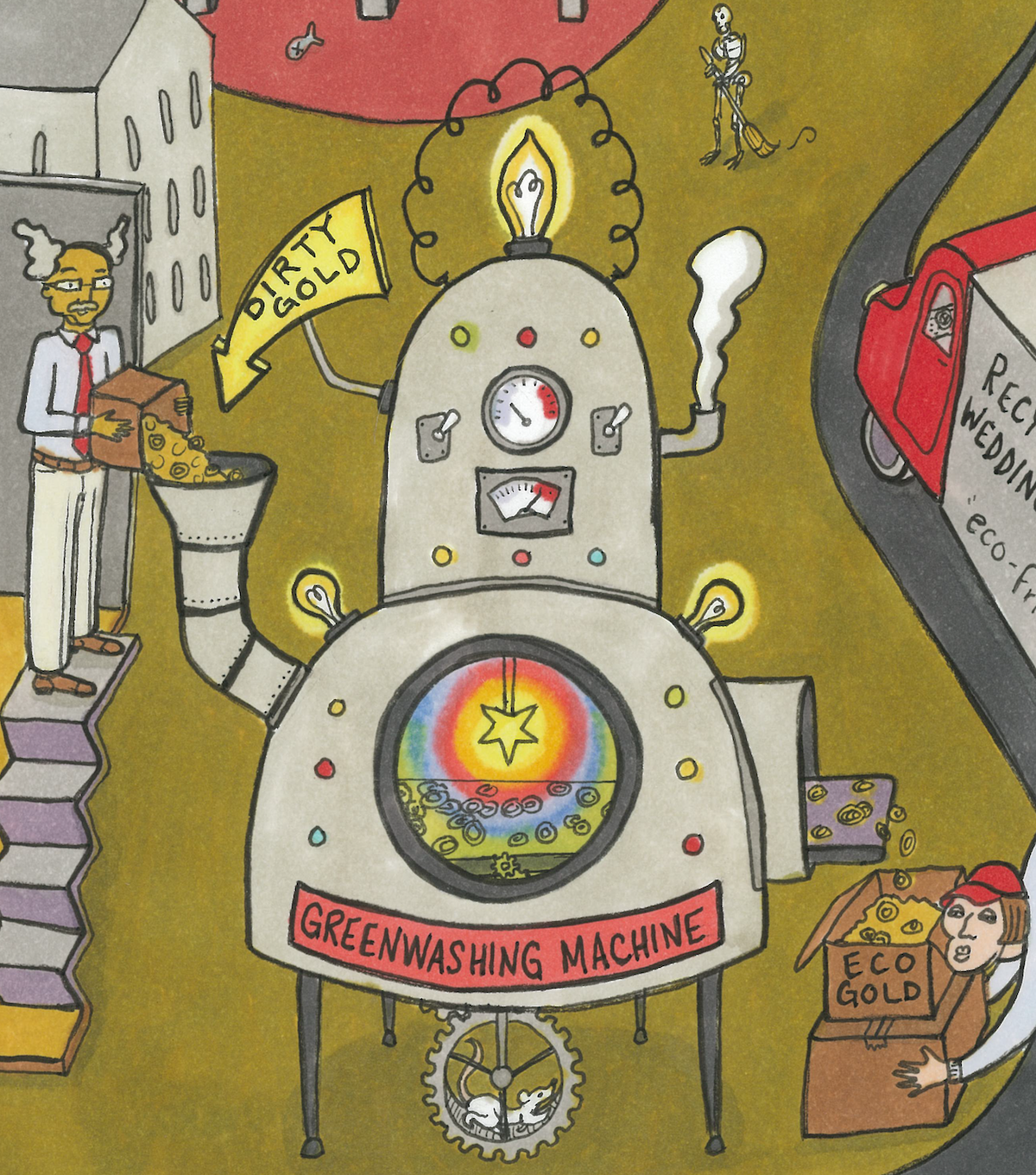
The word “recycled” is inadequate when it comes to gold; it is the beginning of the inquiry, not the end. [As many readers know, “dirty” gold and legitimate gold is often blended together at one point or another along the supply chain. Even now, in 2023, your refiner or vendor may be using the word “recycled,” whereas the gold may include smuggled or laundered gold. There has been a great deal written about this problem. This loophole and egregious misnomer is widely recognized and has to do with international customs regulations and financial and commodities issues. Stay tuned for important conversations on the misnomer “recycled.”]

Adriano Mol presenting the Radical Jewelry Makeover Brazil project at the IAG Gold Conference in NYC. Photo by Christina Malle.

This gold conference is so sought-after that even the platinum folks attended! As was the case at Harvard, attendees at the IAC Gold Conference were also treated to an incredible breadth and depth of expertise. Speakers ranged from Rio Grande’s educator extraordinaire Mark Nelson to Ethical Metalsmith’ board member Cristina Villegas, from World Bank experts on mining in sub-Saharan Africa to a single-origin and traceable gold mining company.
Innovators were also in the room, presenting a range of ideas. We learned about an innovation for removing gold from ore without the use of mercury (thank you, Toby Pomeroy and the GoldDrop team), as well as a lab-grown company relying on solar power. Many in this industry are working hard to reduce the carbon impact of our industry. Those who are working in this field seemed proud to share their results and challenges and there was an eagerness among the audience to hear more. There was a clamor for verifiable data, as opposed to mere claims and virtue-signaling.
Some takeaways:
Concerned about the jewelry industry’s impact on the environment and carbon footprint in particular? These issues are now mainstream. Thank you to Newmont Mining Corporation, the World Gold Council, DeBeers, the Platinum Group and others for showing up, presenting, engaging in challenging conversations and for demonstrating that these topics are both mainstream and important.
Using words such as “sustainable,” “responsible,” and “ethical” to describe one’s business products or processes is insufficient. Backing up such claims with transparent data or verifiable sources is essential.
Traceable sources are already available in gold; whether single mine origin or segregated supplies within refiners.
The word “recycled” is inadequate when it comes to gold. And yet, what next? Perhaps we will collectively begin to distinguish between “recycled” and “repurposed” when it comes to precious metals.

Ethical Metalsmiths students Chelsea Rowe and Shannon Kurzyniec highlighting Radical Jewelry Makeover projects at the Chicago Responsible Jewelry Conference. Photo by Christina Malle.

During this amazing two-day gathering, we met and heard experts representing many facets of our very complex supply chain, as well as esteemed thinkers and academics. In a word: mesmerizing. Many of the panels presented ideas so profound and complex and that this observer finds it challenging to distill the ideas into succinct descriptors.
For a thorough description of this remarkable conference, see Chloe Beaumont’s article for The Source entitled Chicago RJC 2023: Takeaways and Next Steps. Since Chloe already captured the highlights, this observer will just mention some broad comments. Please attend next year and see for yourself; if you cannot travel to the Chicago area, a remote option has been made available in the past and may be again next year.
This is the only conference (of which this writer is aware) where miners are present each year. Some miners or mining community representatives were fortunately able to join in person; others were unable to obtain visas and joined via Zoom. Susan Wheeler Geraghy [EM Board Member] and Andrea Hill [EM Advisor], the organizers extraordinaires, connected the remote-presenters by chat, so that they could answer questions live by chat. Have you heard miners speak to you directly about their challenges and concerns? If not, why not?

Workshop during the Chicago Responsible Jewelry Conference, 2023. Photo courtesy of Susan Wheeler.
It was powerful beyond words to hear from miners about food insecurity and challenges accessing clean water. In some cases, interactions with local and national governments created further obstacles to safe, healthy and secure living conditions. Where do these challenges remain? In countries that are exporting millions of dollars worth of metals and minerals that we are collectively buying, selling and marketing. The disconnects are jarring.
Attendees participated in a workshop, where we brainstormed solutions that could advance accountability in our industry. The question at hand, for each group to workshop: come up with at least one action item to advance responsible practices. Not only did great ideas percolate, but it was also a memorable way to get to know one another!

Ethical Metalsmiths board member Anna Bario, presenting at the Chicago Responsible Jewelry Conference. Photo by Christina Malle.
Chicago Responsible Jewelry Conference.
Some takeaways:
It seems challenging for retailers to engage on topics around responsible practices. What are the impediments to engagement?
People who live in mining communities, even those that produce among the most valuable commodities known on earth (read: high quality diamonds) may not be benefitting at all from nature’s largesse. Indeed, the resource ‘curse’ may mean that local communities suffer more harm than if there hadn’t been valuable minerals nearby. For example, as mining develops, scarce water sources may be diverted for mining operations, at the expense of local inhabitants.
If the government of the resource-rich country does not empathize with and protect its own citizens from predatory mining activities (often, but not always, foreigners), then the citizens become extremely vulnerable. Are there any counter-balances? Public scrutiny, social media, press coverage and perhaps most powerfully, hearing from miners themselves, as we did during the Chicago Responsible Jewelry Conference.
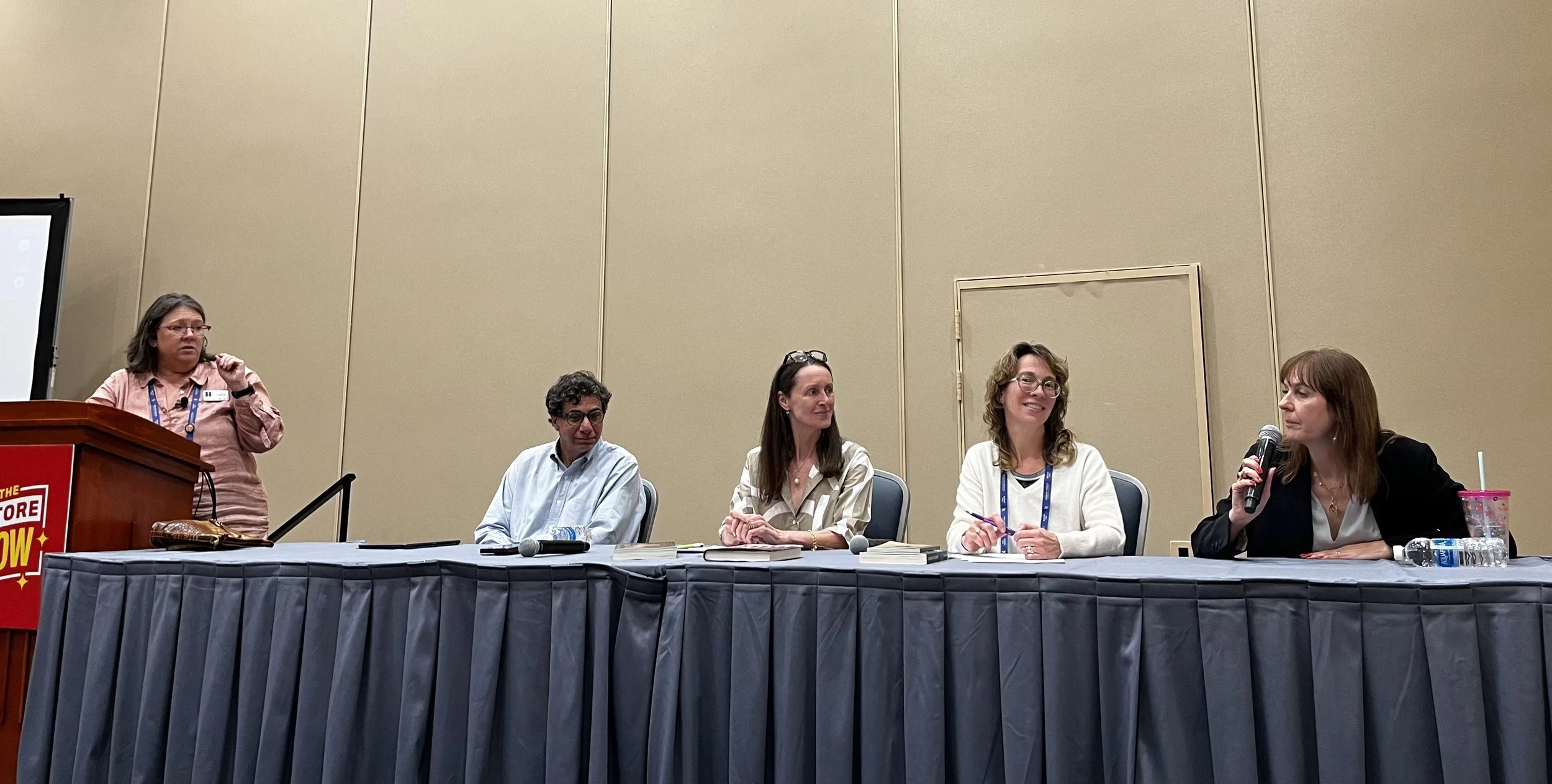
Andrea Hill moderating a panel for the InStore conference 2023: retailers, retail customers and responsible sourcing. Panelists Bob Goodman, Christina Malle, Wendy Woldenberg and Susan Wheeler. Photo courtesy of Wendy Woldenberg.
The InStore Show, geared towards retailers, took place immediately after the Chicago Responsible Jewelry Conference and each conference honored the badges of the other. The retailers who attended the Chicago Responsible Jewelry Conference stood out as leaders in this field and seem to be keenly aware of the challenges when discussing these topics with clients and with one another: it’s complicated! We all know that customers are concerned about carbon footprints and the values of a brand, but how can we address these nuanced issues with consumers?
Thank you to InStore for providing a space and a structure for these conversations!
Attending one or more conference on the topic of responsible jewelry is a great way to advance our industry.
See you there in 2024!
“We are a small team of passionate jewelry industry professionals and writers. We’d appreciate your support to grow our team and continue to be able to provide the best responsible jewelry content for years to come!”



Chloe interviewed Jessica Hudson of The Nomad Jeweler on her latest collection that features ASM Colombian gold and Tahitian Kamoka pearls. Read the full article to learn more about Jessica’s story and why she chose to design with traceable artisanal gold and sustainable pearls.