

Wendy Woldenberg on Earth Centered Jewelry and Community

The content of this article reflects the views of the writer, and not necessarily those of Ethical Metalsmiths. This article was written for The Source.
Full disclosure: Wendy Woldenberg currently serves on Ethical Metalsmith’s Executive Committee.
CB: As part of your origin story, your company WEND was launched after a two week backpacking trip on the Wonderland trail in Mt. Rainier National Park. You said that where other people only saw scenery, you saw rings waiting to be made! I want to know more about this unique story—did you have an “aha moment” on the trail about opening up a retail space?
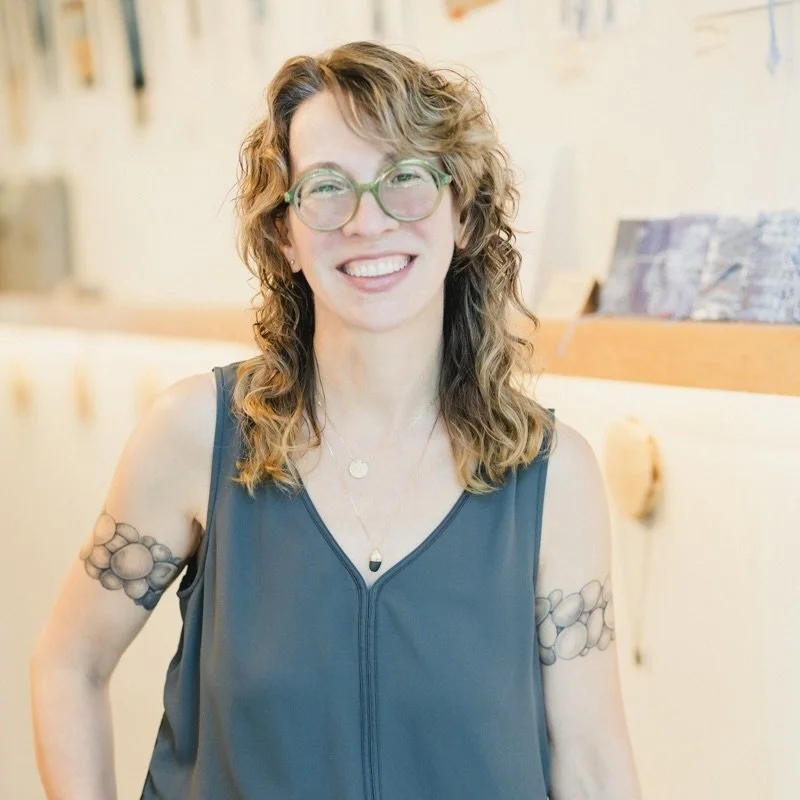
Wendy Woldenberg in her store. Photo credit Diane Knothe.
WW: When I did the backpacking trip around Mt. Rainier, I was a high school Jewelry/Metals teacher, which requires you to be well-rounded in your skill-set. In my personal life, I applied that well-rounded skill set to making Custom Jewelry – usually making pieces for clients to their specifications. I always enjoyed making custom jewelry, and still do, but as a result, I wasn’t working in a particular style.
While walking around that mountain, a unique design perspective centered on nature’s forms, lines, spaces, and textures was born. I was sober the entire two weeks, but the utter exhaustion of that adventure probably helped the hallucinations along! While I had created wedding rings mimicking mountains and water, the designs coming alive on the trail were less literal, and more referential to the textures I was seeing all around me.
I’ve been fortunate enough to have traveled internationally quite a bit, but I had never considered that something so close to home could have such an astounding impact on the direction of my life.
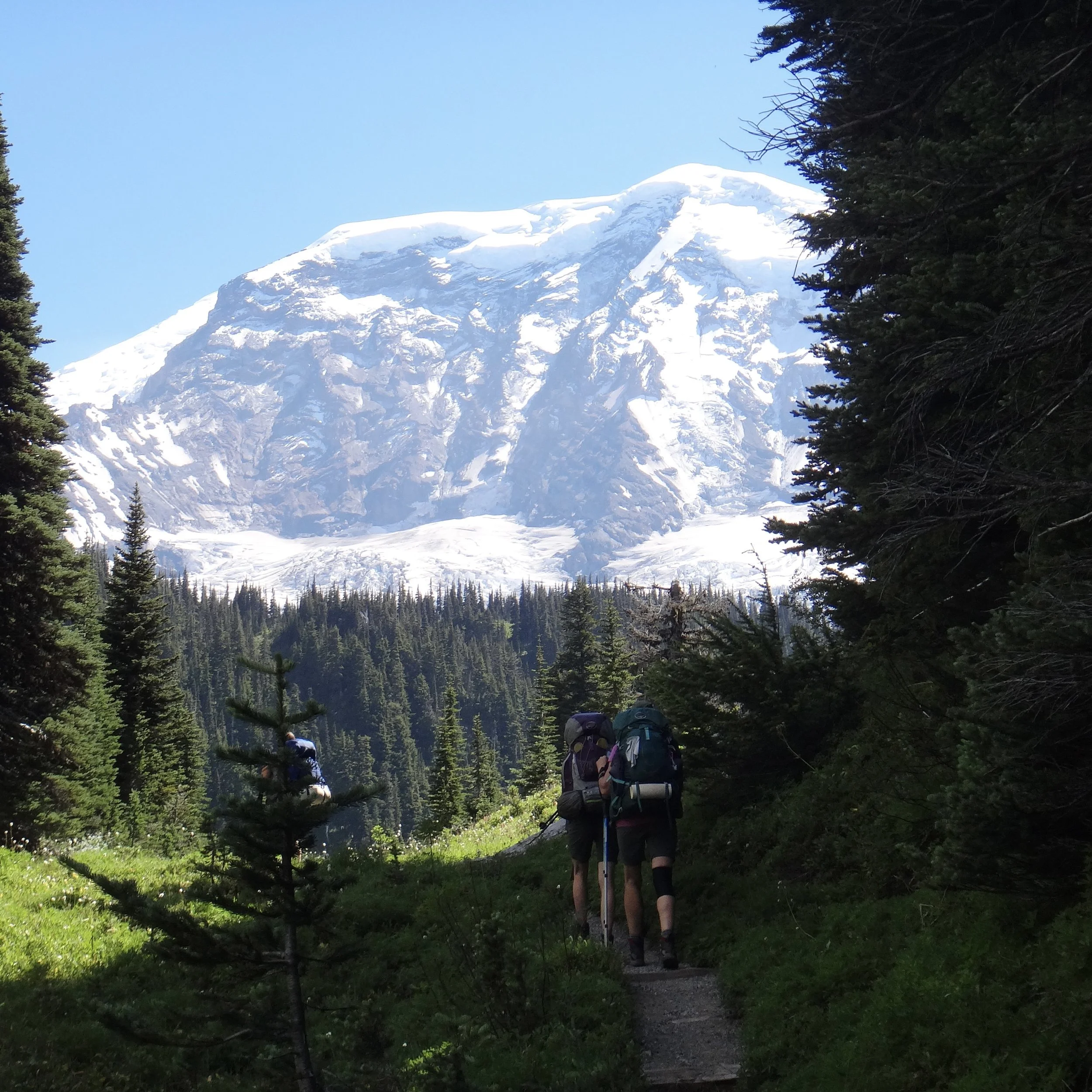
Mt. Rainier via the Wonderland Trail. Photo courtesy of Wendy Woldenberg.
CB: You just did a week-long highlight on social media of your responsible sourcing initiatives after Earth Day 2024. I loved seeing that you source your lab-grown diamonds from a women-owned, solar-powered lab in Ukraine called Alkor-D. Can you talk more about that and how you got connected with the owner Julia Kusher?
WW: While at the Chicago Responsible Jewelry Conference, I met the fine humans at M. Geller, Ltd. a Chicago-based wholesaler of special order, loose mined and lab grown diamonds. They had some pieces on display from Julia’s jewelry line, Solo for Diamonds. The pieces were gorgeous, but as a maker myself, I didn’t want to buy finished pieces.
That’s when I learned that Julia also runs the factory that makes the diamonds. The factory is SCS Certified, which is a standard I appreciate. SCS grades the diamond’s impact on the environment and confirms chain of custody to ensure high ethical standards are upheld. That means each diamond receives a second grading report that breaks down what energy was consumed, where it came from, and anything that was done to offset it.
Here are the pillars of an SCS Certified diamond:
Verified Origin Traceability: Guaranteeing the origin of each certified diamond through advanced testing, gem identification protocols, surveillance audits and sampling across the supply chain.
Twelve Principles of Ethical Stewardship: Adhering to comprehensive environmental, social and governance (ESG) requirements.
Net Zero Carbon Footprint: Demonstrate a net zero carbon footprint based on continuous operational improvements, investments in renewable energy and other climate mitigation initiatives.
Sustainable Production Practices: Committing to the principle of doing no harm to humans or environment, and actively working to avoid, eliminate or offset any impacts that might be associated with the production process.
Sustainability Investments: Investing in efforts that not only improve internal operations and supply chains, but also in projects that help communities and protect climate and the environment.
CB: Also I’d love to know more about it being solar powered–that is amazing and I rarely hear about solar-powered factories.
WW: For the diamonds grown at Alkor-D, any non-renewable energy that is used in the growth and cutting process is offset through the UN’s Climate and Clean Air Coalition, specifically the Himalayan Brick Kiln Improvement Project to protect clean air, as well as other projects to prevent black carbon pollution for 1.3 billion people.
The majority of the factory, however, is powered by renewable power plants. With Ukraine’s climate, this is a combination of solar and wind. This reduces regional air quality impact by 80 percent and fully neutralizes any hazardous emissions. After the Russian invasion and bombings, green energy has taken a hit but still makes up 11% of Ukraine’s grid, one of the highest in Europe.
CB: I’ve heard from multiple other jewelers that work with both lab grown diamonds and natural that there is still quite a gap of knowledge when it comes to consumer awareness about post-consumer recycled diamonds and Canadian diamonds. It seems like they’ve only heard about lab grown or newly mined diamonds. Have you experienced this as well?
WW: Not really. So far, people who find WEND seem to understand that we have limited the choices to only a few ways we will source diamonds. We don’t sell many diamonds. People attracted to our brand are drawn in by our jewelry designs and our values, and are happy to go with the limited choices we’ve laid out.
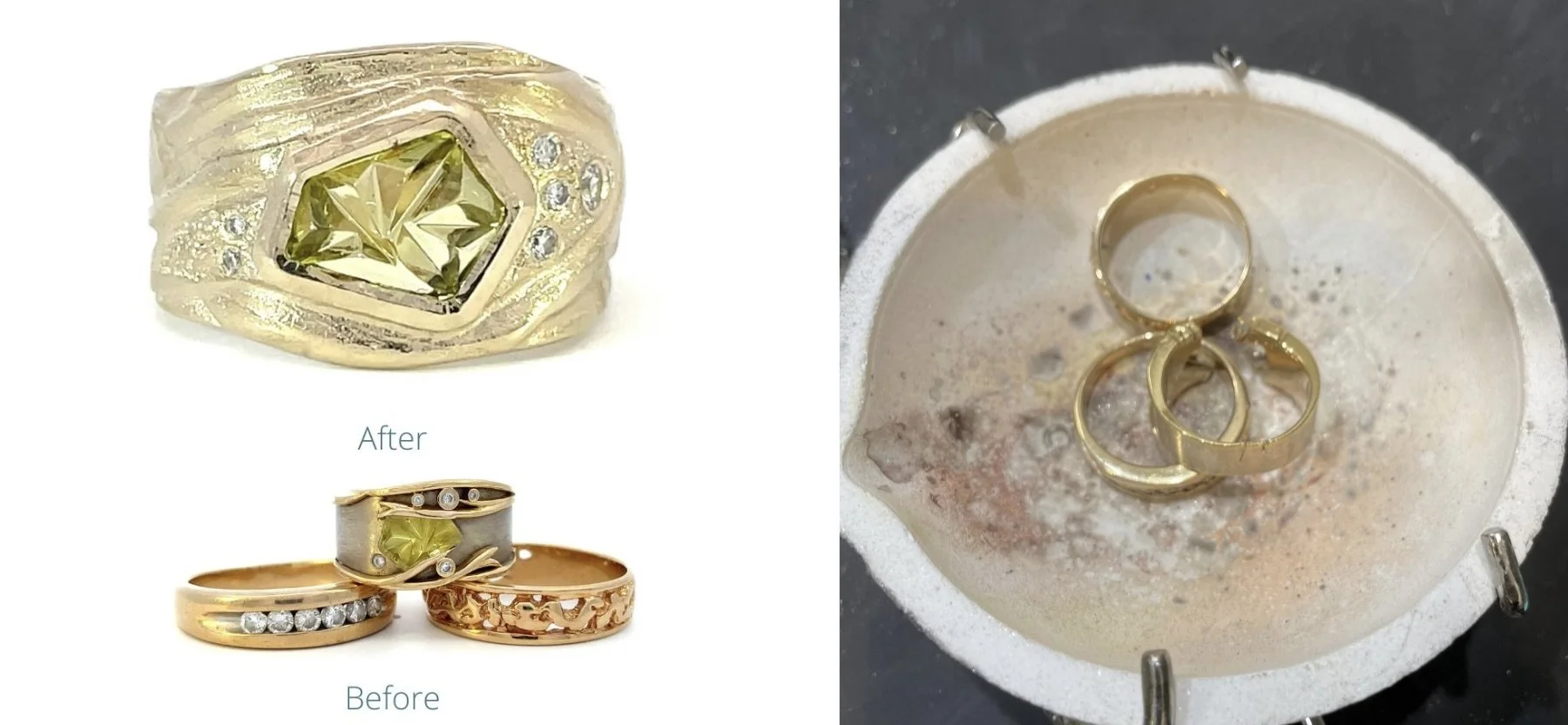
A WEND before-and-after using client gold and gemstones. Photo courtesy of Wendy Woldenberg.
CB: How do you approach the lab grown vs natural diamond pricing conversation with your clients?
WW: Prices on our lab diamond pieces are well below our reclaimed diamond prices, so this conversation hasn’t come up. We don’t sell the diamonds alone, instead we sell our designs, and we add diamonds to them. Gemstones have always been the secondary consideration for WEND. Most jewelry brands sell the stones first, then what they call the “settings” or “mountings”. We sell an interesting ring, then add the diamond to it.
CB: What is your most popular gemstone category to work with: heirloom, post-consumer recycled, or lab grown? (Or are they all about the same?)
WW: Our most popular category is using our client’s stones (heirloom), by leaps and bounds. This makes me super happy, since I always prefer to use what already exists. But, it also adds a lot of stress because, what if something happens to their stone? Setting our own stones doesn’t keep me up at night, but worrying about what might happen to a beloved grandmother’s diamond does!
Our second category overall is Montana Sapphires as center stones.
Third is lab-grown diamonds. We used to use USA lab-grown diamonds, but production in the US is moving toward industrial uses over jewelry uses. That’s when we found the Ukrainian diamonds.
Last is reclaimed, and we have a preference for Old Mine Cut and Old European Cut stones.
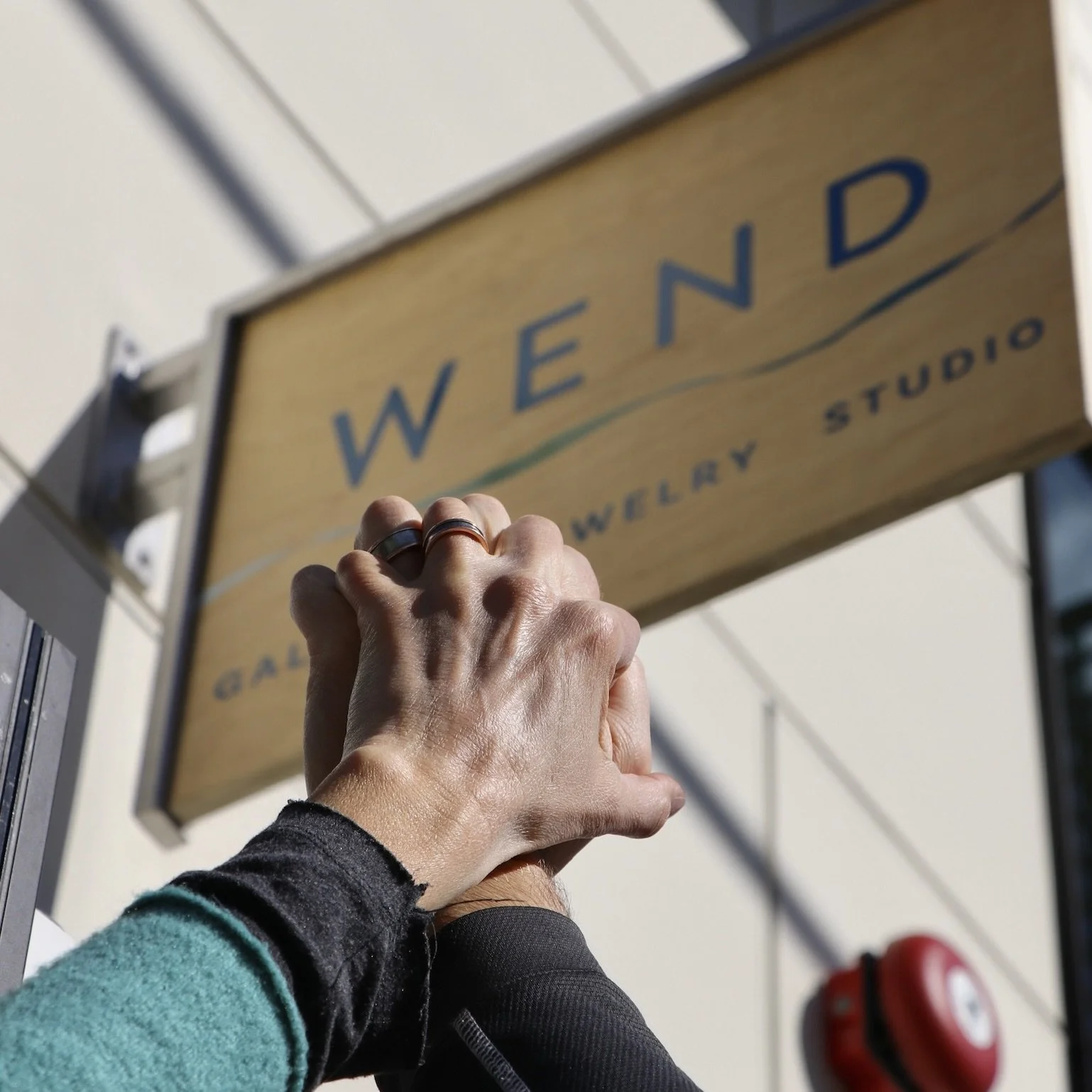
The WEND sign featuring client hands. Photo courtesy of Wendy Woldenberg.
CB: What’s one thing you learned from teaching high school jewelry that you incorporated into your business?
WW: I taught 5 classes a day for 22 years, which was around 140 students a day and almost 7000 people. It was incredibly fulfilling and a wonderful way to spend the day. So, I brought teaching with me to WEND. We teach classes on “jewelry maintenance” for non-jewelers, and lead people through simple jewelry projects. We don’t go super deep, but instead aim to give people an experience they will cherish. We also offer classes in other art forms (think moss art and fabric arts) and yoga in our back courtyard in the summer.
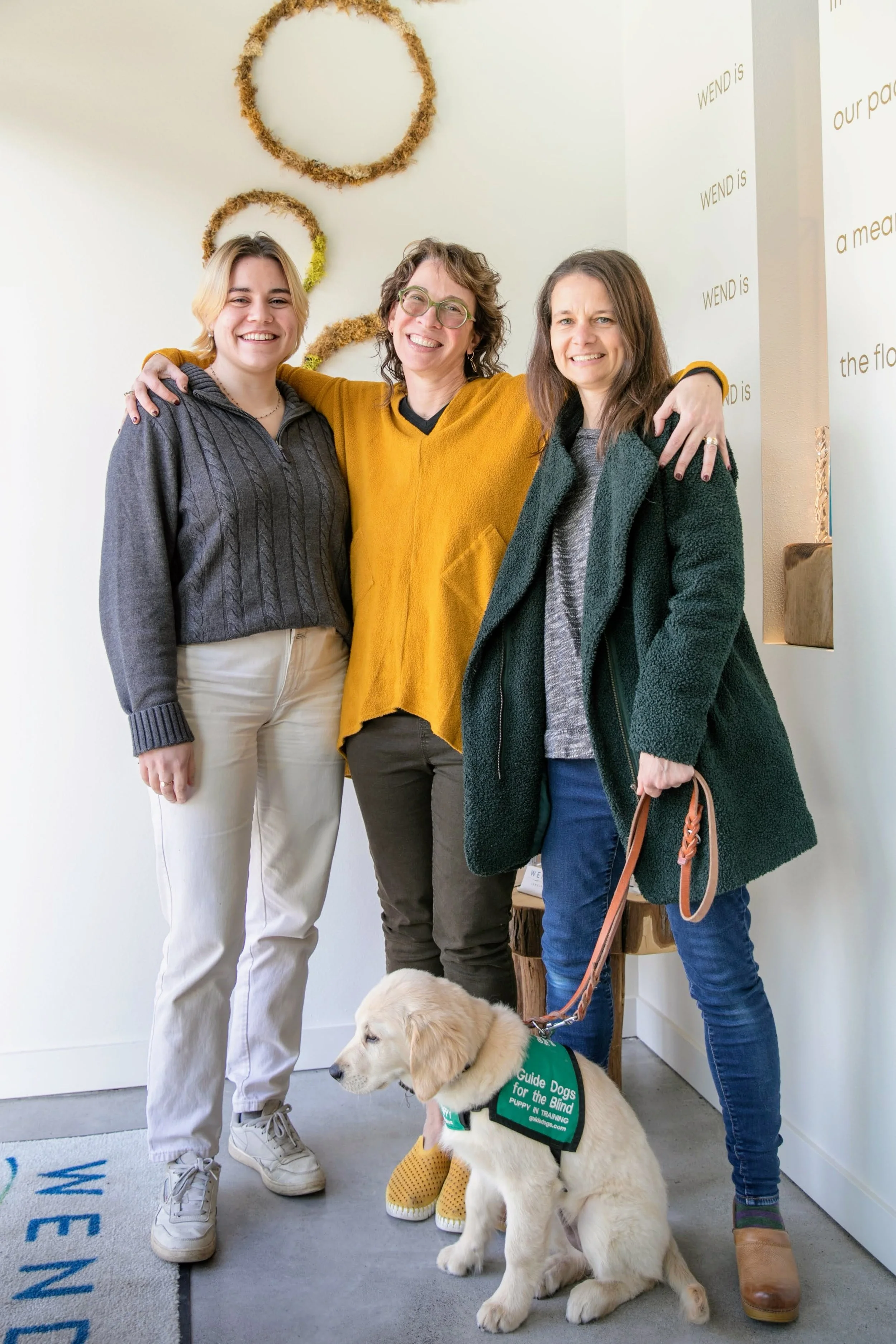
The WEND team: Lexie Tiffany, Wendy Woldenberg, Mitzy Oubre, and their rotating guide dog puppy in training. Photo credit Kimberly Larson.
CB: I’ve had the opportunity to see what an awesome guide you’ve been to Lexie Tiffany, your talented bench jeweler at WEND! Any tips for others out there who are looking for the next generation of bench jewelers or salespeople when it comes to mentorship and leadership?
WW: I’m so grateful that Lexie sought me out from a spot in a magazine highlighting WEND’s Earth-first value system. She and I share similar hopes and dreams for the jewelry industry, so our alignment was natural. When she found me, I wasn’t hiring, but I’m so lucky I took a chance and said yes.
My biggest advice for employers is to remember that the relationship is reciprocal – I learn as much or more from her as she does from me. Realizing people’s value is critical to a good working relationship.
CB: What’s your favorite thing about being a part of the responsible jewelry community?
WW: Finding people who also center their practice on the earth and her inhabitants has been critical to my career as a jewelry designer. Without this community, I don’t know if I could be in this field.
CB: What advice do you have for newer designers?
WW:
Limit yourself to components you know to be well sourced.
Ask really hard questions of anyone you think about sourcing from. Ethical Metalsmiths has an incredible one-page guide to help with this.
Join Ethical Metalsmiths and find your community. This is so important.
Attend the Chicago Responsible Jewelry Conference if you can.
CB: Wendy, thank you for sharing and becoming my latest “Illuminator!”
“We are a small team of passionate jewelry industry professionals and writers. We’d appreciate your support to grow our team and continue to be able to provide the best responsible jewelry content for years to come!”
Editorial Section
What to read next from The Source
Like what you are reading? Please help support our editors and writers today.

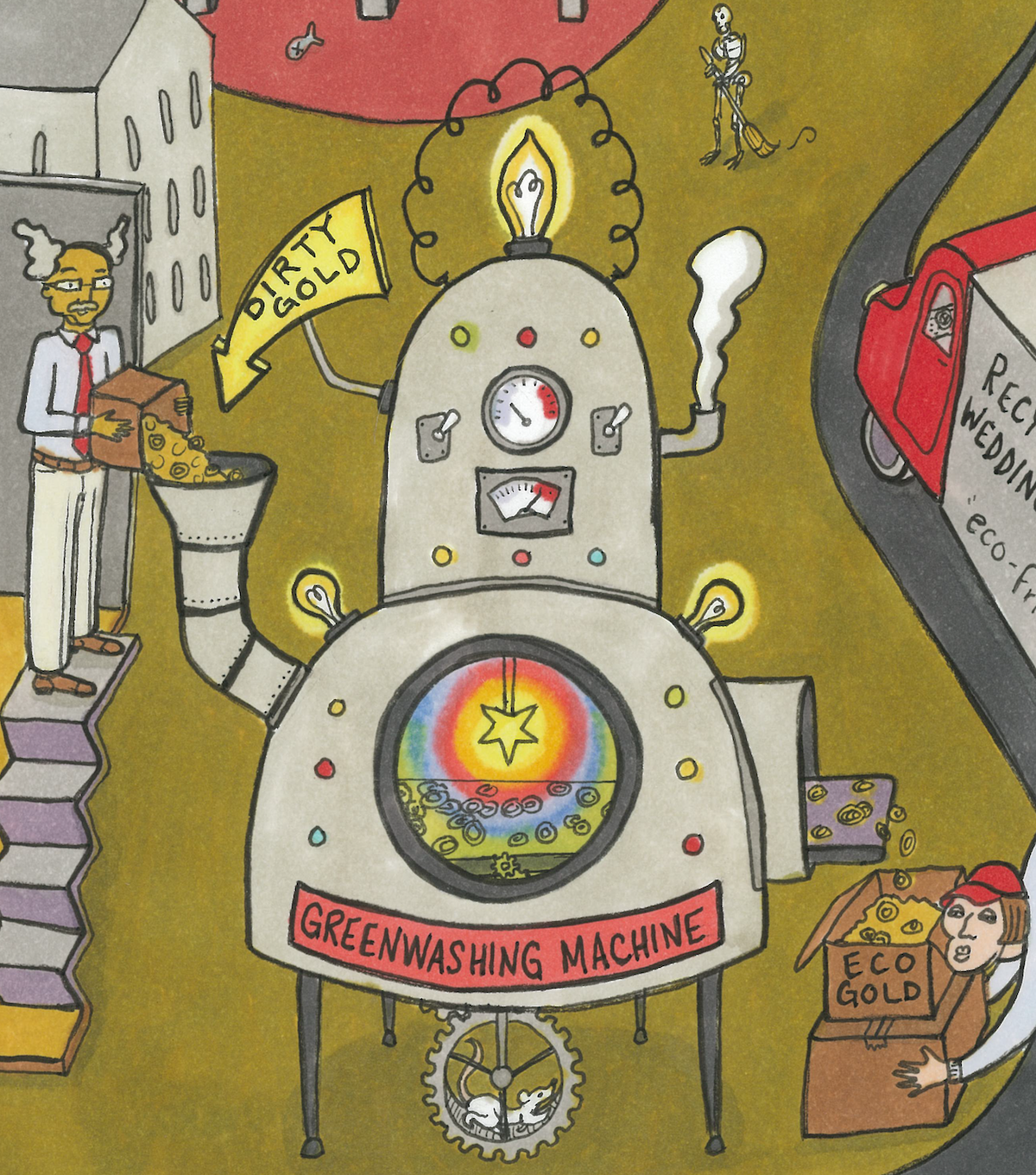
Chloe interviewed Jessica Hudson of The Nomad Jeweler on her latest collection that features ASM Colombian gold and Tahitian Kamoka pearls. Read the full article to learn more about Jessica’s story and why she chose to design with traceable artisanal gold and sustainable pearls.