

Who’s Responsible? The RJC and the Burden of Proof
The content of this article reflects the views of the writer, and not necessarily those of Ethical Metalsmiths. This article was written for The Source
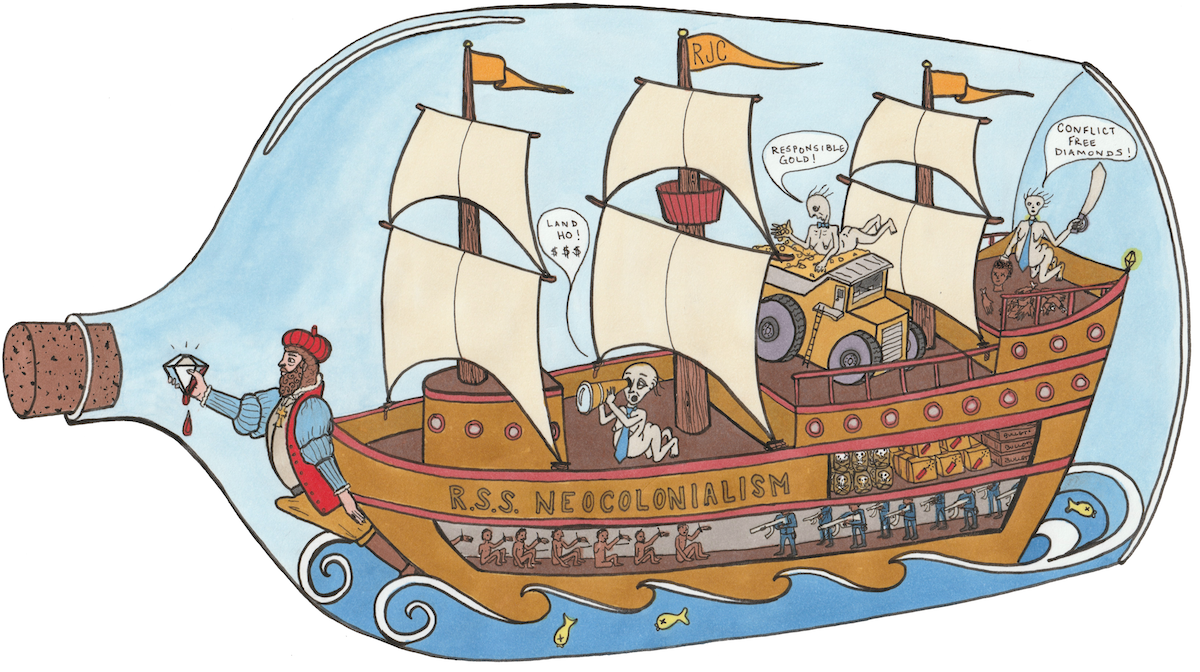
This illustration by Alyssa Lown encapsulates many of the arguments presented in 2018’s Ethical Jewelry Exposé: Lies, Damn Lies, and Conflict Free Diamonds — written by Marc Choyt and edited by Kyle Abram.
Author’s note:
The Responsible Jewellery Council (RJC) is an organization understood by some to promote ethical sourcing in our industry. The RJC’s methods and effectiveness are controversial, and have sparked much debate — in particular earlier this year, as pertaining to the scandal surrounding Russian diamonds from Alrosa. In the article below, I argue that the RJC’s standards and practices do not center around improving sourcing for our industry — but rather, that their focus is on crafting the mere appearance of change to bolster the financial interests of their 1600+ members. I question whether the RJC has provided any measurable benefit to the communities that source our precious metals and gems, or to the planet we all share. Finally, I ask the RJC to give us — the industry — some proof of their impact.
This is a complex subject, and the article below is not the full story. But it offers an analysis that’s crucial if we wish to see change for the better. It is imperative that we understand who is working with us, and who is working against us — as there are many possible motivations when it comes to gold, diamonds, and the like. Below, I have listed some additional resources for further reading. I also encourage you to follow the many links in this piece. And as always, all views are my own.
—Kyle Abram
Further reading:
More Shine Than Substance: Earthworks’ 2013 report on the RJC
The Hidden Cost of Jewelry: a 2018 report on the jewelry industry by Human Rights Watch (HRW)
See also HRW’s follow-up report from 2020, and the associated call to action
Much Ado About Russia: my last piece for Excavations, which contains relevant background
Leading Change and Building Trust: the RJC’s 2022 annual report
Two takes I disagree with below:
We Need To Rebuild, Not Tear Down, The Responsible Jewellery Council by JCK’s Rob Bates
See also this article, which quotes strategic advisor to the RJC Brad Brooks-Rubin
The Ethical Jewelry Exposé: Lies, Damn Lies, and Conflict Free Diamonds. (This is a 40,000-word work from 2018 written by this author’s employer, Marc Choyt, and edited by this author himself. Several chapters center on the RJC.)
The Jewelry Glossary Project: terms such as “ethical” and “sustainable” can be complex, and come paired with baggage, strings, and assumptions. The overarching concern of Excavations is to explore what “ethical” could and should mean in the sourcing of precious metals and gems, and The Jewelry Glossary Project is an invaluable resource for all of us.
Who’s Responsible? The RJC and the Burden of Proof
Several months ago, amidst an emerging controversy surrounding diamonds from Alrosa/Russia and an unprecedented exodus from the Responsible Jewellery Council (RJC), I posed a serious question: if the RJC cannot manage its own membership, how can it possibly regulate the actions of its members to ensure they align with its professed goal "...to ensure all jewellery is responsibly sourced?"
Since publishing that piece, the industry has hosted much discussion of the efficacy of the RJC and its standards. The visceral public backlash to not de-certifying Alrosa seemed to catch the RJC off guard — and why shouldn’t it have? For 17 years, the RJC has built its reputation almost entirely on claims and statements, without providing supporting evidence to bolster these. The industry has been, for good reason, hungry for PR-solutions to stave off the next “blood diamonds” crisis, and the RJC has delivered.
Still, back in April it appeared the organization may have been overconfident in its seemingly-solidified position — as its silence in the face of Putin’s war proved too much reputational risk for some members to bear.
These days however, the tide has turned back. Business as usual has resumed, judging by recent emails touting “a member base at an all time record of 1,646.” Kering and Richemont have in fact rejoined the RJC, and former CEO Iris Van der Veken is now Executive Director of the Watch & Jewellery Initiative 2030.
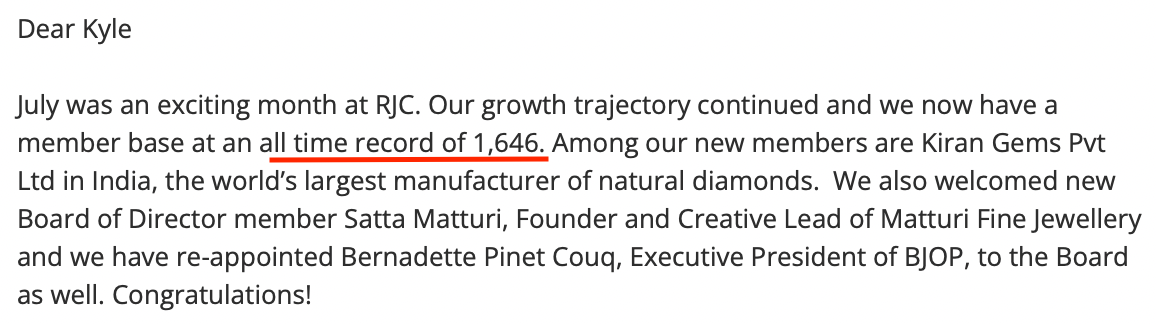
Screenshot excerpt of the RJC newsletter received by the author on August 2, 2022.
This pattern: controversy leads to outcry, outcry slowly fades to silence, silence leads to resumption of the status quo; is nothing new to our industry. In fact, it’s par for the course. And this is something to keep in mind — but it’s not the focus of this piece.
Instead, consider Rapaport Magazine and their rather typical industry view of the RJC. In one recent article, they state that the organization is “...taking a leading role to make a true difference,” and “...facilitating [a] path” to contribute to a better world.
I expect this point of view from mainstream industry press. But genuinely surprising to me, personally, has been the outward profession of support for the RJC and their mission from many high-profile members of the “ethical” jewelry world. As events unfolded earlier this year, I poured through a number of discussion threads on LinkedIn in which various “ethical jewelry” heavy-hitters reaffirmed their support for the RJC’s mission, and wished it well in moving past present hardships.
Then, and now, I hold one burning question: what measurable good has the RJC done for People and Planet?
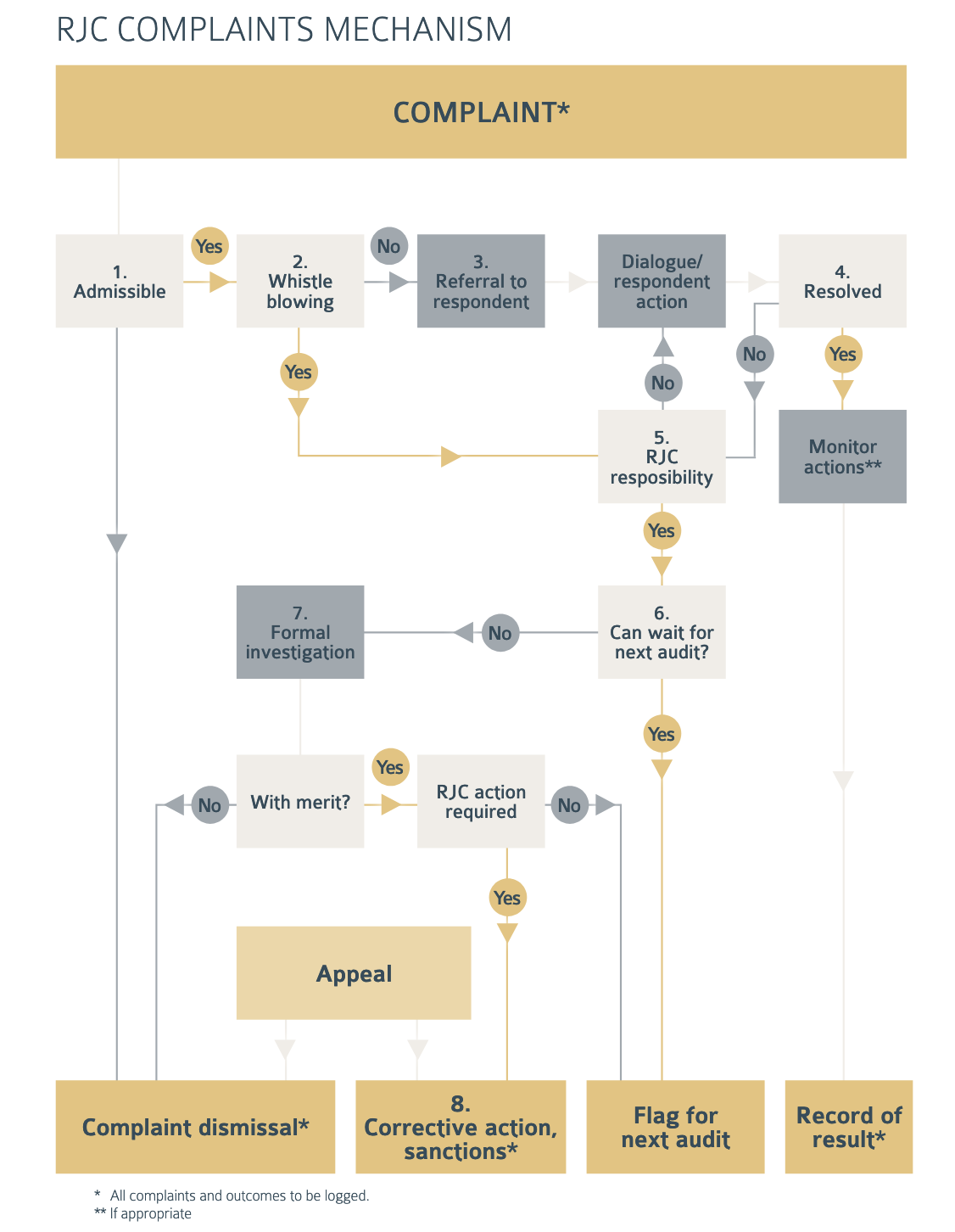
This screenshot from the RJC’s 2022 annual report details the RJC’s complaints mechanism. This image is as notable for what it leaves out as for what it includes. This author has found no documentation from the RJC containing details of specific complaints lodged against members, or of corrective actions taken. This author also questions whether this opaque approach is the best way to move our industry forward.
What the RJC Doesn’t Do
Many of those debating the capacities of the RJC want the same thing: that is, for the industry to act in more “ethical” ways, variously understood. So the real question is whether the RJC has helped facilitate positive change in its 17-year existence.
My industry experience lends me a strong sense that the RJC is not invested in the same future some of us desire, or in heralding positive change in the industry. For instance, take this non-exhaustive list of alleged atrocities committed by RJC members:
Rio Tinto allegedly violated human rights in New Guinea, destroyed a sacred site in Australia, is currently attempting to destroy another sacred site in Arizona, and has committed numerous other actions to earn it a reputation as “a poster child for corporate malfeasance”
Newmont illegally occupied a farmer’s land in Peru. See more on their controversial Conga mine in Peru here.
AngloGold Ashanti has faced allegations of “massive human rights violations” in the Democratic Republic of Congo.
BHP (formerly BHP Billiton) has been accused of being “woefully negligent” in Brazil’s worst-ever environmental disaster, which left 19 dead. See also a host of additional allegations against BHP.
Throughout each of these controversies, all of these members remained in good standing with and do not appear to have suffered any consequences from the RJC.
I could mention how the RJC’s first CEO all but admitted that the RJC is a trade organization masquerading as a certification agency — which suggests its true “responsibility” is to its members’ bottom line, not ethical sourcing. I could write exclusively about its Code of Practices, how members are allowed to join without undergoing an audit, or the “grandfather clause.”
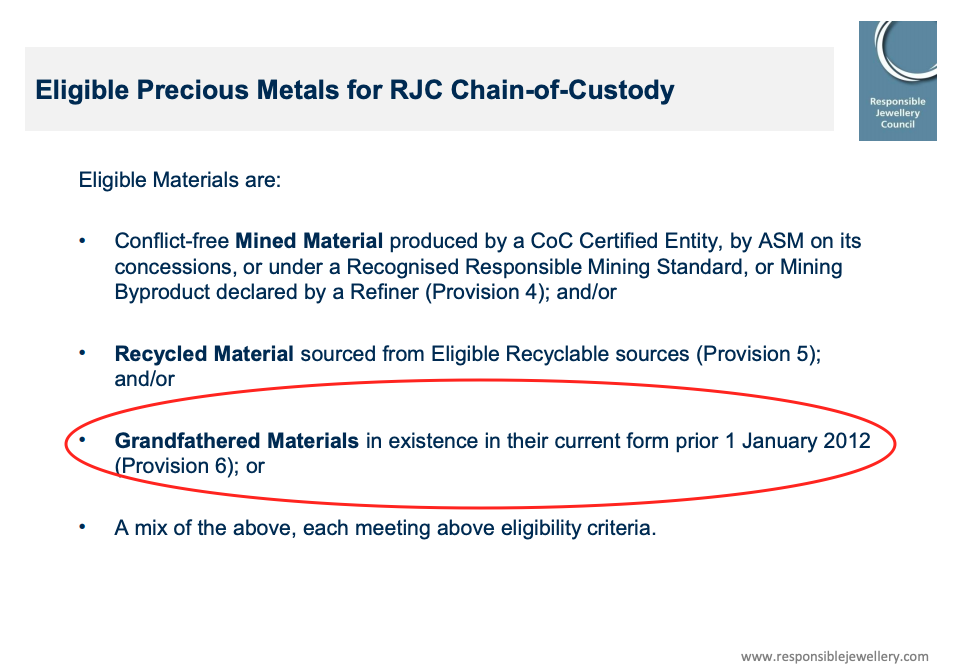
The RJC’s grandfather clause, from its chain of custody guidance.
I could even detail how, seven months before Russian troops entered Ukraine, a mine 40% owned by Alrosa spilled tailings into the Congo river — killing at least 12 and sickening thousands, to say nothing of the environmental toll. And I might add the question: where was the RJC when Alrosa claimed zero responsibility for this catastrophe?
But I don’t need to do any of this.
For one, Earthworks already crafted a 124-page rebuke of the RJC back in 2013, entitled “More Shine than Substance: How RJC Certification Fails to Create Responsible Jewelry.” Among the highlights are these six points, which have not been corrected in the almost decade since this report was written:
1) The RJC is exclusively industry-controlled and governed, leaving civil society out of decision-making or oversight,
2) RJC fails to include and respect the voices of those most affected by jewelry-supply-chain practices,
3) Certification is based on standards that fail to fully protect communities, workers and the environment,
4) Multiple loopholes in the certification process weaken the system’s legitimacy,
5) The certification system has virtually no public transparency or accountability,
6) The complaints system is inadequate and RJC-controlled rather than independent.
Secondly, Human Rights Watch issued its own report on the jewelry industry in 2018, updating it in 2020. The associated call to action, signed by 29 NGOs — including Amnesty International, Global Witness, and IMPACT — states that “..the Responsible Jewelry Council promotes standards that allow companies to be certified even when they fail to support basic human rights.”
But most importantly: the burden of proof does not lie with me, or with anyone else in the industry. If the RJC truly wants a reputation as a forward-leaning industry body, they need to earn it — not simply stake a claim. Rather than argue endlessly about what the RJC is not doing, here is a direct challenge I am issuing today: let’s see some proof of the improvements you’ve made to our industry.
I am not talking about theoretical value added by deflecting criticism. I’m not speaking to business metrics, or bolstered consumer confidence. I’m referring to the quantifiable impact on real human beings and the planet we all share.
As an organization dedicated to promoting ethics in the industry, surely this should be rather straightforward to answer. Yet, I can find no satisfactory comments on quantifiable impact from the RJC, even in their 2022 annual report.
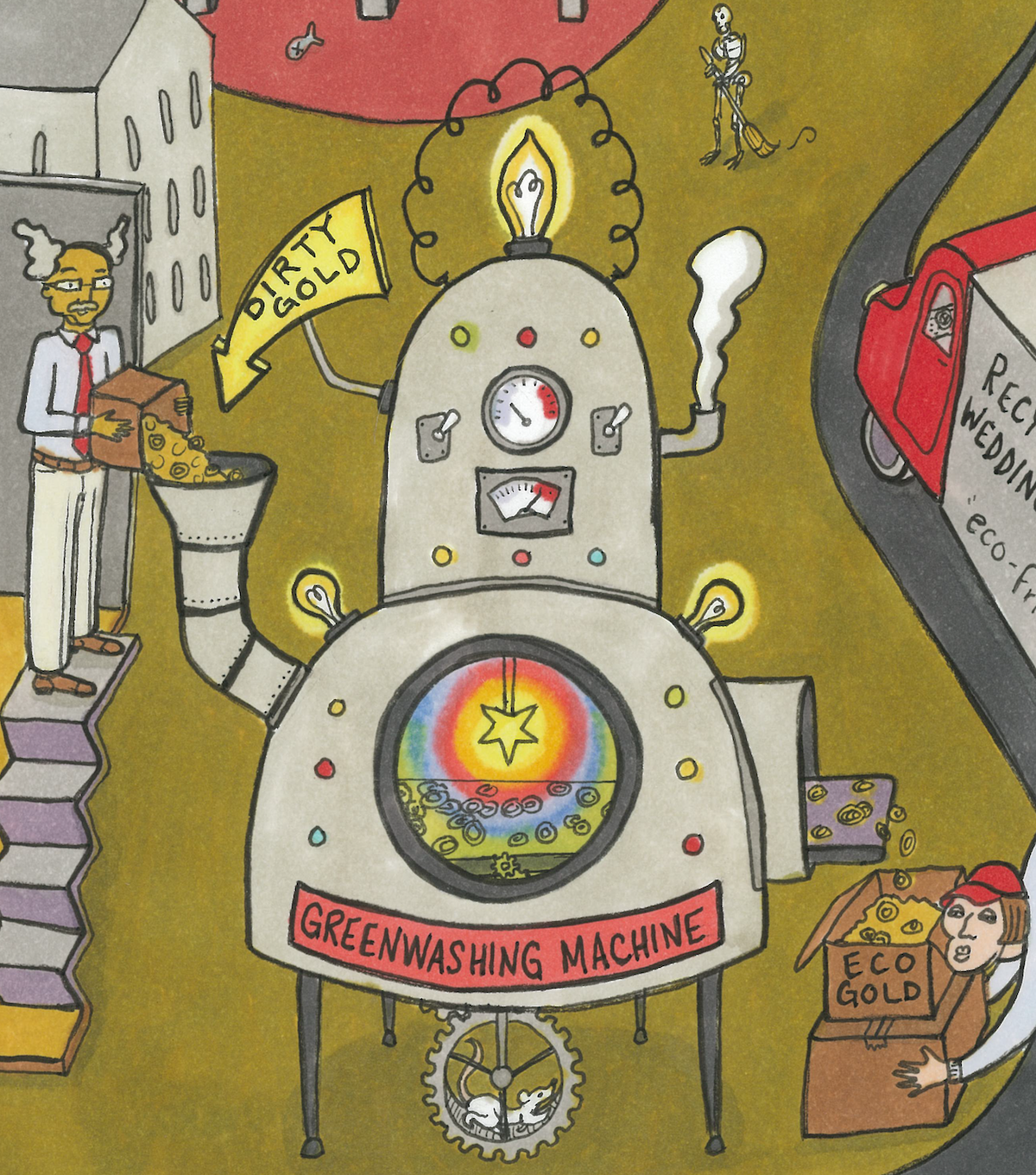
The Greenwashing Machine makes another appearance in Excavations, to remind us of what often lurks just beneath the surface. Illustration by Alyssa Lown.
What the RJC Does Do
In recent commentary, Brad Brooks-Rubin, strategic advisor to the RJC, expressed concerns that if the RJC is abandoned, there is no other industry body to take its place. “That leaves the jewelry industry exposed to real concerns about: what standards are you implementing? What does it mean to be responsible, sustainable, ethical? The RJC has provided that — and if it’s not the RJC, what takes its place?”
And in a piece entitled “We Need to Rebuild, Not Tear Down, the Responsible Jewellery Council,” Rob Bates of JCK states, “[The RJC is] an organization that measures companies against a list of standards. That’s it. Comply with those and you’re good.”
I disagree with both of these takes. To begin with, I am not convinced that the RJC actually does “measure companies against” any list of standards: the RJC does not mandate members to publish audit reports or lists of violations. Additionally, I must reiterate that the RJC’s inability or unwillingness to suspend or revoke Alrosa’s membership calls its authority to enforce standards into serious question. (For the record: the RJC has never so much as formally reprimanded any member — which is very telling.)
Likewise, I am not convinced that the RJC has ever provided constructive or actionable guidance on "responsible," "sustainable," or "ethical" practices in the jewelry industry. Yes, the industry should be concerned about this vacuum! But the answer is not to cling to a false prophet if they do not address the void we so desperately need to fill.
(A quick note on terminology: “sustainable” and “ethical” are inherently vague terms, with no widely-agreed upon definition in the jewelry industry. The Jewelry Glossary Project represents one attempt to address this. See also my recent piece, Sourcing Responsibly: Alrosa, the KP, and the RJC, which discusses the nature of “responsibility.”)
The only evidence this author can find of the RJC’s impact boils down to convenient narratives — narratives the jewelry industry can wield to “prove” that they do in fact care, are in fact trying, and things are in fact getting better. From a marketing perspective, this is incredibly valuable. Again: who among the Newmonts and Rio Tintos of this world wants a repeat of the “blood diamonds” crisis? (“Crisis” referring to the threat this posed to their bottom line, not the actual atrocities committed.)
But here’s the thing: there is no need to read between the lines here. The RJC tells us what it’s all about directly on its own homepage: “We promote standards that underpin people’s trust in the worldwide jewellery and watch supply chain.”
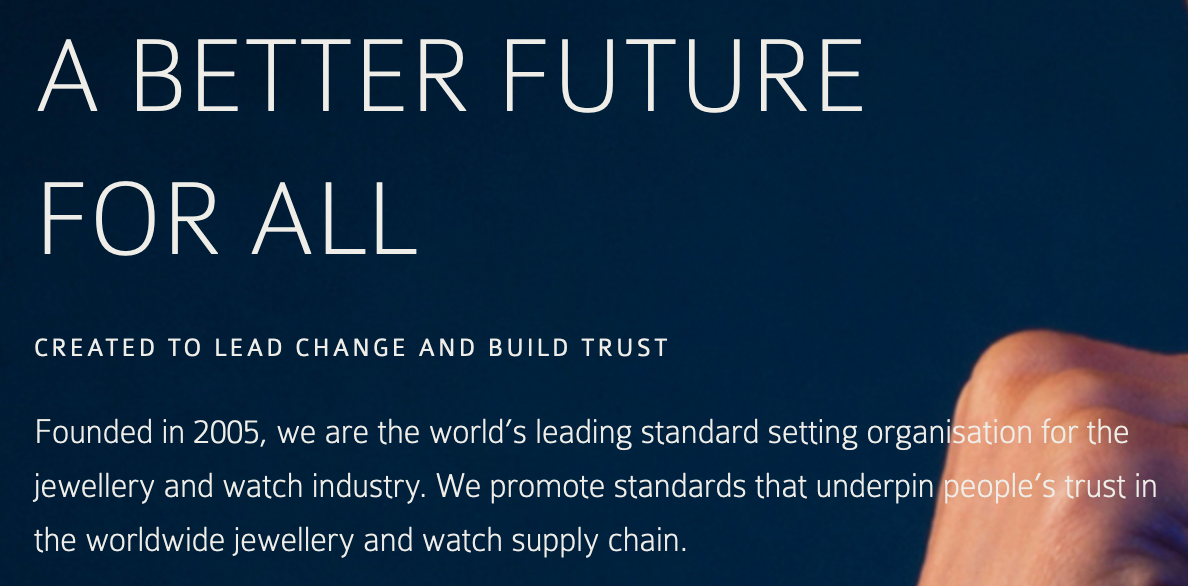
Screenshot from responsiblejewellery.com; taken August 18, 2022.
There it is, clear as day: the RJC is concerned with underpinning trust, not with promoting evolution in our supply chains.
If you need further proof, just consult their posted mission statement: “We strive to be the recognised standards and certification organisation for supply chain integrity and sustainability in the global jewellery and watch industry.”
As far as I can tell — taking into account all the evidence listed above in this article, taking note of various actions and statements from the RJC over the years, and even perusing their own website — the RJC is concerned with two things: its own reputation (“underpinning trust”), and establishing dominance in the certifications sector. To achieve these goals does not require improving industry supply chains. In fact, any attempts to implement change would be a dampener to their rapid expansion. The RJC and its members are by and large invested in maintaining the status quo, while convincing you and your customers that they’re leading the charge into a new era of “sustainability” — whatever that means for extractive industries.
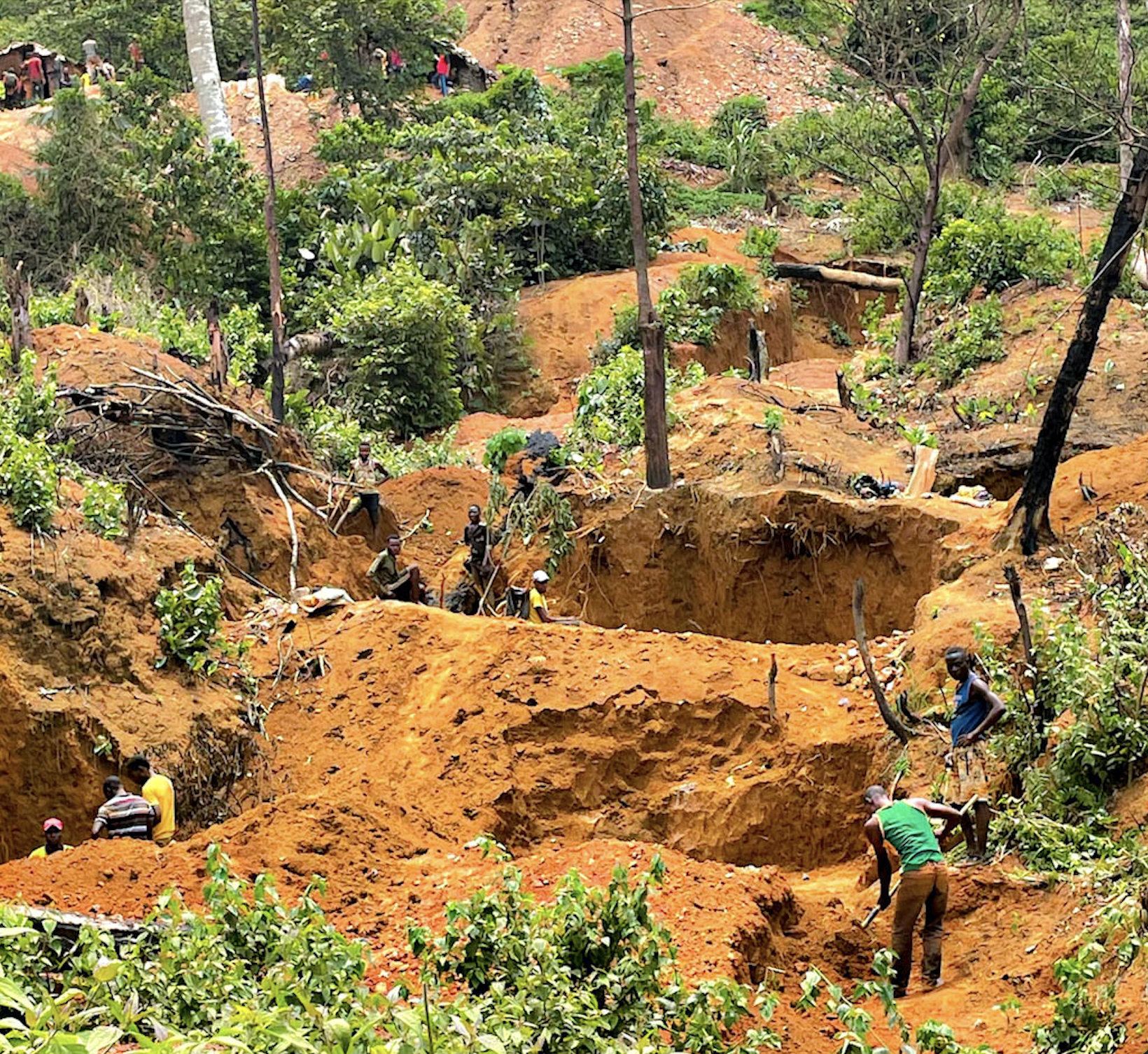
A gold mine in the eastern Democratic Republic of Congo, where hundreds of miners are currently working using hand tools and mercury. Miners reside with their families in nearby mud-brick houses, without access to clean water or electricity. Photo by author.
What We Must Do
I wish to make this abundantly clear: working toward ethical jewelry sourcing is a noble goal, not least because it is so damn tricky. Many gold, diamond, and gemstone supply chains have deeply-entrenched structures with century-old multinationals at the helm — and these structures do not take kindly to reform efforts that threaten their bottom line. Then there is the matter of the 100 million artisanal and small-scale miners toiling worldwide, and all the complex colonialist causes and consequences inextricably woven into their lives.
Here is one more thing I need to make abundantly clear:
The arguments in this article are not about the RJC being “less than perfect.” They are about the RJC functioning as a cover-up for some of our industry’s worst atrocities, providing consumer confidence in the form of specious claims and narratives, and disguising itself as an agent of change while in fact laboring almost exclusively to maintain the status quo. I contend that the RJC has not moved the needle one inch forward for ethical sourcing, but has instead put up massive barriers to what might constitute desperately-needed real change in our sourcing structures.
The barriers I’m speaking of are unconscionable in the face of what producer communities in the Global South have been facing for generations. They are outrageous in the face of our planet’s uncertain future. They are abhorrent in the face of consumers genuinely trying to do good with their purchase, who are redirected into a funnel that merely reinforces present structures.
We who know better have a duty to do something about it.
In fact: if you are looking for concrete steps to take, I encourage you to join Ethical Metalsmiths’s Action Coalition. This group is tackling the real-world problems facing our industry — with current initiatives including a consumer-facing project to promote responsible ASGM (artisanal and small-scale gold mining), and an industry-wide survey of responsible sourcing practices. Please email action@ethicalmetalsmiths.org to join our next meeting. New voices and ideas are always welcome, and your involvement is always appreciated.

Are you a member of Ethical Metalsmiths looking for ways to get involved?
Consider joining our newly-formed Action Coalition: an initiative where we tackle the real-world problems facing our industry.
Email mail@ethicalmetalsmiths.org for more info.

What do beekeeping and fish ponds have to do with diamond mining?