

The Enemy of the “Better”

CHEERS TO ONE YEAR OF THE SOURCE!
The Source Team is thrilled to be celebrating our one year anniversary this month!
We can't believe that one year has already gone by. It has been a year of diligent research, honest conversations, and thoughtful design. I'm so proud of our team for launching and growing a unique resource for the responsible jewelry community---amidst a global pandemic, nonetheless.
Thank you to our wonderful readers, and all those who have left encouraging and insightful comments. We hope to continue producing more valuable content that can be shared through every facet of our industry for years to come.
Stay curious,

Chloe Beaumont EDITOR-IN-CHIEF
We aren’t just celebrating one year of the Source, but also a brand new section called “Excavations: Unearthing Ethical Jewelry.” Kyle Abram joined our team as an Editor last month with his inaugural piece, “Ethical Jewelry Reality Check,” which you should definitely read if you haven’t had the chance yet. Kyle is excited to finally unveil his section’s title, so named in order to start a conversation around what exactly “Ethical” jewelry even is, and to dig up tough industry issues that are too often buried.
As always, we hope you gain something useful from our content, and we encourage you to leave your thoughts/comments/discussion questions in the comment section below the articles!
The content of this article is the opinion of the writer and was written for The Source
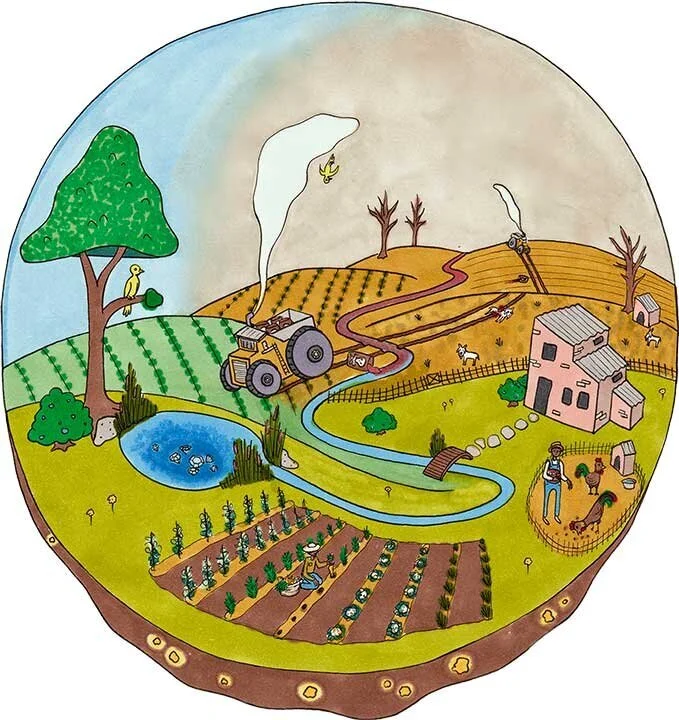
Illustration by Alyssa Lown.
The Enemy of the “Better”
On May 28, 2021, Germany officially apologized for the state-sanctioned genocide of the Herero and Nama peoples, which took place between 1904 and 1908 in what is now Namibia.
This harbinger of the Holocaust occurred after German colonizers had stolen Herero and Nama land — which turned out to be exceedingly valuable, and full of some of the richest diamond deposits ever discovered.
On May 28, 2021, Germany officially apologized for the state-sanctioned genocide of the Herero and Nama peoples, which took place between 1904 and 1908 in what is now Namibia. This harbinger of the Holocaust occurred after German colonizers had stolen Herero and Nama land — which turned out to be exceedingly valuable, and full of some of the richest diamond deposits ever discovered.
Germany's apology has been resoundingly criticized, on the grounds that it's an acknowledgement of wrongdoing devoid of any serious attempt to address or rectify the damage done. Critics say Germany seems to want the moral standing of owning up to their misdeeds, without paying the price of trying to make it right.
Still, what is most striking about this apology is that it even happened. It’s the first time I have heard of a colonial power apologizing for past atrocities associated with mining.
Having worked in the ethical jewelry world for the past few years, my immediate thoughts went to the diamond-funded wars of the 1980s and ‘90s, when 3.7 million Africans were killed.
In an interview by my colleague Marc Choyt, Ian Smillie, an architect of the Kimberley Process (KP) and chair of the Diamond Development Initiative, said, "When we were negotiating the KP, I knew if we spent too much time looking back, we’d never move forward."
The events in Namibia are not exactly analogous to what happened during the ‘80s and ‘90s. One was state-sponsored, and one was industry-sponsored. Yet, some similarities loom…. In both cases, not one person was ever held accountable for the atrocities that took place. And today, there are millions of people wearing diamond engagement rings obtained through the deaths of Africans from both time periods.
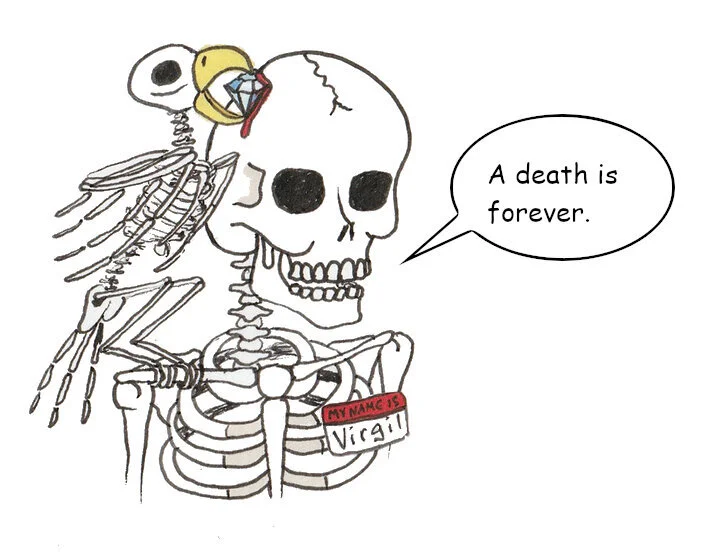
Illustration by Alyssa Lown.
This model of bypassing atrocities has been copied, to great success, by others. Take the Responsible Jewellery Council (RJC) member Rio Tinto and the alleged Bougainville massacre. Consider also the RJC’s grandfather clause, which automatically certifies as "responsible" all minerals sourced by members before 2012, regardless of how they were sourced.
The question I hold is: how can there be any veracity to ethical claims in the jewelry sector —including terms such as “conflict free diamonds” or even “ethical jewelry” — without addressing past misdeeds?
In trying to answer this question, I often run into variations of that well-known phrase, "Do not let perfect be the enemy of the good." Let me propose an alternative: "Do not let the good be the enemy of the better.”
Take Smillie’s quote above, a variation of letting perfect be the enemy of the good. I understand Smillie's perspective, and have a great deal of respect for his pioneering work. (His book Blood on the Stone even sits on my shelf.) Yet, there's something about this that doesn't sit quite right with me.
And let’s get back to Rio Tinto, who just last year destroyed the 46,000-year-old sacred site of Juukan Gorge in Western Australia, despite an awareness of the cultural value it held and locals' acute objections. Though CEO Jean-Sébastien Jacques and two other top executives were forced to step down due to the public outcry, each received millions in bonuses and severance pay, to the displeasure of shareholders.
In the fresh wake of this saga, Rio Tinto is still moving ahead with plans to destroy Oak Flat, an archeological site in Arizona sacred to the San Carlos Apache people.
Rio Tinto remains a member of the RJC.
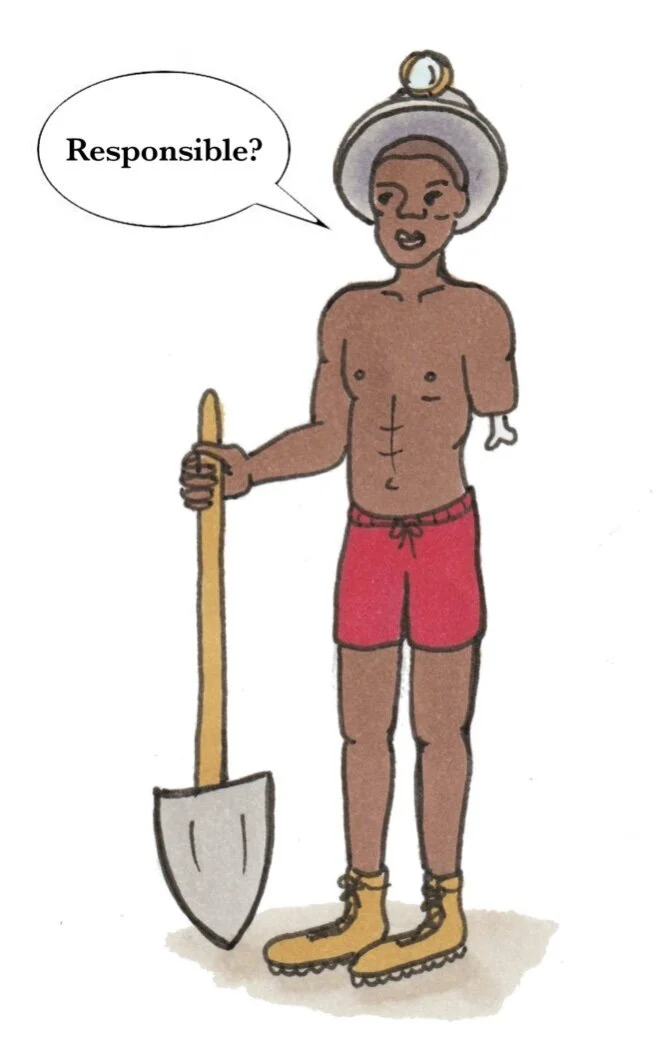
Illustration by Alyssa Lown.
After any travesty, we have to take a first step. This is in everyone’s best interest — even that of the victims. But pitting perfection against good has subverted any energy for foundational change in our supply chains, and allowed the same players to continue just as they always have. To quote from Anand Giridharadas’ Winners Take All, “The people with the most to lose from genuine social change have placed themselves in charge of social change often with the passive assent of those most in need of it.”
Perfection is, by definition, sometimes unobtainable. Perfection in my eyes would mean all diamond-funded wars, less-than-ethical sourcing by RJC members, and the destruction of Juukan Gorge never occurred.
“Perfection is off the table. Simultaneously, what’s passing for good is not “good” enough. The pertinent question is: how do we get to “better?”
We all know there is tremendous potential in the minerals beneath African soil. Not just the raw, latent power of uranium or the colossal possibilities of lithium — I'm talking about the potential to do a lot of good for a lot of people. Over the past few centuries, almost every major military power in the world has taken what it wanted from Africa, and acted with impunity and without regard or respect for the people who had lived there for millennia. (A list of specific grievances would obviously be far too long to enumerate...but they implicate Germany, France, Great Britain, Portugal, Belgium, Italy, the USA, the USSR/Russia, and China.
The "dark continent" hardly seems to have benefitted from any of this interest in the riches of its soil. 36% of Africans alive today face each day in extreme poverty. In the immeasurably resource-rich Democratic Republic of the Congo (DRC), the rate is 73% — while 43% of children are malnourished. Often, the deeper you look, the worse it all seems. And ultimately, if business as usual continues, the vast wealth of this continent will continue to be siphoned off, and the resource curse will perpetuate — rather than benefit those who ask for the least and need it the most.

The gold, diamonds, and other resources extracted from Africa over the past several centuries are largely stolen wealth. Illustration by Alyssa Lown.
The hopeful change I'm getting at begins with accountability, first and foremost. 50% of the Nama and 80% of the Herero, about 80,000 people total, were slaughtered in the genocide that began this article. That this took place 113 years ago has no relevance to the moral judgement or objective horror of what occurred — these were real people, made of real flesh and blood, full of real hopes and dreams, living with their real families in a real time and place. "Sorry" doesn't cut it. This robbing of life has had incalculable effects on the generations who lived between then and now, and will continue into the future.
Then there is the stolen wealth and the opportunity it contained. The diamonds taken from the soil for the past 100 years, which should have been used to the benefit of the Herero and Nama, have instead enriched a few Germans and South Africans. The people of the land, their children, and their children’s children have been left with nothing.
(I would be remiss not to acknowledge that the peoples of many African countries have had their suffering exacerbated by the greed of their own leaders since gaining independence from former colonial powers. Still, it was undeniably the actions of colonizers which created the fertile ground for such instability, chaos, and corruption. That is to say: colonial powers are not the sole entities who bear blame for this suffering I have detailed.)
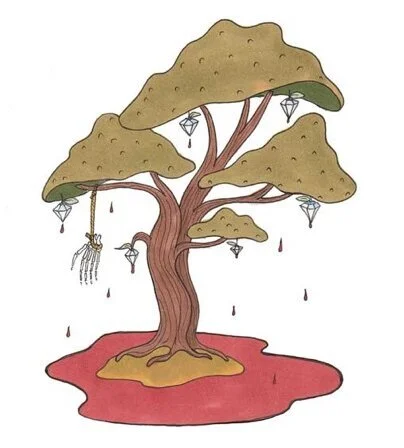
To many, diamonds have become a kind of “strange fruit.” Illustration by Alyssa Lown.
Accountability entails truth, restitution, and reconciliation. Acknowledgement is a clear prerequisite, but it is just not good enough. It is merely the first step.
“Good” is a step up. Examples of jewelry sourcing that I, personally, quantify as "good" are sources that do not contribute to further harm of producer communities in the Global South, but also do not lead to their betterment. They will not contribute to any scenarios of mass-murder or to the robbery of intergenerational wealth, but also will not rectify them in the slightest. These include lab grown diamonds, Canadian diamonds, recycled gemstones and diamonds, and post-consumer recycled gold. (Emphasis on post-consumer, because anything else is not "recycled" in my view.)
The question remains: how do we get to “better”?
Better sourcing to me means actively working to right the wrongs of the past, and bringing benefit to those who have suffered. It means uplifting our brothers and sisters from poverty, and restoring their right to benefit from the resources of their land. Fairmined and Fairtrade Gold come to mind, as do several colored gemstone projects.
This is indisputably heavy stuff to put on the shoulders of a small jeweler — likely you, the reader. The good news is, none of us need to play Atlas individually. There are many of us who want exactly what I've espoused, and many who are willing to do their part. Turning our industry from exploiter to benefactor isn't going to take place overnight, but it can take place.
Look at the shift that's occurred over the past year. Consumers are more aware than ever, and they are ready.
“They can handle the truth, so give it to them.
Tell them about your Fairmined, Fairtrade, or certified small-scale gold. Be honest with them that Canadian diamonds are not perfect. Demonstrate to them that you are working to be part of the solution.”
The time of perfection has passed, and we do not live in a perfect world free of injustices. But we can demand that companies and individuals do better, and that starts with holding them accountable.
Are you a member of Ethical Metalsmiths looking for ways to get involved?
Consider joining our newly-formed Action Coalition: an initiative where we tackle the real-world problems facing our industry.
Email mail@ethicalmetalsmiths.org for more info.

What do beekeeping and fish ponds have to do with diamond mining?