

Pricing - the Hardest Part?

The content of this article is the opinion of the writer and was written for The Source

How do you price your own work? Graphic credit Christina Malle.
You’ve just finished polishing a new piece of jewelry or designing the recent collection for your line. Now it’s time to price it. Is this the hardest part? Pricing isn’t easy to talk about; that said, I’ve been asking a few designers to share their pricing formulas with us. Since this is the studio jeweler’s section of The Source, the jeweler in mind is a maker or independent designer, rather than a mass manufacturer.
How did you learn to price your work? Was pricing part of the curriculum in your school? Or did you learn from a mentor? Or entirely on your own? I got my start at the local Y, which luckily, happens to be New York City’s 92Y; I took a class at the Jewelry Center at the 92Y, called “How to Sell Your Jewelry.” The class was superb – no surprise there – and the teacher shared a pricing formula with us. Her advice resonates years later; if I could only remember her name! If I were able to contact her now, I would ask if she had any updates to share.
One thing she repeated during each class was the following: do not underprice your work. That is a losing strategy in the long-run. And, always record the price of gold (or silver or other materials) per pennyweight or gram, as well as the price per ounce. Since the price of precious metals changes, having the price per pennyweight makes it easier to recalculate the cost of the piece when the metal price fluctuates.
Pricing Formulas
Here is one formula my instructor at the 92Y shared with us:
[Materials x 2] + Labor + Studio Costs/Overhead of 15% + Profit of 10% = Wholesale
Wholesale x 2 = Retail
The instructor reminded us that if profit was not built into the formula, we would not be able to grow or even maintain the business. Other jewelers use different formulas, some of which are shared below.
Saskia Shutt, a fellow member of Ethical Metalsmiths in Brussels, referred me to Marlene Richey’s writing on the topic! Thank you, Saskia! As an aside, did you know that members of Ethical Metalsmiths can share resources, ideas and even answer one another’s questions in an online platform for members?
Back to Marlene Richey: her book, called Profiting by Design, published by the MJSA, is very helpful (you can find it on Amazon but not, as far as I can see, on Bookshop). That cover photo of a ring by Barbara Heinrich always catches the eye! Rio Grande also shares helpful pricing insight from Marlene Richey:
“Labor (the time it takes to make a piece multiplied by your hourly charge)
+ Cost (the direct cost of materials)
= Cost of Goods Sold
× 2.0 (or 2.2, 2.5 or some variation of this) for overhead (freight, taxes, paper, etc.)
= Your Wholesale Price (the price at which you will sell your work to a retailer
Then the retailer will multiply your wholesale price by [her] own figure (2.0 or 2.2 or 2.5) to cover overhead.
This is the retail price, and it's the price you should sell your work for when you sell direct to the public through a craft show or other venue.”
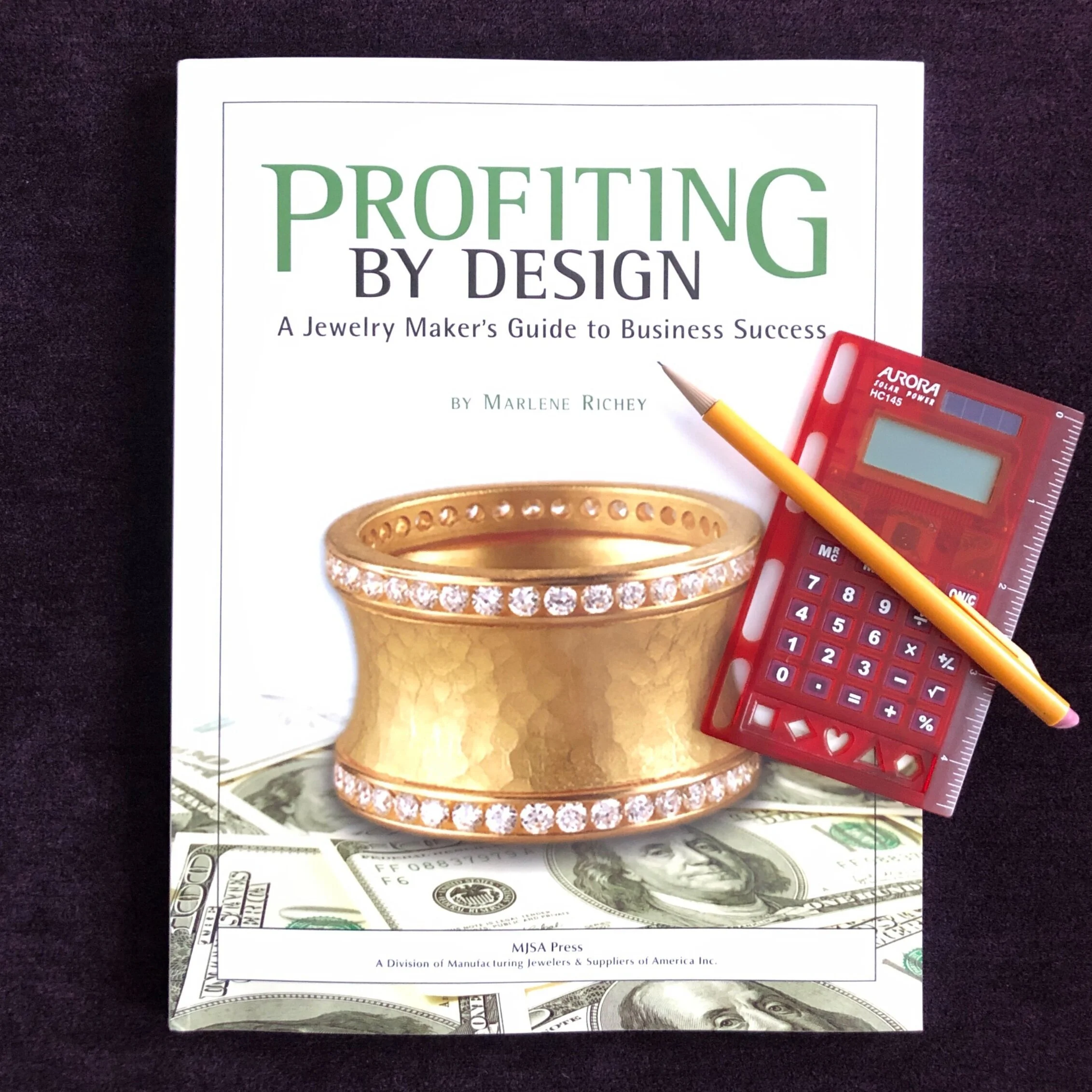
“Profiting by Design” by Marlene Richey and published by MJSA offers pricing help. Photo credit: Christina Malle
The quote above is from Pricing Strategies Part 1 on Rio Grande’s site. Thank you, Rio Grande, for sharing helpful information -- and even bench videos -- in the Resource Center. I’ve learned so much from Rio over the years—anyone else?
The site Wholesaler in a Box suggests the following formula:
Materials + Labor + Expenses + Profit = Wholesale Price
Wholesale Price x 2 = Retail Price
The author of the post adds “BIG caveat here -- this is certainly not the only way to arrive at a price.” [Emphasis in original.] Shopify’s site also has advice on a wide variety of topics, including pricing. And here’s another site that lists a few different formulas for handmade work: Aelodia.com with an article by Arianne Foulks.
The Fluctuating Price of Metal
The Portland, Oregon chapter of the Women’s Jewelry Association hosted a Zoom session a few months ago entitled “Pricing Jewelry.” The presenter, Bonnie Kahn, who advises small businesses, was terrific; she shared her pricing insights and also generously answered the participants’ questions. She reminded the participants that it is “essential for artists to anticipate fluctuating prices of metals.” Bonnie advises artists on pricing and other business strategies and has a great deal of experience with jewelers and designers.
Online Tools
There are dozens of programs and apps to help streamline pricing. Has anyone tried Crafty Base? Or seen this article in Accounting for Jewelers? It mentions a few online programs (including its own, called Bench Works), to help set prices and keep track of them for accounting purposes. Many thanks to EM members Jane Bartel and Nancy Klotz who also suggested Bench Works and a post from the Metalsmith Society, respectively.
How Do You Pay Yourself?
You’ve established a pricing strategy, but another question looms large: how do you pay yourself? What is your hourly wage or salary? If you don’t know where to start, you can check job postings for similar work and degrees of experience. Or, look at the US government statistics for any number of positions, including jeweler. The US Bureau of Labor Statistics publishes more data than most people care to absorb here. You can also use that site to see a state-by-state breakdown of hourly wages and salaries for jewelry-related jobs and other professions. Obviously that data is not specific to you as an individual; how can you put a dollar value on your own unique background, artistry and experience?

How do you value your own time?
Another nuanced question arises over the creation of custom jewelry pieces; aren’t you using different skills and taking more time to create that bespoke piece than if you were fabricating a piece that is already in your line? If you are an artist creating a custom piece, wouldn’t you assess your time differently?
On the opposite end of the mass data that is found at the US government Bureau of Labor Statistics, I wonder how fine artists put a value on their own time. How do clients and galleries value the time of artist Kara Walker, Sarah Sze or Damien Hirst of diamond-studded skull fame? You and I may not be internationally-acclaimed artists, but can the perception of the value of their time shed any light? Are you an artist or a fabricator? Aren’t we also making treasures to be valued for generations?
This piece in Creative Hive has suggestions on how to pay yourself.
Consistency
Should it go without saying that consistency in pricing is important? True, the cost of metals and materials vary, but at least be consistent among your retailers and on your own website. If you sell directly from your website, why would you undercut the retailers who are working hard to promote and sell your product? Inconsistent pricing can lead to confusion and worse: can undermine the feeling of goodwill.
Profit: Another Look
One American jewelry designer, whose name has loomed large over the last few decades shared this observation with a friend of fellow jeweler and EM member Kathleen Lynagh: think of your business or each project in thirds.
Your Project =
1/3 cost of materials and labor
1/3 overhead
1/3 profit
If you can make that percentage of profit ratio then you have something worth selling. At least, that was the advice of one particular jeweler, who does appear to have achieved financial success!
Separating Personal and Business Finances Can Help Protect Your Assets
As an astute observer, you already know there is no “one size fits all” when it comes to pricing. You may have an entirely different approach to pricing and profit. Please feel free to add your approach or refer us to helpful sites in the section below.
Finally, a note to all: please research how to keep the finances of your business separate from your personal finances. It is not complicated to create a business, at least in New York State. On the other hand, if you co-mingle your personal and business accounts, you run the risk of putting your personal assets in a position that makes them vulnerable to potential creditors. This article does not constitute legal or accounting advice, but rather, corrals a few ideas to help you begin your research.
Thank you for reading and we’re all eager to hear one another’s ideas!





What do beekeeping and fish ponds have to do with diamond mining?