

Susie Ganch and the Radical Jewelry Makeover

The content of this article is the opinion of the writer and was written for The Source. *Please Note: Susie Ganch is currently on EM’s advisory council.
Chloe Beaumont: When did your interest in jewelry begin? Was it through higher education, or before that?
Susie Ganch: My background was initially in Geology, and I didn’t even know you could get a degree in jewelry making at that time. I was taking lab courses in my undergrad and I needed an elective, at which point my brother recommended that I take a metalsmithing class that he took previously. That professor became my mentor; I can’t describe the lightbulb that went off in my mind when I got to work with metal. So, once I got my BS in Geology I went on to pursue metalsmithing.
Eventually, I realized that I loved higher education because of what kind of a student I had been—everyone learns differently. My struggles were related to the way that I process information and the way that my brain works, so I was dedicated to teaching because I wanted to catch people like myself. We don’t always have the right systems in place to help people understand how they learn.

Brooch by Dawoon Jeong. Photo courtesy of Susie Ganch.
CB: I want to hear any updates you have about RJM!
SG: A big deal is that we are confirmed for New York City Jewelry Week 2022! That will be showcasing the Radical Jewelry Makeover (RJM) Artist Project, which includes RJM Alumni’s work. These are 25 working artists that are creating works and series that are in line with RJM’s values. Their work really stands up to compete against contemporary jewelry in the US, yet all of it is made from recycled gemstones and metals.
I don’t like to jinx things until contracts are signed, but I will say that because of Covid, our Brazil project was largely stalled, but they are moving forward again. That project should be wrapping up sometime in late fall. The University of Minas Gerais is going to be completing the exhibition by the end of 2022.
We have been invited by a West Coast university that I’m so excited about but can’t reveal yet. That won’t be for a couple years. We have a large Midwest regional project happening that will include multiple schools that we are currently planning. There is also a possible East Coast project happening.
RJM is finally reaching the momentum that I always thought it would have, it’s really a beautiful thing. I think with where my mind was in terms of environmental values and climate change in the early 2000s, I assumed that everyone would be with us right away. But it’s taken a long time for people to get behind this [Radical Jewelry Makeover.] Even though Ethical Metalsmiths is an inclusive community, people who haven’t joined often have this attitude of “Oh I can’t call myself Ethical, I can’t join.” I think that’s where RJM can come in and be a stepping stone for people; let’s do this together. People are finally willing to look at and scrutinize our systems, and how we participate in them.

Necklace by Taylor Zarkades King. Photo courtesy of Susie Ganch.
CB: Right now, I think people often have a binary way of thinking about either using recycled or responsibly sourced materials like Fairmined Gold. Some people make the argument thatrecycling is not going to affect change, because it doesn’t decrease the demand for newly mined anyway, and that people should only support responsible newly-mined initiatives. Should we be doing both?
SG: I think it's a “Yes, AND” situation. Both recycled and newly mined have their complications; the thing that you are making should be worth the ramifications of the choice you make. Even though I do pitch recycled materials as a responsible option, for one, most of what we get at RJM is costume jewelry, which we can’t really recycle. The gold plating and glue comes off, and we can’t always verify the metal content in these pieces.
Furthermore, we don’t know where the materials originally came from besides “Jane Doe’s jewelry box.” I have to acknowledge that whenever I’m melting down some gold that came in, there are ramifications that are forever tied to that material. I think we all just need to be transparent and own that reality. I don’t think we should entirely distance ourselves from the newly-mined sector even if we predominantly use recycled materials, because unless we demand better from the mining industry, you’re right: just recycling isn’t going to change it.
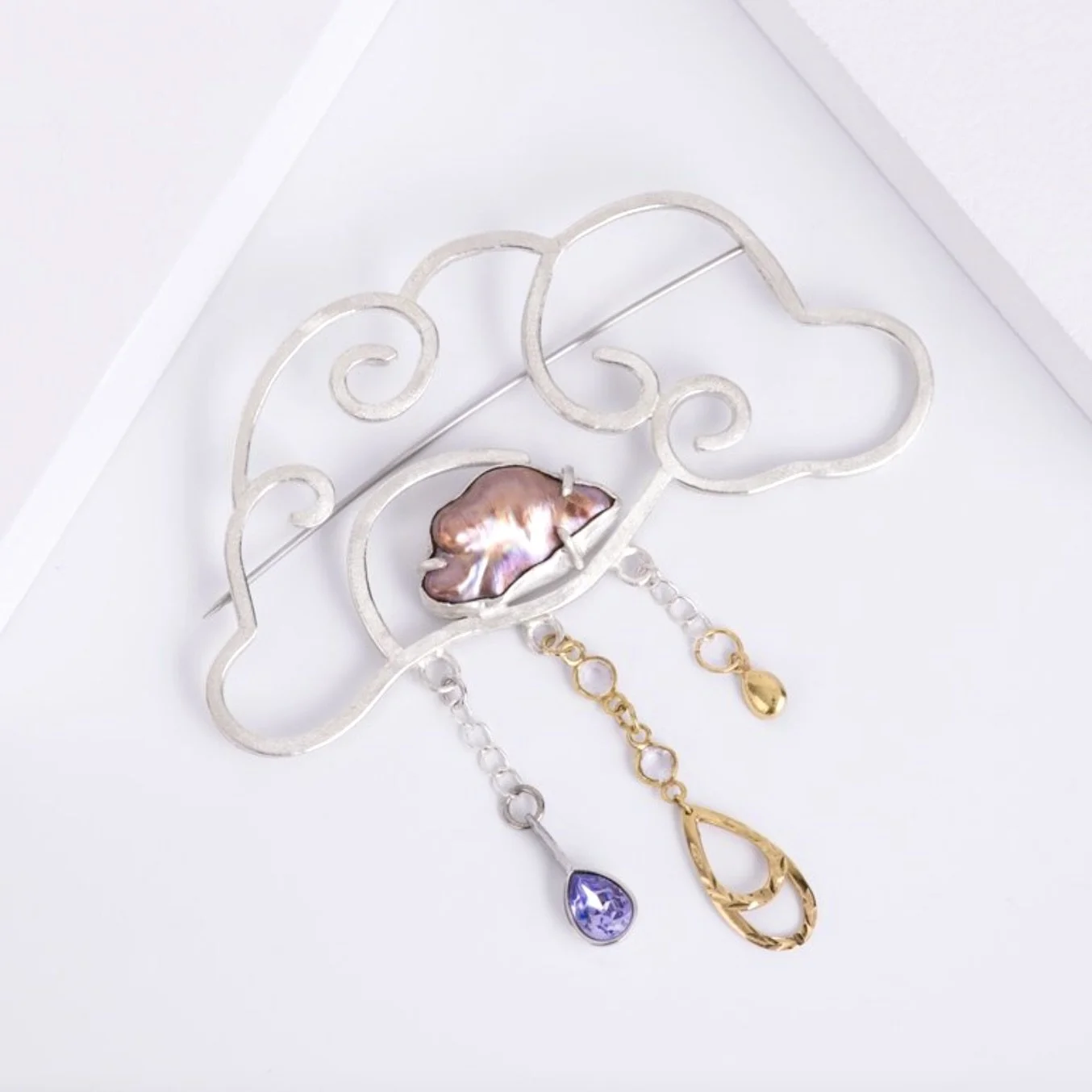
Claire Zimmerman piece as part of the Scottish Goldsmiths Trust installment. Photo courtesy of Radical Jewelry Makeover.
CB: I love that you said it’s an “AND” because to me that seems like the best way to move forward, especially if we are active participants in this industry, not just outsiders talking about it. One of the things I love about RJM is that it is focused on Upcycling: making something even better than it was before – modernizing and elevating it to a whole new level.
SG: Yes. We want to encourage people to stop hoarding: if it doesn’t mean anything to you, or you don’t use it, put it back into the supply chain! Building a culture of circular thinking might actually have the power to affect the mining industry.
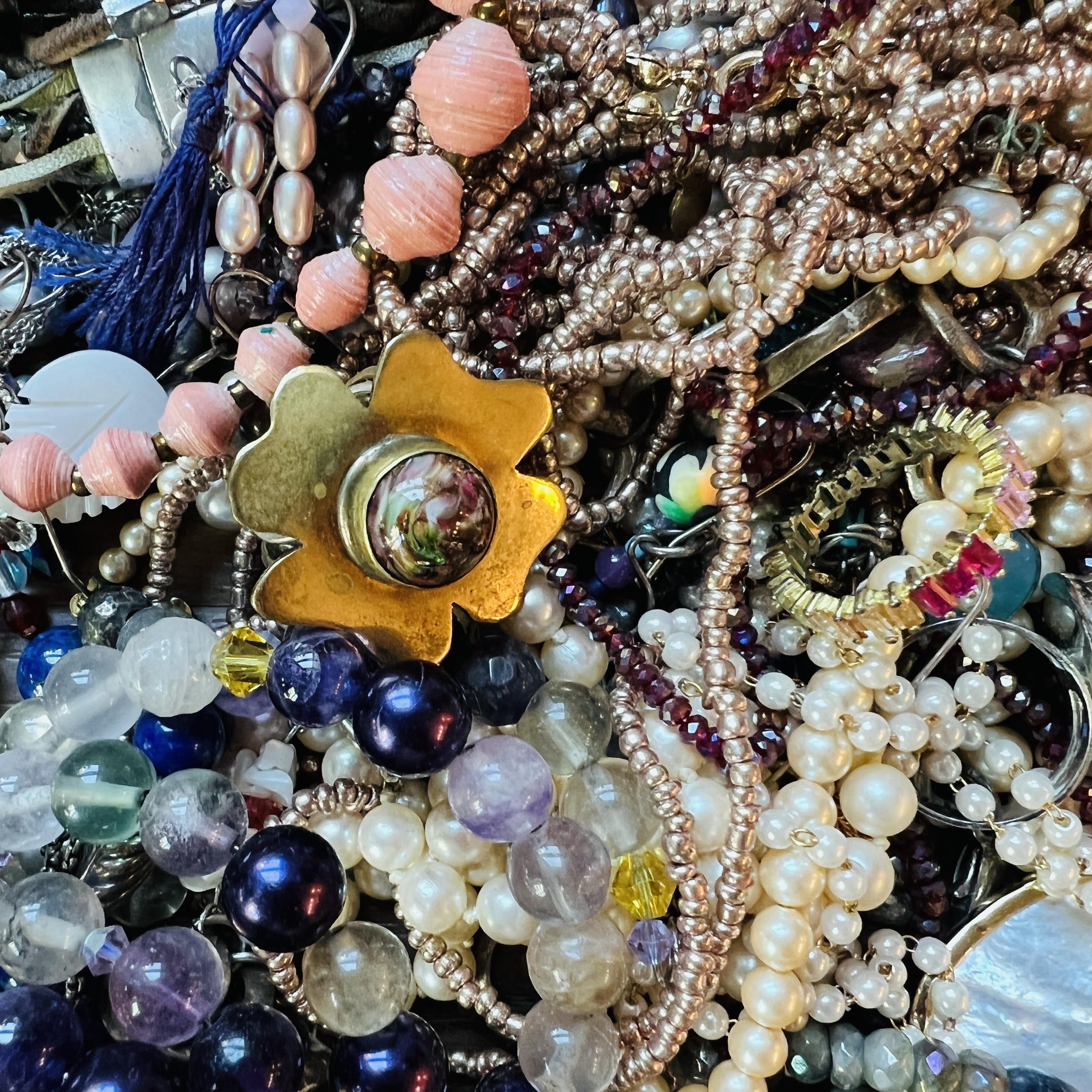
Chloe’s personal pile of jewelry to be donated to RJM. Photo courtesy of Chloe Beaumont.
SG: What is your favorite thing about being a part of the responsible jewelry movement and EM?
CB: You know what I love about EM, is that I feel welcome to ask questions and participate from a position of not knowing the answers to everything. I trust that underneath me is a net, and that net is EM.
I think it’s so huge to be given that space as a creator. This is not a group of people who claim to be know-it-alls who have all the answers. We are on a quest.
SG: That’s exactly how I feel. One of my biggest dreams was that we’d have articles like in The Source, and now we do! I’ve been really struck by my student’s reflection essays that they did on Source articles. I feel really excited about the direction that the organization has gone since I joined in 2007.
CB: Can you name three things that give you hope for the future of the jewelry industry?
SG: One of the things that gives me hope is that EM + the RJM community have both grown exponentially. I do believe that collaboration and collective wisdom hold the key to our future. We’re heading towards responsible jewelry becoming mainstream. My hope for the future is that one day Radical Jewelry Makeover will no longer be “radical.” Instead, the ideas of recycling, upcycling, circularity will all be mainstream and embedded in teaching curriculums.
CB: Susie, thanks for sharing and becoming my latest Illuminator!
To learn more about RJM click HERE
To donate jewelry to RJM click HERE
Interested in hosting your own Radical Jewelry Makeover installment?
The RJM Tool Kit provides a diverse range of institutions such as universities, high schools, guilds, and art centers, with practical information for organizing their own Radical Jewelry Makeover event.
Editorial Section
What to read next from The Source

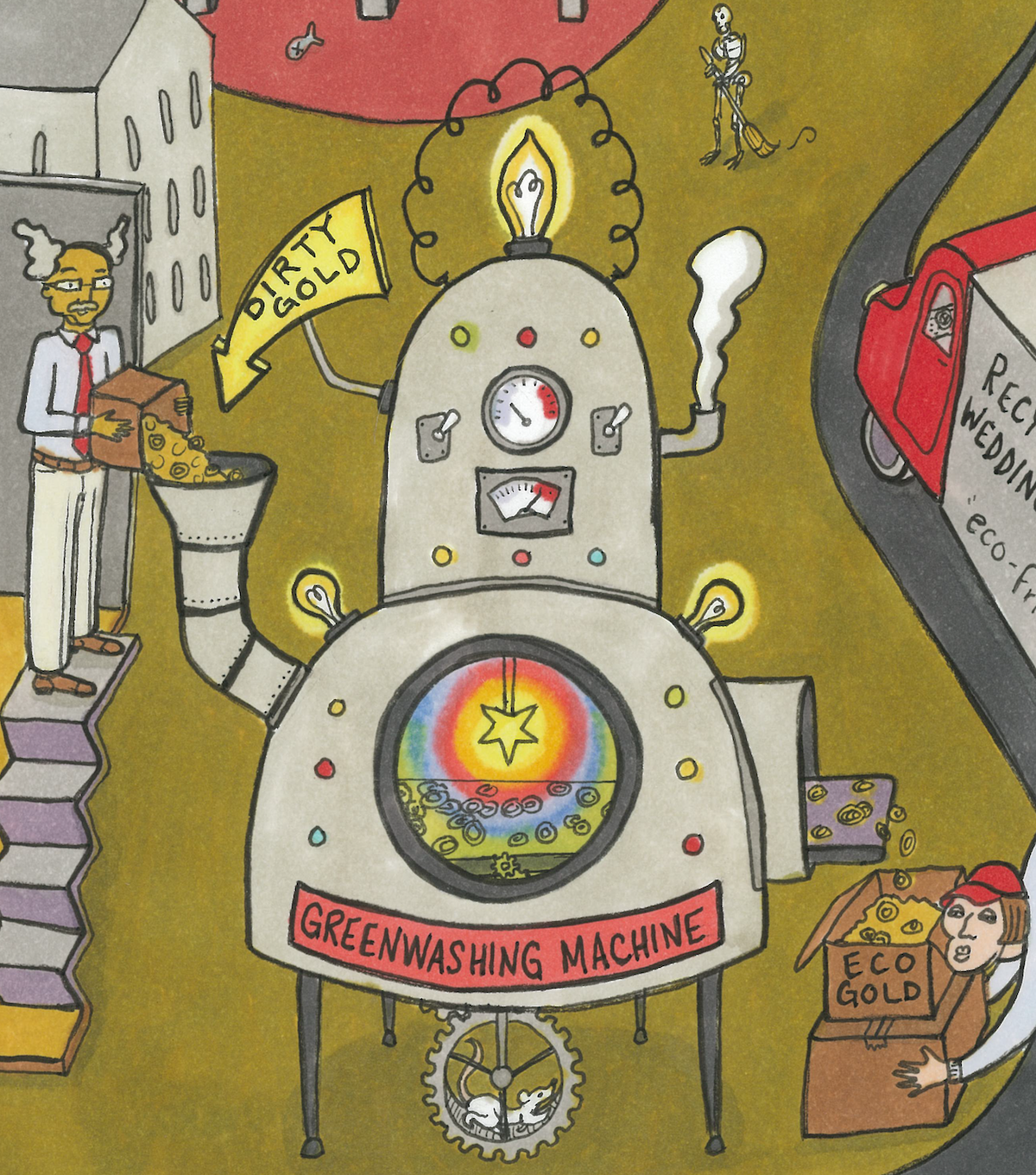
Something we rarely talk about to the extent that it is almost taboo is what happens with a break-in, burglary or even a hold-up: How do we deal with the aftermath?