

Chicago Responsible Jewelry Conference 2022 Highlights

The content of this article reflects the views of the writer, and not necessarily those of Ethical Metalsmiths. This article was written for The Source. *Please Note: Monica Stephenson is the current EM President of the Board.
This year’s Chicago Responsible Jewelry Conference just wrapped up an hour ago as of this writing, and my head is still exploding. I’m filled with hope and excitement about so many incredible (and several new!) initiatives in the responsible gem + jewelry industry.
I unfortunately caught Covid and was still testing positive when I had to make the call to cancel my plans to attend in person; nevertheless I was able to tune in via livestream.
First and foremost, a HUGE thank you to Susan Wheeler, Andrea Hill, Rachel Black, and their teams that helped organize and put on the conference.
Here are my official highlights from both days of the conference!
DAY ONE
SANCTIONS:
He doesn’t want you to be depressed, just informed! That was Brad Brooks-Rubin’s message as he kicked the conference off by reminding us of the current countries that the US has sanctioned in gold, diamonds, and gemstones; with Zimbabwe emerging as the biggest red-flag standout (aside from obvious pariah Russia).
In case you are unaware; Zimbabwe, as the Kimberley Process Vice Chair, is currently slated to assume leadership of the Kimberley Process as Chair in 2023 — all while massive oppression and atrocities are still taking place in the Marange Diamond Fields in Chiadzwa area. If you are thinking, “Wow, isn’t that messed up?” — you’d be correct.
MARANGE WOMEN’S ALLIANCE:
Zimbabwe’s status perfectly segues into another important update we received on the Marange Women’s Alliance (MWA) — a group of over 50 women who have banded together in this area to help each other, host community support initiatives, and raise international awareness about what is actually happening on the ground. Susan Wheeler’s NGO The Responsible Jewelry Transformative raises funds to support MWA by paying for data so that all the women can be connected via WhatsApp and host weekly “Tuesday Talks.” (Susan is also the founder of the Chicago Conference and co-founder of Virtu Gem. Yeah, she’s pretty amazing!)
The MWA was also recently = able to conduct a Marange Clean Up initiative for their communities.

A social media post advertising a past Marange Women's Alliance Tuesday Talk.
People who live in the Chiadzwa region fall under a horribly-named “Protected Area” in Zimbabwe, which essentially overrides their constitutional rights and results in abuses such as sex trafficking and exploitation and lack of the freedom of movement. For example, if one woman wants to go to the next village over to visit someone, they have to pay a bribe (read: money, food, or even sex) to the checkpoint officials as well as show proper ID. If they can’t pay, they are routinely held in detention for two days — and forced to pay for food while there.
Billian Matambo, chairperson of the MWA, wants everyone to know that what the Zimbabwe Consolidated Diamond Corporation states on their website — as far as community projects are concerned — is not true and does not reflect what is actually happening on the ground. She also pointed out that many human rights violations are perpetrated by security guards hiding behind the Protected Places and Areas Act.
According to the Business & Human Rights Resource Centre, “The police have to seek permission from the Assistant Commissioner (ASCOM) in charge of operations in order to investigate crimes committed by members of the security forces deployed in the area. As a result, the delivery of justice on cases committed by security forces and state entities has been hard to come. Members of the community cannot easily access justice to all forms of harassment, murder, assault and sexual abuse perpetrated by security operatives in the protected areas.”
Basically, it seems the only things being “protected” in this area are money, power, and greed. As of this writing, the MWA wasdenied permission to protest the World Diamond Council’s visit. Billian said their voices feel stifled by these diamond corporations and councils that continue to conduct business as usual while their communities are suffering.
Susan Wheeler has drafted a letter in protest of this decision to info@worlddiamondcouncil.org.
EM members: to copy and paste Susan’s letter, go to the Circle app and find the post about it under the main community chat (EM All Members).
TRACEABLE WOMEN-MINED GOLD IN PERU:
The mood lifted greatly as Andrea Jose Castro, Cristina Villegas, Jen Marraccino, and Morgane Nzelemona formed a panel on a new source of traceable ASM gold from the Madre de Dios region of Peru.
Pure Earth has been working in the area to fight mercury pollution and deforestation, as well as helping implement mercury-alternatives such as the “shaking table” method. They received a $300,000 grant from Brilliant Earth and the Alliance for Responsible Mining (ARM) over four years in order to implement this, as well as to help teach miners reforestation methods.
Andrea shared how she learned that the miners were not able to successfully sell their mercury-free gold in the local markets, so she started buying it directly from them instead. She has collaborated with Pure Earth to work with women artisanal gold miners. They started out with just one miner, and now there are 30 miners (all women) participating!

Peru Pisco Evening NYC Jewelry Week event. Photo courtesy of NYC Jewelry Week.
NYC JEWELRY WEEK PERU ASM GOLD COLLECTION:
In other exciting news: this ASM women-mined Peruvian gold will be featured at a NYC Jewelry Week event on Thursday, November 17th from 4:30pm-7:30pm at the Peruvian Embassy in Manhattan.
I will personally be attending this event on behalf of The Source and would love to meet you there. DM me at @chloekristine17 or email me at eic@ethicalmetalsmiths.org if you will be there!
From the NYC Jewelry week site:
A group of international jewelers, each from different backgrounds and origins but all of them seeking a deeper purpose in their work, have partnered with a network of female artisanal miners from the Peruvian Amazon to create a sample of jewelry pieces from slow-mined gold, using responsible practices and a regenerative perspective. The following designers are part of this collaboration: Dana Bronfman, GBGH by Jackeline Barbosa, Kathryn Kelly, Amulet by D, Silvia Davila, Delphine Leymarie, Matia Lia Baroni, Maria & Maria, Candor and Andrea Jose.
Click the link above to register. Also reach out to Andrea Jose Castro at andreajose@andreajose.com about buying this ASM women-mined Peruvian gold, or how to support her. She’s even starting a jewelry school in the Amazon, since the women miners are so inspired by meeting their first-ever jeweler. Talk about momentum!
During the audience Q + A’s, Maarten de Witte of Root Diamonds made an incredible comment:
“The gold, diamonds, and gems we can offer ARE THE STANDARD. Fairmined, Fairtrade and other responsibly sourced gold’s price IS the price of gold. Anything less is a “discount” for doing things irresponsibly + cutting corners.”
Wow. I know I’m not the only one who wrote that down in their notes!
VIRTU GEM:
We moved on with an update from Virtu Gem on their Craft Code in Gemstone Mining, “Virtuous” buyers, and the National Gem Cut Design Competition.
I talked in depth with Susan Wheeler about the incredible National Design Competition and the Craft Code in a previous Source article HERE.
If you are a designer, reach out to Virtu Gem and get your order in for which gem you want to have cut! The Design Competition details will be on the website via this link very soon.
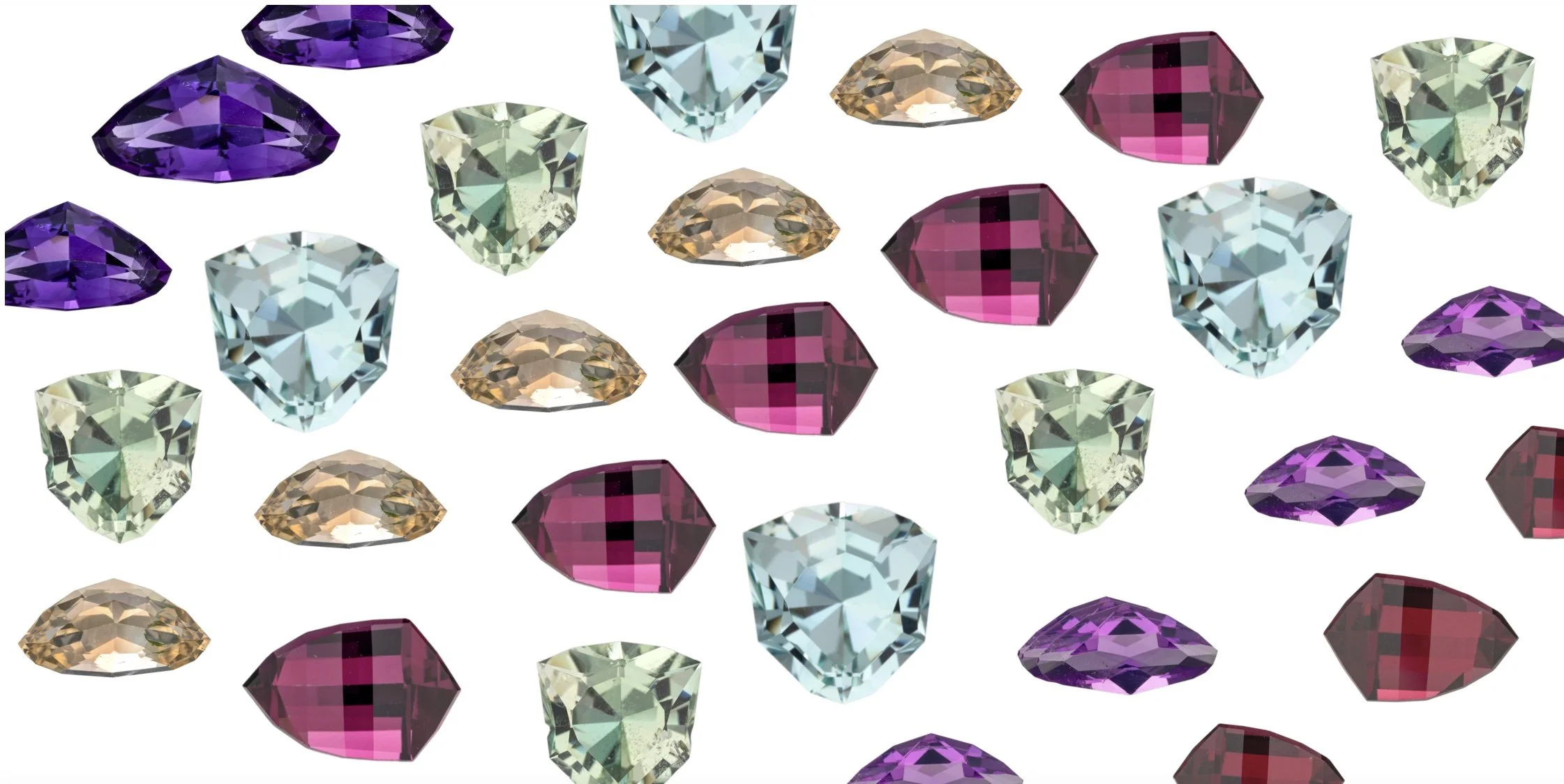
The National Gem Cuts featuring the Kenyan Cheetah cut, the Zambian eagle cut, and the Malawi cichlid cut. Photo courtesy of Virtu Gem.
I’d love to see some awesome pieces of jewelry featuring these gemstones made in the near future. All the gems are cut in-country, so you’d be supporting the local cutters in Malawi, Kenya, and Zambia and helping them advance that sector of the jewelry industry there.
CARBON ZERO IMPACTS:
Lastly, a panel converged to touch base on carbon neutrality. Here are a few points made by each panelist:
Mark Hanna, CMO of Richline Group (a Berkshire Hathaway company and parent of Rio Grande) said that they currently have 9 employees working exclusively on carbon neutrality and gathering data.
Pauline Mundia, VP of the Federation of Small Scale Mining Associations of Zambia, made the point that ASM mining does not contribute that much to a carbon footprint because so much of the mining is done with picks and shovels.
Eric Braunwart of Columbia Gem House followed up on her point by making it clear that we mustn’t “place an embargo” on ASM mining countries that don’t fit the carbon-neutrality mold. Many of the miners in regions that he sources gemstones from do not even have electricity and have no concept of what a carbon footprint is.
DAY TWO
ETHICAL METALSMITHS:
Day two began with Monica Stephenson, current President of Ethical Metalsmiths and founder of ANZA Gems, giving an update on EM’s purposeful initiatives and community.
Shameless plug: If you haven’t already subscribed to The Source so that you never miss our Thursday publications, click here and enter your email address in the subscription box to the right.
Did you know that you can now give an EM membership to someone else? If you aren’t a member yet yourself, click the link to see all the different membership levels EM offers.
When you join EM, you join a community of like-minded, caring, passionate people who are driven to make the jewelry industry better bit by bit. We have our own Circle app community chat, where we share events, resources, suppliers, and answers to questions. For me, personally, EM has been the “greatest gem” that I’ve found in this industry, and I would not be the same person without all the mentorship and community I have found.
FLIGHT OF THE DIAMOND SMUGGLERS
Another Day 2 highlight was author Matthew Gavin Frank’s captivating reading of his book, Flight of the Diamond Smugglers.
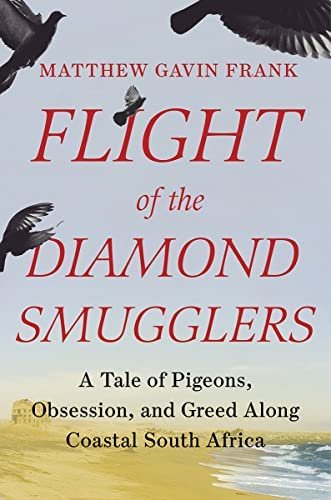
Flight of the Diamond Smugglers Book Cover.
The book is centered around Frank’s journey to the coast of South Africa and Namibia border, where diamonds and destruction go hand-in-hand. Miners there smuggle rough diamonds out of the mine sites by strapping them to the legs and wings of trained carrier pigeons — if you can believe that! Frank met Msizi, a thirteen year-old miner with Silicosis that would sneak his pigeon Bartholomew into the mine site by hiding him in his lunchbox.
This story is gripping and devastating, but poetically written. It’s worth the read, especially if you are in the jewelry industry.
Haven’t read the book yet? It’s your lucky day: I will be giving away my copy of the book to the first person who comments that they want it! Leave a comment down below with your instagram handle or email so I can message you about shipment.
Side note: The author published an article that got picked up by NPR on his journey to a DeBeers mine and what he learned. A higher-up at DeBeers came after him and tried to squash the story. Gavin Frank was able to defend himself because he had photographic evidence to disprove everything that DeBeers had accused him of.
Gavin Frank stated during question time that “there is a lack of willingness even in higher up positions to look at the history and what’s even still happening. They have the power to greenwash in that kind of way and erase history.”
After being asked by Emily Phillippy of Emily Chelsea Jewelry about his view of the industry, he stated that he still believes that the jewelry industry and designers can make beautiful things without contributing to decades worth of harm. He’s not sure the diamond industry on the whole has figured out how to do that, which leads us to another day-two standout:
ROOT DIAMONDS: ARTISANAL DIAMONDS FROM SIERRA LEONE
You may have heard of Sierra Leone before — it was one of the countries that started the whole “Blood Diamonds” concern. Well, that narrative is being turned around, and positive changes are happening on the ground to write a new legacy — one where miners are not only named, but supported and empowered. Finally, something we’ve all been waiting for.
Root Diamonds is creating a new story.
To form this passionate team, Fas Lebbie — a Sierra Leone native himself — teamed up with two diamond cutters with 40 years of industry experience each.

Fas Lebbie, co-founder of Root Diamonds. Photo courtesy of Susan Wheeler.
Lebbie is a Teaching Fellow and Ph.D. candidate in Transition Design at Carnegie Mellon. He also manages a team of product designers at Meta. Furthermore, Lebbie collaborates with MIT as a Government Innovation Mentor, working with design researchers in West African governance to develop policy and innovative programs.
Root Diamonds are sourced from artisanal miners & landowners at independent mines in Kono District, Sierra Leone. A portion of revenue from these diamonds will fund Root Studios: Lebbie’s initiative that creates job-ready programs for locals.
They offer diamond cutting, jewelry design and product design classes that are geared toward women, youth, and the disabled.

Hawa Jabbie, a landowner in Sierra Leone. Photo courtesy of Root Diamonds.
This is Hawa: one of the women that Root Diamonds works with. Hawa took over the land from her husband when he passed away. She once was with him when he found a 10ct stone on their land, but their sponsors gave them less than 1% of the value back. As a single mother, she works to put their five children through school and keep a roof over their heads. ~Root Diamonds website

Yei Bona, a landowner in Sierra Leone. Photo courtesy of Root Diamonds.
This is Yei Bona, another woman in the co-operative. She and her eldest brother are looking for supporters like Root Diamonds to mine the land and be paid a fair amount to provide for her family. Her granddaughter is awaiting results of the national exam to see if she got into university. Her biggest priority is access to a consistent income to assist with her granddaughter’s college education. ~Root Diamonds website
The Conference audience also got to watch a 30-min documentary by Roy Maconachie called “Voices from the Mine.” Watch the full video below to learn more about the struggles miners have faced in Sierra Leone.
Maconachie is a Professor of Natural Resources and Development in the Department. of Social and Policy Sciences at the University of Bath. During the ASM diamond panel, he shared that he feels strongly about using his film skills to share this message with as large of an audience as possible.
If you are an educator, please feel free to use this video as part of your curriculum!
WRAPPING IT ALL UP
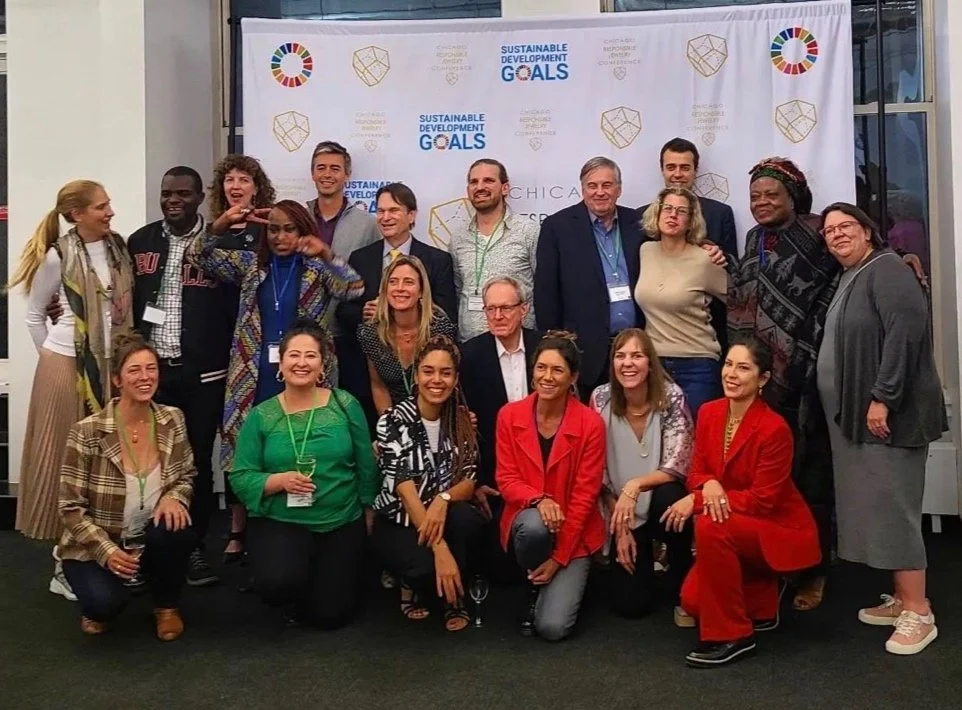
Speakers at the 2022 Chicago Responsible Jewelry Conference. Photo courtesy of CRJC.
What a great, powerful two days jam-packed full of connection and knowledge. Andrea Hill and Brandee Dallow read the current Manifesto from this year and took feedback from the audience to add to it.
Here are a few stand-out quotes:
“Models matter. That’s how we get bigger companies and corporations plugged into doing things responsibly.
We NEED the country of origin for mined AND lab grown diamonds and colored stones.
Fairmined Credits instead of Carbon Credits — we should support this schema, it’s not 100% perfect, but it could really help support the initiative. ”
“Industry perspectives on the definition of recycled will be extremely important in the upcoming FTC Green Guides revision. —Sara Yood, JVC
We need to invest in the equipment that miners need to be successful.
We need to raise all the voices and give everyone a seat at the table.”
Must-have Resources:
NEXT YEAR:
Great news: InStore Magazine will be providing the venue for the conference, and the next conference dates are in August of 2023!
Hopefully, these new dates will allow more industry individuals to attend. The more the merrier!
Follow the Chicago Responsible Jewelry Conference’s website and Instagram to stay informed.
Editorial Section
What to read next from The Source


Something we rarely talk about to the extent that it is almost taboo is what happens with a break-in, burglary or even a hold-up: How do we deal with the aftermath?