

Jewelry Journeys with Christina Miller
The content of this article is the opinion of the writer and was written for The Source

Better Without Mercury. Image Credit: Christina Miller.
What better way to kick off the first blog post for The Source than to have a chat with one of Ethical Metalsmith’s co-founders!
The following conversation has been edited for content and clarity.
Christina Miller is head of Christina T. Miller Sustainable Jewelry Consulting and investor and partner with Better Without Mercury, a project to eliminate mercury pollution at an artisanal gold mine in Colombia.
Chloe Beaumont: Thank you for co-founding Ethical Metalsmiths in 2004! What was the catalyst for undertaking such a monumental challenge?
Christina Miller: Well, I graduated from East Carolina University in the spring of 2003. I had just finished graduate school focusing on mining issues so you couldn’t shut me up when it came to talking about mining! I was studio assistant at the time to Brigid O’Hanrahan, and she introduced me to Susan Kingsley, who was writing an article called, “The Price of Gold,” that would go on to appear in Metalsmith magazine. We realized it was ridiculous to try and tackle these kinds of things on our own, so we started collaborating.
CB: In the beginning, when you were first developing Ethical Metalsmiths, were you responding to a felt need, or has it grown into that?
CM: I love this question! No, it wasn’t. Mostly, people didn’t want to hear what we were saying at all. In 2005 there was a SNAG (Society of North American Goldsmiths) Conference in Cleveland, Ohio and Kathleen Brown, whom had recently retired from teaching at Kent State, invited us to have a speaking slot at that conference. We turned it into an introduction to the concept of the price of gold. We invited Tom Goldtooth, an indigenous activist, Payal Sampat, who was the brainchild of Earthworks’ No Dirty Gold campaign, and Glen Miller, a geology professor at University of Nevada at Reno, to the panel.
It was really the first time at any SNAG conference ever that materials were discussed with regards to ethical sourcing. When the panel was over, we had maybe two or three people come up to us expressing how appreciative they were to know that this was being discussed, but that was it.
CB: Of course, this all happened before social media. I’m sure it was different from the demand from Millennials and the wave of change that we have now. That’s quite brave to start a conversation about sourcing materials responsibly when few were talking about it.
CM: Yes, and it was interesting that we became so involved because Susan Kingsley and I both identified as artists above anything else. We were inspired by a group of artists who were referred to as “The Interventionists.” We thought that was so awesome; and we asked ourselves, “How do we intervene in this mining and jewelry space?” We thought raising awareness was probably the first place to start, which is why we took on a SNAG conference and why we wanted to do it differently than what we’d seen in the past.

Rolberto Alvarez and Christina Miller speaking at the mine site in Colombia. Image Credit: Christina Miller.
CB: I bet it’s been incredible to see more attitudes changing since that time within the jewelry industry. What is the biggest change that you have seen since 2004?
CM: I think a big difference now is that responsibility is just expected by consumers. I never thought I would see the day! The fact that there are giant companies today mapping their supply chains to know exactly where their materials are coming from? I guess on one hand, I’m thinking, “C’mon, really, we are still at the mapping phase?” But on the other hand, knowing how incredibly elaborate our supply chains are (though not that complex compared to other industries, like automotive), I’ll appreciate that we are at this point.
CB: I want to bring up the Better Without Mercury project, which aims to remove mercury from an artisanal gold mine in Colombia. How did you get connected with the project’s leader Rolberto Alvarez?
CM: Since EM brought Fairmined gold to the US in 2013, which was basically a 2-year project, I had traveled with the Alliance for Responsible Mining (ARM) whose headquarters are in Colombia. They were the organization that was willing to hold our hand through the process.
EM wasn’t going to become a purchaser or a supplier of Fairmined Gold; our intent was to catalyze demand and figure out who was interested in it, as well as how to source the material. In 2018 ARM hosted their third trip, this time to Colombia to visit three mines there, including the Gualconda mine which is run by Rolberto’s organization La Fortaleza. He’s a phenomenal individual and an incredible teacher.
Rolberto introduced us to the site and gave us a tour so we could see how the materials are processed, and then he took us on a nature walk that they are building. It was the first and only mine I’ve ever been to that had a nature trail built into it! Then Rolberto brought us to this area of the mine that was clearly polluted.

The area of the mine contaminated with mercury. Image Credit: Video still from France 24’s Spanish Channel.
CB: The contaminated soil has just been left sitting there for a long time?
CM: Yes, and it was only in 2017 that they finished building their plant that was able to use cyanide to process the ore instead of mercury. Mercury is much more dangerous and a more persistent toxin in the environment.
CB: Is it also much harder to remove than cyanide?
CM: Yes. Cyanide doesn't bio-accumulate the way mercury does. It is still toxic and requires careful handling, but it doesn't have the global, long-term impacts that mercury has. Mercury accumulates in the body and leads to Parkinson’s-like tremors, and severe birth defects if women have it in their bodies.
While we were looking at this contaminated material, Rolberto admitted that it was a problem. I asked, “How big of a problem?” To which he replied, “It’s about a 400-ton problem.” Then I asked him how much he thought it would cost to clean it up. Rolberto said, “Well, it’s about $65,000.” I was thinking, in the grand scheme of things, that’s not a lot of money. We were all pretty eager to figure out a way to help.
“La Fortaleza is a 12-person operation; they don’t produce much gold, and they are supporting multiple families. ”
I think there’s a misconception that because they are mining gold they have so much money, which isn’t true. Rolberto really supported this vision to be mercury free and to be able to bring people in and teach them how to mine responsibly. Rolberto’s drive definitely inspired our group to want to be a part of the very tangible solution in front of us. We are aiming to remove and then securely store the contaminated material away from the site for as long as necessary.
CB: It’s impressive that Rolberto even had the vision to build an educational component into the mine, to show people how things used to be done and the progress that is being made.
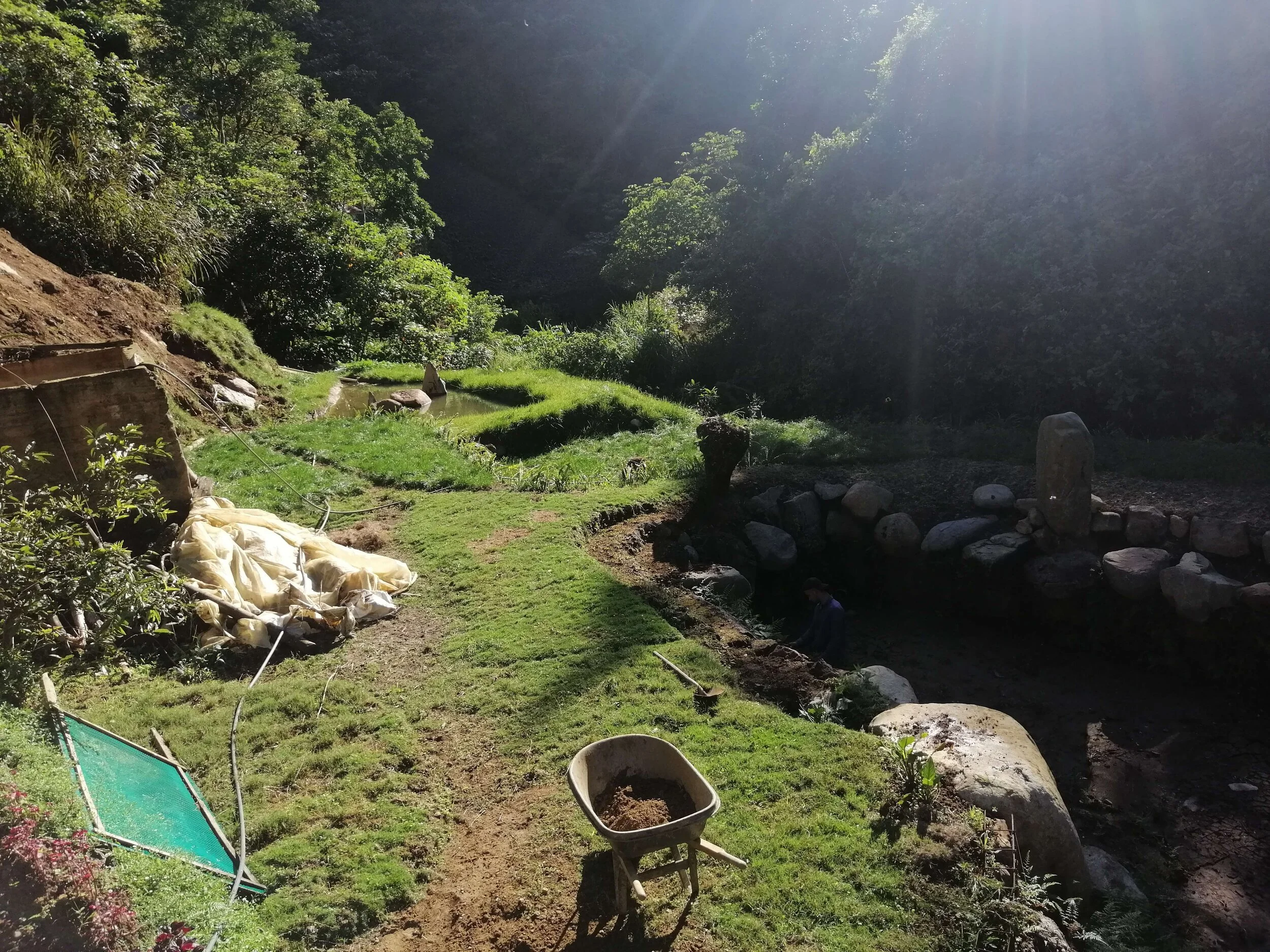
The landscaped section of the Gualconda mine trail. Image Credit: Christina Miller.
CM: Yeah, it’s happening! It has been incredible for me to be able to say I helped prevent the proliferation of mercury at an artisanal mine in Colombia. On top of that, I know Rolberto is going to share his knowledge with as many people as he possibly can. That’s the investment: it’s even more than getting rid of the mercury and cleaning up that acute area, because frankly there are so many more contaminated areas just like that. We’re investing in him, because we know he’s committed to the cause.
CB: Right, and Rolberto can help inspire more people in Colombia to do what he is doing at different mines using the Gualconda Mine as a model. I love that Better Without Mercury is truly about partnering with local leaders and empowering them to create positive change and wellbeing in their own communities that is long-lasting.
***Note: As of October 2020, the Better Without Mercury project is now on to Phase 2: Restoration in which the area that has been cleaned will be regraded, landscaped and planted with native plants and trees. The 1000 meter nature trail will be completed. If you would like to donate to this incredible project, please do so here.


What do beekeeping and fish ponds have to do with diamond mining?