

Silver and Gold Are Not Clean: Discussing Racism and Jewelry
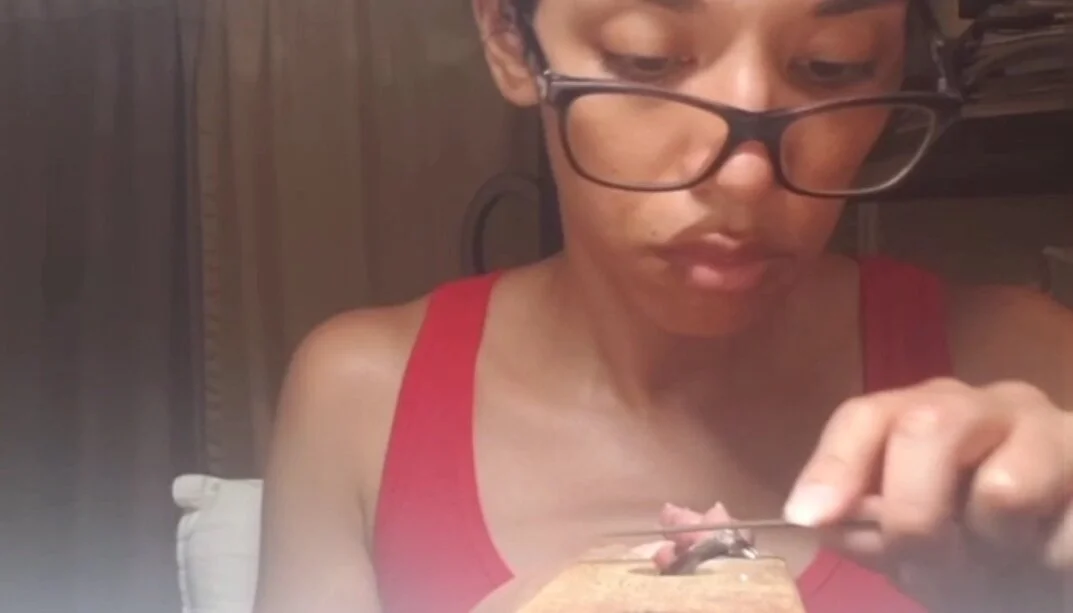
Robin Erfe at work at her bench. Image courtesy of Robin Erfe.

Message from the EDITOR
This article was originally published by Jewellery Business Magazine on 12/2/20. The Source Team has received written permission from Robin Erfe and Kyle Abram to repost this article and images with credit given.
In mid-2020, 29 BIPOC (Black, Indigenous, and People of Color) U.S.- and U.K.-based jewelry designers penned an open letter to the jewelry industry, inspired by the Black Lives Matter (BLM) movement.
Part of the letter states, “We, as BIPOC designers, stand together united as one voice in the jewelry industry...Our points of view are our pride and joy; we welcome support and an ongoing conversation.” The Source Team is entering the new year of 2021 with the desire to give these important conversations on race and racial justice our platform, as well as increasingly amplify BIPOC voices in our industry.
The following interview with Robin Erfe, one of the 29 designers whose name was on the open letter, was conducted in August 2020 by Kyle Abram, contributor for both Jewellery Business and The Source. This piece helped inform “Where Black Lives Don’t Matter to Jewelers,” an in-depth look at racism in the jewelry sector co-written by Abram and Marc Choyt.
This longer piece, linked above, covers the origins of the US ethical jewelry movement, and discusses why few producer communities are seeing the benefits of this movement today. The interview here is a conversation with Robin about her own experiences as a Black and Asian woman in jewelry, and gives a look at her journey into ethical sourcing. It is our hope that you find something valuable to take away from this interview, no matter your background.
Kyle Abram is the Brand Catalyst at Reflective Jewelry. His duties include brand management, online marketing, and SEO, as well as writing, editing, and conducting research on issues related to fair trade and ethical jewelry.

Chloe Beaumont EDITOR-IN-CHIEF
This article has been edited for clarity
Kyle Abram (KA): How did you get into the jewelry world?
Robin Erfe (RE): I’ve been doing work probably since I was 13—going on 17 years now. It’s been on and off; I was doing beadwork, then, around eight years ago was when I wanted to get into silver and metalwork. It was scary to get into it, because it takes money and education, but I found a school in Manhattan, Studio Jewelers, where they provide bench skills.
In the past two years, it’s been about bringing my brand out here and using my voice as a woman—more specifically as a Black and Asian woman who creates responsible and ethical jewelry—to draw attention to my clients and audiences about ethical and sustainable practices.
People don’t always want to hear the bad things; they just want that stamp of sustainability. So, it’s about engaging with my clients and audience and saying, “This is the truth,” while also selling them jewelry when the topic itself isn’t always so beautiful.
KA: What was your involvement with the BIPOC letter that sparked this conversation? What can you tell us about how it came about?
RE: I’m in a group, a handcrafted collective of women jewellers, and we were talking about the different things that have been happening and what we would like to see in the industry. So, that was our conversation stemming from the protests and all these different things that were happening.
KA: So, you feel there should be a strong connection the whole way through the supply chain, in terms of addressing issues around systemic racism?
RE: It is the consumer who wants to buy ‘sustainable’ jewelry—but that’s vague; it’s really vague. There are some consumers who will do the research, but they don’t have access to information I may have, or even the knowledge of where to search. So it is really the jewelry designers; we are the consumer of these materials.
The industry knows what’s happening and it keeps slapping on what feels comfortable. I don’t know what to do to keep hope. The only thing I can tell people is everything is interconnected.
KA: Where do we go from here?
RE: I don’t know exactly what to do, other than coming together and continuing to put the pressure on and ask these questions. There is no one solution. Racism is a global issue; environmentalism is a global issue. It’s connected.
I, personally, am doing a lot of research on Central and South America, and the Caribbean, because that’s where a lot of my family is from. So, when a mine is expanding in the Dominican Republic, and I go to their site and they say, “We’re going to make sure it’s sustainable,”—well, what does that mean? (I say ‘we’ speaking about the jewelry/mining industry as a whole.) We can’t just say, “Oh, well, we’re providing jobs.” This is not a saviour complex. We are not saving people. We are going to their land and we have to ask them, “What do you need?”
Right now in Honduras, there are five leaders of the Garifuna people who have been abducted. You have the Xinca tribe in Guatemala being told, “You don’t exist, so we can put a mine here.” So, it’s like, No. 1: do the local people even want you there? And, No. 2, what can you provide? Don’t think you’re the expert going to these people’s lands.
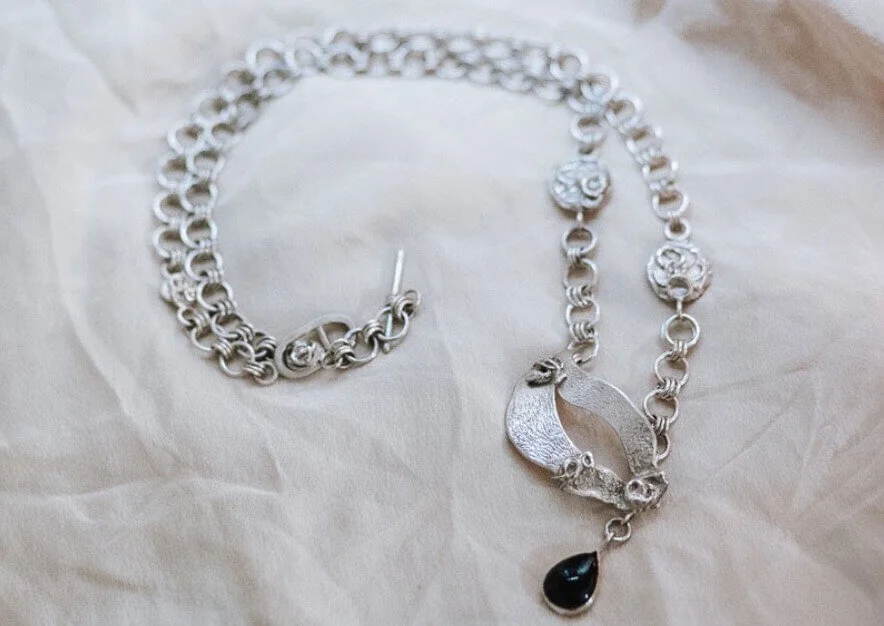
Handmade Silver jewelry by Robin Erfe. Image courtesy of Robin Erfe.
I don’t know exactly what to do, because this is built on colonialism. It’s a manifestation that just keeps changing. This is basic human rights…what I can do right now is bring awareness to it, work within my community, continue my research, and support those who are doing truly sustainable and ethical work.
The silver and gold are not clean. I’m not saying we can’t have any nice things, but we have to be uncomfortable and come up with solutions. As an emerging designer, I’m still figuring that out.
KA: I’m curious about your own experiences that would lead you to sign the BIPOC letter?
RE: Once I left school, I sort of isolated. I would go to one shop only because I felt like they kind of understood me, but other than that I didn’t go into the diamond district; I didn’t feel seen and I felt I didn’t belong there.
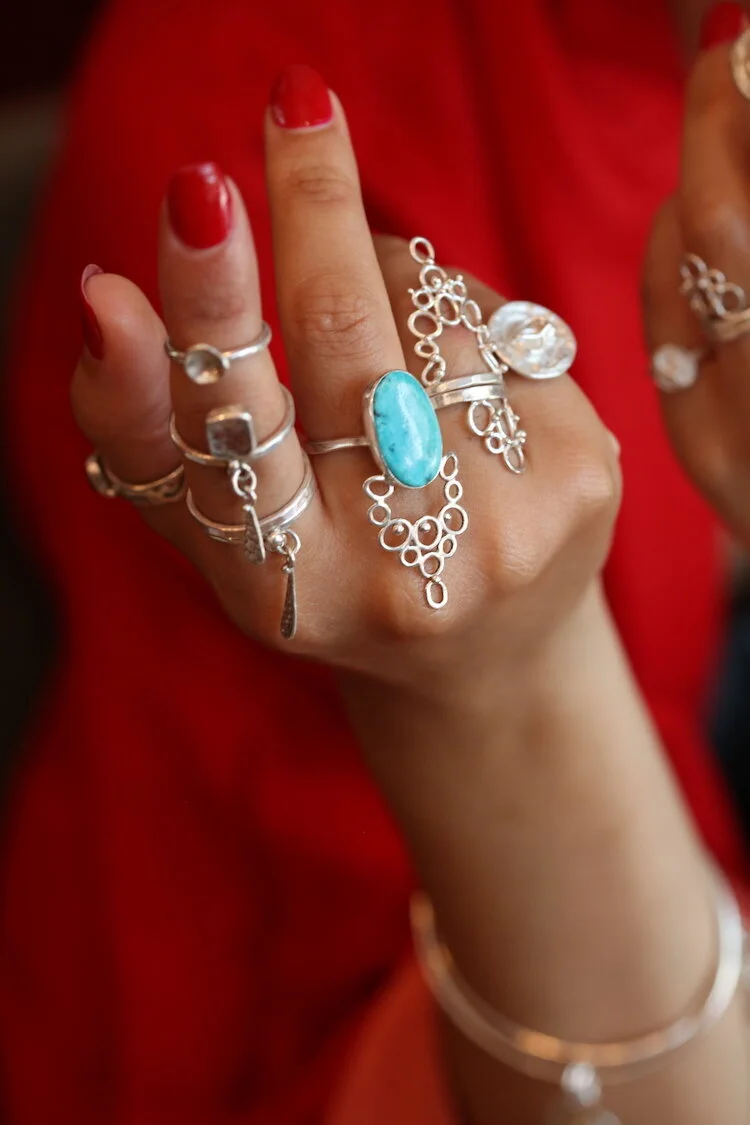
Jewelry by Robin Erfe. Image courtesy of Robin Erfe.
Only in the past two years have I started having community, because I was like, “I don’t belong in the fine jewelry world.” My jewelry is whimsical; it’s really based on my culture and me finding those parts of myself and expressing myself.
I’ve been told, “You don’t want your jewelry too ‘ethnic’—whatever that means, right? Or, “Make sure your jewelry is for ‘everyone’”—and what they meant was, for white women.
I knew that—and that was a Black person telling me this! A fellow person of color saying, “Hey Robin, you don’t want to do this.” So, for me, it’s like, how am I going to talk about these issues? I want to talk about my history and my art, but it’s not going to be mainstream.
KA: Do you think that these experiences are particular to the jewelry industry? Or that anything having to do with luxury goods might make this worse?
RE: It’s everywhere. In my area of the jewelry industry, I see that people are more vocal about it, but it’s a mindset that’s embedded in many cultures and many societies.
When I was selling at a pop-up one time, some women were saying, “You’re so cute,” you’re this, you’re that—but I realized I was just a caricature for them. Kind of like when you go to another country and you see people selling in the street, and they become caricatures. They’re not human beings and this is their art. For [those women], I was a caricature of New York Black and Brown jewellers. I remember sitting there and feeling very uncomfortable, even though people were smiling at me.
The thing is, there are a lot of BIPOC jewelers who are just not welcomed. They’re not deemed “official.” The thing is, big companies are copying these styles from African artists, from Asian artists, and really often from Native American artists. So, are these people not jewelers too? A lot of times, people go to different areas of the United States to learn traditional Native American techniques. I know there are a lot of jewelers who are not being acknowledged and supported the way they deserve to be.
A lot of designs, labor, and resources come from BIPOC people, but we don’t get to benefit the most in our communities. If we were able to own a large-scale jewelry brand, would that mean causing harm that many of these brands have been a part of? I think many of us don’t want that. We don’t want to hurt our communities or the Earth. It can sometimes seem that the only way to succeed in this industry is by hurting others, exploiting resources, and simply greenwashing brands to avoid scrutiny. That’s what’s been taught.
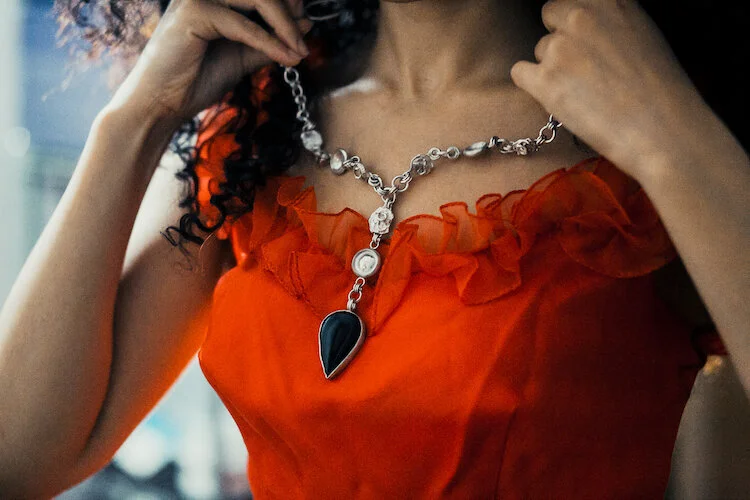
Jewelry by Robin Erfe. Image courtesy of Robin Erfe.
I love my work and I have a new campaign coming out—but I also feel this, not quite guilt, but responsibility. I’m going in with gusto; it’s just a challenge to understand that change is taking time. It shouldn’t take this much time, but it is.



Our Source Wrapped piece this month marks our 100th article since we launched in 2020! In celebration, we organized all our most popular articles into easy-to-navigate categories.