

Peter Janowski on a New Community-Oriented Sapphire Mine in Sri Lanka

The content of this article reflects the views of the writer, and not necessarily those of Ethical Metalsmiths. This article was written for The Source.

CEYLONS | MUNICH blue, orange and yellow Sri Lankan sapphires. Photo courtesy of CEYLONS | MUNICH.
I (Chloe) met Dr. Peter Janowski and Leander Schorr, co-founders of the wholesale sapphire company CEYLONS | MUNICH, at the Ethical Metalsmiths x WJA (Women’s Jewelry Association) afterparty hosted by Ethical Gem Suppliers in Tucson this year. After visiting them at their AGTA booth and seeing a plaque advertising a Sapphire “ECOMINE”, my curiosity was piqued.
Ceylon’s “ECOMINE” is a venture between Peter, Leander, and their close Sri Lankan friends and partners Mewan + Roshini to establish a community-oriented artisanal sapphire mine. This mine aims to be carbon-neutral and will even include an aquaponic greenhouse and koi ponds that will serve as supplemental income sources.
Read the full conversation I had with Dr. Janowski below and learn every detail about the ECOMINE project, where this vision originated, and how CEYLONS | MUNICH is supporting the miners and women faceters in their supply chain.
Chloe Beaumont: Peter, it was really great to meet you and your co-founder Leander in Tucson this year! Can you tell me a bit of background about how you both started the wholesale sapphire company CEYLONS | MUNICH?
Peter Janowski: I did my engineering degree in the UK, where I met a very close friend of mine. Roshini is from Sri Lanka, and I ended up meeting her future husband Mewan at that time as well. I’m actually the godfather of their children now! So that is my link to Sri Lanka. Over time, during my first travels, I wasn’t as much interested in gems as the mining; however after many visits and looking at more and more stones, I became fascinated by them. I started asking questions like, “Where do those gems actually come from?”
Leander was a close friend of mine who came to Sri Lanka with me as well. People couldn’t tell us specifically where the gems we were seeing came from, so we thought it was a problem we could help solve. We thought it would be a good opportunity to try and change something that not too many people are trying to change.
We were all working in different jobs in the beginning, and three years ago we all quit - even our Sri Lankan friends, Roshini and Mewan, to focus on this full time.

Mewan, (left) Peter Janowski (second from left), Saman, Nihal, Wasantha, and Leander Schorr (far right). Photo courtesy of CEYLONS | MUNICH.
CB: I read that Sri Lanka, known for its strict rules around the mining industry, actually has a rule that foreigners can not be sole owners of mines in Sri Lanka - you must have a Sri Lankan partner. How did you meet your current partner?
PJ: Yes, that is correct - no Western companies are allowed to have sole ownership of any mines or mining ground - which is great, in my opinion. For example, Gemfields tried to establish themselves several times in Sri Lanka, but they are not allowed to due to the protective law.
These gems are a gift that Mother Earth gave to us and it’s only fair to protect the people who live on the land that they come from.
The land in Sri Lanka actually belongs to my friend Mewan. It had been passed down in his broader family. I have talked with him extensively about starting something, even pre-Covid, but we didn’t have a complete vision [for what the mine would look like] until recently. The Covid-19 pandemic and the ensuing financial crisis in Sri Lanka definitely made us rethink quite a few things.
Our vision for this sapphire mine is that it could be a model for the other 7,000 mines in Sri Lanka. We know that not every aspect (such as the aquaponic greenhouse, or communal areas, or koi pond) could be applied to every mine, but it does have many characteristics that could be scalable.
We want this mine to be completely carbon neutral by using only renewable energy sources. Between solar, wind, and hydro power, we want to test them all and see which (or what combination) works the best and would be the easiest for other mines to copy. During the financial crisis, Sri Lanka was so dependent on using generators to run the pumps for the mines. If they ran out of money for the generators, then sometimes people simply couldn’t mine anymore and entire communities were put out of work.
It’s not just about considering climate change; people simply need to have dependable income.
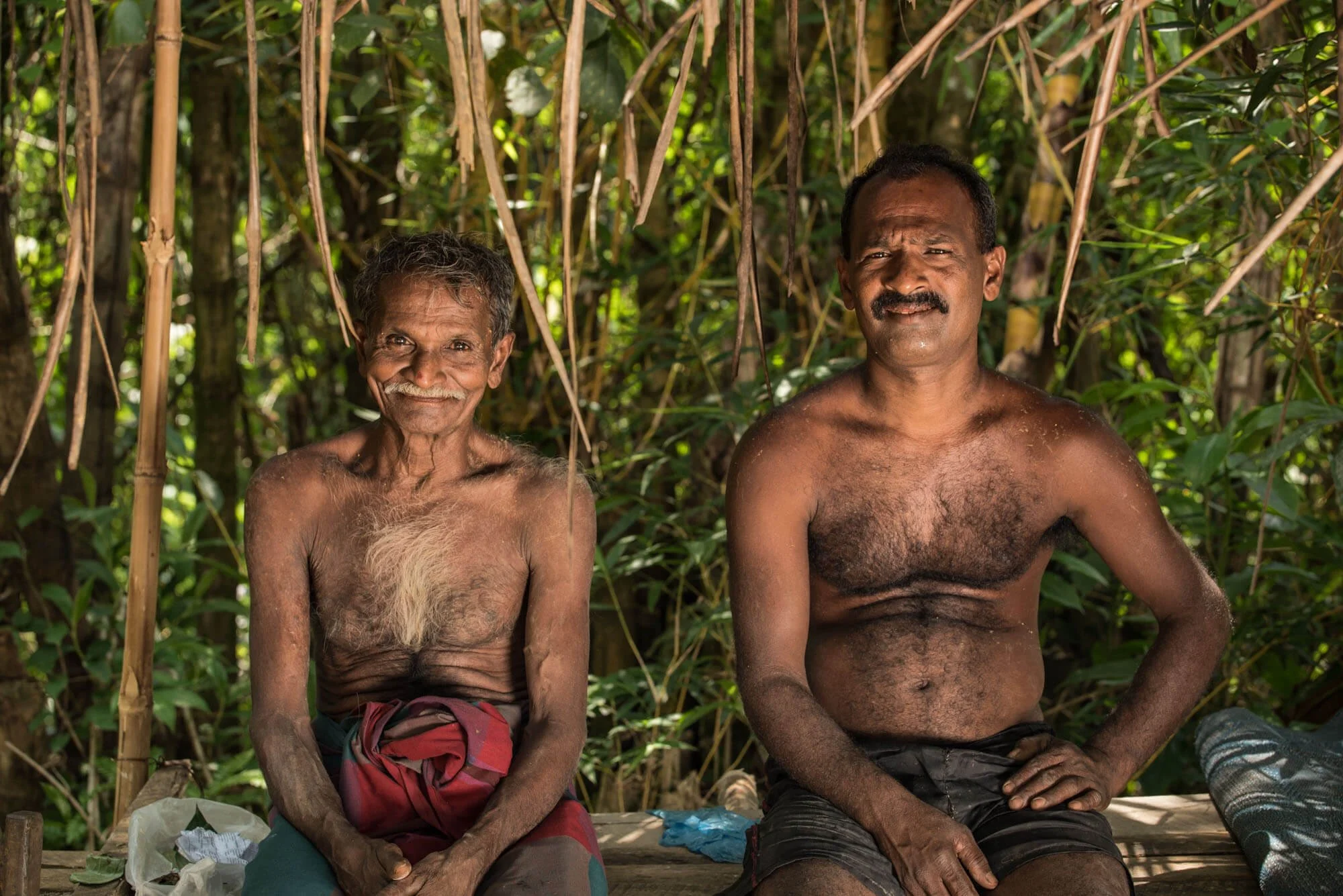
Sri Lankan miners Ariyapala (left) and Kumara (right). Photo courtesy of CEYLONS | MUNICH.
CB: When will breaking ground for this mine project officially begin?
PJ: At the end of April, after the Sri Lankan New Year. We also have to wait for the rice crops to be fully harvested as there are rice paddy fields where the mine will be. Once the rice has been successfully harvested, in Sri Lanka it’s a good omen. You are never meant to dig through a current harvest season as the miners consider it very bad luck.
CB: That makes total sense to honor that.
PJ: Yes. Actually speaking of the miners, by Sri Lankan law they get 60% of what the mines produce. 20% goes to the landowners, 10% to the title holder (me) and the rest to the Mine Operator. This can vary a bit depending on the negotiation before the mine starts and of different circumstances (e.g how many people are involved). In our case, at the moment the miners will keep all small stones directly for themselves additional to their shares.
However, if the mines are producing dry runs (not finding any or many sapphires) for a season, then miners often fall on hard times. Our hope is that by building in opportunities for alternative income, the entire mining communities can benefit and not be left solely dependent on mining for money.
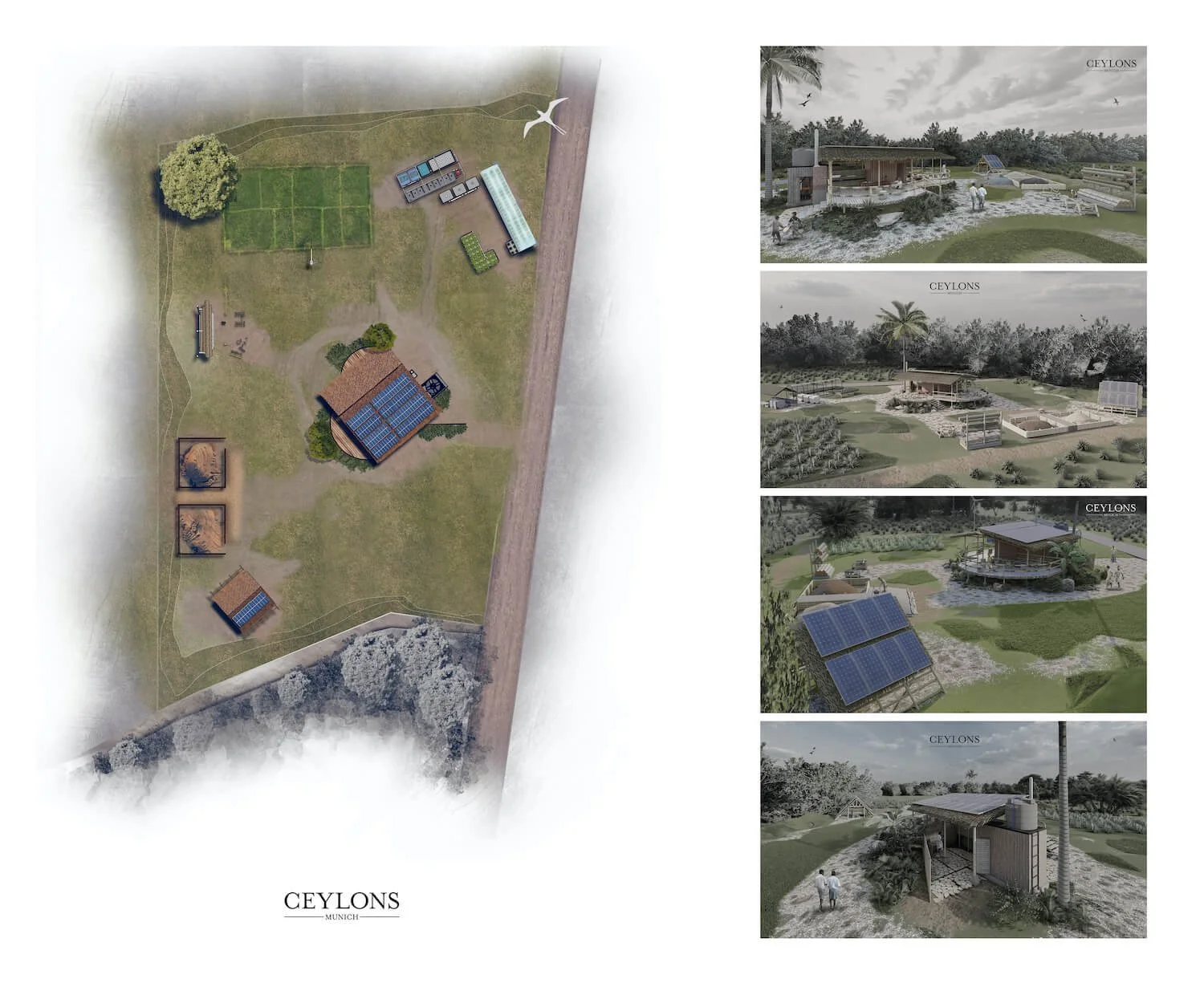
ECOMINE renderings. Photos courtesy of CEYLONS | MUNICH.

ECOMINE Renderings showing aquaponic greenhouse and solar energy sources on the mine site. Photo courtesy of CEYLONS | MUNICH.
As far as our idea to build an aquaponic greenhouse on the mine site, this will help provide food for the communities, but also additional income from selling the extra. We are currently talking with miners about what types of food they would be interested in growing. We are also talking with some supermarkets in the capital to see if they would be interested in selling different types of chili peppers or herbs.
CB: I was also wondering why you thought to add a koi pond - are koi fish very popular there? Do they get a lot of money?
PJ: Our idea with that is for them to not only have fish that is edible, but that can (hopefully!) be sold to markets. If you do it right and get the right kind of desirable colors, then it could be a source of extra income as well. So, there will be two different ponds: one for consumption, and one for selling.
With all the things that I’ve mentioned, of course we will try them out and learn from them. If we need to adjust or change things, we will. This all will bring complexity, so the more people looking after this concept, the better. The most important thing is to get the mine up and running so that the miners and surrounding communities can see its benefits and start getting involved. Our idea is not to build this super great mine that other miners in the vicinity will just have to be jealous of. The whole idea is that they can start implementing practices that we are incorporating in their own mines, as well.

A woman faceter that Ceylons works with in Sri Lanka. Sapphire rough pieces from CEYLONS | MUNICH.. Photos courtesy of CEYLONS | MUNICH.

Rough Sri Lankan Sapphires
CB: I really appreciate that your approach is not to build an exclusive project, and that you want to not only listen to but share knowledge with the local people. On your website you pointed out that women are not miners in Sri Lanka, but that you wanted to include and empower women in your supply chain. Can you talk about the women cutters you work with?
PJ: Yes, and we actually are very excited about a new lapidary that we are setting up in Colombo, Sri Lanka that will employ women from a school for the deaf. We just talked with three ladies from the school to begin working with us to become faceters and have begun renovations for the lapidary space. We had been working with three other women faceters already, but two of them had to get new jobs (one due to moving, and one because she was commuting too far).
CB: Sri Lanka has a very long, rich gemstone industry with deep ties to the land. What are your favorite parts of the Sri Lankan culture surrounding mining and cutting?
PJ: I think how proud they are about the traditional Sri Lankan way of mining, and their mindfulness of the environment.

A mine site in Sri Lanka. Photo courtesy of CEYLONS | MUNICH.
CB: How has the reception of all of this been in Germany? Are people demanding responsibly sourced gems or are they more concerned with color and quality still?
PJ: Unfortunately, it’s still mostly about the quality - but there is definitely a change happening and more people are asking the questions that need to be asked.
Peter, thank you so much for sharing about your vision for the new Sapphire mine in Sri Lanka, and for becoming my latest “Illuminator!”
To donate and support the community-oriented sapphire mine project, click HERE.
The fundraiser has met their current goal, but let’s help exceed it, as this was just the first round of fundraising needed in order to get started.
Guess what? Donors will even receive “perks” based on the amount of their donation…..
€50 = a Thank You card written by the miners
€100 = a 1ct rough sapphire from this mine
€250 = a .25ct faceted blue sapphire from this mine
€500 = a .50ct faceted blue sapphire from this mine
€1,000 = a .7 - 1ct faceted blue sapphire from this mine
€2,000 = Invitation to group for 0.5 day training course (6 hours) for sapphire insights personally from CEYLONS founders, either at CEYLONS showroom in Munich or as an online course via teams (course times by arrangement).
€3,000 = Set of 3 fine faceted blue, yellow and pink sapphires 2.5-3cts each from this mine
€5,000 = You will get to have the unforgettable experience of visiting this mine for one day to meet the miners and CEYLONS. You will get the chance to go into the mine and find your own sapphires! Travel expenses must be paid by the participant (travel times by arrangement beginning of January 2024).
€3500 → unique offer for B2B customers to visit the mine in person and to be able to create their own marketing material
“We are a small team of passionate jewelry industry professionals and writers. We’d appreciate your support to grow our team and continue to be able to provide the best responsible jewelry content for years to come!”
Editorial Section
What to read next from The Source
Like what you are reading? Please help support our editors and writers today.

Something we rarely talk about to the extent that it is almost taboo is what happens with a break-in, burglary or even a hold-up: How do we deal with the aftermath?