

Pitching Your Jewelry: Advice From Experts

The content of this article reflects the views of the writer, and not necessarily those of Ethical Metalsmiths. This article was written for The Source
About to pitch your jewelry to a store? It can be daunting!
With the goal of avoiding disappointment and frustration all around, I asked retailers to advise us on what to do – and what not to do – when making a pitch. Some stores state their parameters clearly on their own websites, so take a very careful look at their sites as part of your research. Please take the retailers at their word!
Retailers, whether brick-and-mortar, online or hybrid, are swamped: we know! You’re juggling dozens of challenges, some of which existed before the pandemic and some of which landed more recently. Retail seems as tough as metalsmithing, but without the fun of molten metals!
Therefore, it’s especially generous when retailers and industry veterans take time to share their insights with The Source.
To those who took time out of their days to answer these queries: thank you very much! (Some replies have been condensed.) Is pitching your line a topic about which you'd like to learn more? Please let us know, either in the comments section below or on social media.
TWIST

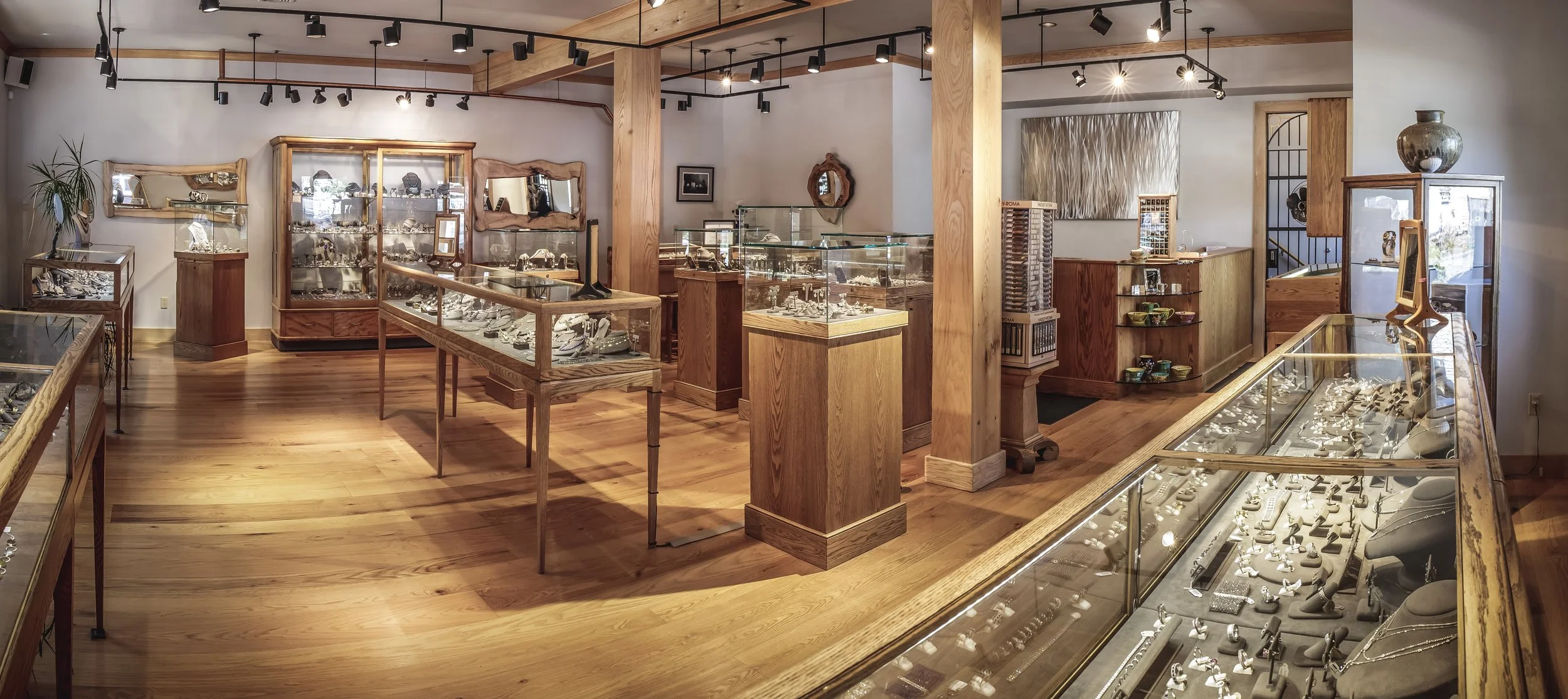
TWIST in Portland, Oregon. Photo courtesy of TWIST.

TWIST Owners Lauren Eulau and Paul Schneider. Photo Courtesy of TWIST.
TWIST looks like an ever-thriving business, with stores in Portland and Seattle, and the captivating TWIST Online. Paul Schneider, one of the owners of TWIST, explained that he wished he had more time to mentor designers individually. Both he and co-owner Lauren Eulau had careers as makers before they shifted their focus to jewelry retail. They clearly care a great deal about makers, which comes across beautifully on their website. In addition to the very clear guidelines for artists’ submissions on the TWIST website, Paul offered the following advice for designers:
DO
Be organized.
Tailor your communications to each store individually. You must convey that you know about that store. Sending the same form letter or cookie-cutter email to all of the potential stores on your list won’t get you far.
Show that you care about the values and business of the store to which you’re pitching; invest some time and thoughtfulness into your communications with them.
Aim correctly, instead of just aiming high, when identifying stores. Which retailers would be a good fit, both for your designs and for how evolved your business is? If you’ve just started out and only have ten styles of earrings and two rings, it doesn’t make sense to pitch to a nationwide or international retailer that carries full lines of jewelry.
Consider contacting local stores, even if they aren’t necessarily jewelry stores. A design store, clothing store or even a furniture store may be great for both the retailer and you. Make it easier for a store to envision working with you by offering to do the following: take care of the bookkeeping, provide a showcase, train salespeople about the work and so on.
Follow up. If you get a response (too rare...), even if it's not what you want to hear, thank them for the communication. If you don't get a response, maybe try again. Show that you continue to be aware and interested in the retailer.
DON’T
Lose sight of the fact that times have been especially tough for retailers; they may be understaffed and not have time to respond to every unsolicited pitch or email.
Overlook the fact that most retailers have never been makers, designers or artists and many jewelry designers are inexperienced with retail. This disconnect can cause some hiccups, but keeping it in mind might make communications smoother.
Forget that you’re building something together: a sales interaction is therefore more than simply a dollar amount from the sale of a piece of jewelry. The maker needs to receive more than money for their work; they need to be taking a step forward with every sale.
Lose your connection with the goal, art or inspiration that motivated you to create something to begin with.
WORKS GALLERY

Madison Avenue’s Works Gallery, on NYC’s Upper East Side. Photo courtesy of Works Gallery.
Works Gallery is an independently-owned fine jewelry store on Madison Avenue in Manhattan. (Full disclosure for the sake of transparency: this gallery shows the author’s line of fine jewelry.) They are a mainstay on the Upper East Side and have dedicated customers who appreciate finely crafted and unique designs. They really know their customers, their designers and their product and the space is an antidote to commercial consumerism.
DO
Have a signature look or style.
Have a large body of well-crafted fine jewelry.
Use the highest-quality gemstones and materials.
Have an online presence that supports your professional brand, look and story.
Have an aesthetic for your line that would fit in at the gallery and would work for our clients.
DON’T
Pitch costume, “fashion,” or commercial jewelry.
Show a line that looks similar to one we already carry.
Present any poorly-made pieces or sub-par materials.
Expect an outright sale if the store works on consignment.
Walk in, expecting to show your line without an appointment! This is unlikely to be a good time for anyone in the store.
Hummingbird Jewelers
Hummingbird Jewelers in Rhinebeck, Hudson Valley New York. Photo courtesy of Hummingbird.
Hummingbird Jewelers in Rhinebeck is a favorite place in the cool Hudson Valley, New York. It has been for some time; Peggy and Bruce Lubman founded Hummingbird many moons ago, and their daughter Jaime has since joined the team. (Full disclosure for the sake of transparency: this gallery shows the author’s line of fine jewelry.) Hummingbird is an anchor for the town and region and is a beacon for designers and jewelry admirers, near and far. The owners and staff have keen eyes and know our industry front and back. Here is a distillation of their collective insights:
DO
Introduce your work in an email that includes a statement of purpose or inspiration for creating the line.
Send line sheets, allowing a store to see if the line would fit in with their aesthetics and appeal to their customer base. If the store felt it might be a good fit, they could then set up a meeting in-person or at the next trade show.
Decide whether you, as a designer, are a retailer (selling directly to the consumer) or a wholesaler. It can be challenging to even accept consignment of new work from someone who is also selling directly to retail customers. Often, customers will receive all the information they can get from the retailer and then, as soon as they are out the door, will attempt to purchase the item directly from the designer at a reduced price. This obviously undermines the whole point of being in business and retailers and designers must have a mutual agreement to respect and support that relationship.
Include a thumbnail image for every item on all line sheets and invoices. Retailers are often under-staffed and short of time; having a visual for each piece is tremendously helpful. On a related note…
Keep good inventory records. For larger stores, which might have software like Edge and staff members dedicated solely to inventory, this is less of a problem. However, smaller shops and galleries may not have a person dedicated to inventory management alone. It is much easier to manage inventory when an image accompanies all paperwork, as opposed to just an inventory number or brief description. It also helps a buyer remember what they have sold.
DON’T
Overlook the fact that this is a business relationship. For us, shopping for new work is a commitment to a new business relationship, not simply a design decision.
Undercut your retailer! With the advent of the internet, many retail buyers will receive all the information they can get from the retailer and then as soon as they are out the door, will attempt to purchase the item directly from the designer at a reduced price.
Ignore the concerns of the retailer’s customer base. Our customers care about origin and issues surrounding sourcing of materials. These topics have become more important than ever. Younger customers in particular have done their research and appreciate salespeople who can speak to issues of sourcing. It’s even more meaningful when a salesperson has independent information to back up their statements. This means the customer doesn’t just have to rely on the word of the salesperson helping them.
For example, one of our major diamond suppliers has started including origin on each parcel paper they send with a loose diamond. It is so powerful to respond to the question ‘where did this diamond come from?’ by showing the parcel paper that is stamped “Botswana“ or “Canada.” This would be helpful with colored gemstones as well.
Ignore the values of the store. As an environmental lawyer-turned-jeweler, I [co-owner Bruce Lubman] have always tried to use recycled gold and silver and responsibly sourced gems. Interacting with individual designers directly gives us the opportunity to find artists who have a similar commitment to the environment and sense of ethical sourcing. We look for designers who might share a similar philosophy about making jewelry.
To drive home this advice, this industry veteran suggests we do the following: Take any ego involved here, shove it down to the heel of your shoe and step on it!
An Industry Expert
A highly-regarded jewelry industry expert, with vast experience in retail, wholesale, manufacturing, and design, suggests the following:
DO
Research the stores you’re pitching: not all retailers are right for you (or your line) and your jewelry won’t be a good fit for all retailers.
Merchandise your pieces! Buyers are always thinking about how a new line of jewelry would look in their store, and must consider how new pieces would look near existing ones. By merchandising your pieces, you are making this easier for the buyers.
Listen more than you speak! Really absorb the feedback you receive; it can be incredibly valuable. Take that feedback to heart!
Set aside your personal feelings about your work as much as possible, so you can digest that feedback and not get in your own way.
Remember that retailers are looking for business partners when they're considering a new line; be ready to act like a business partner. In other words, be professional, reliable, ready to fill orders in a timely fashion and so on.
DON’T
Be discouraged; this is one of THE toughest industries ever! Perseverance is the most valuable factor here.
Ignore your competition: know their work, prices, where they sell and so on. Retailers are looking across the entire market and you are just one voice within that larger industry. For example, don’t price in a vacuum; your retailers are aware of prices across the market and you should be, too.
Operate without a budget! If you don't know how to create one, use any resources available to you to start. Most states have free resources online for small businesses owners. There are also plenty of other sites to help one create a budget; or, perhaps a friend can help.
Walk in off the street and start pitching! Time is a retailer's most valuable commodity, so make an appointment to show you respect it.
Expect to change the things you dislike about the industry overnight; there is room for change, but it takes time and persistence.
If we let our personal attachments to our own creations get in our way, we may not be in a position to absorb the valuable feedback we’re getting. Are we getting in our own way?
Several other people who were interviewed for this article echoed the importance of not taking rejection personally. Instead, they suggest trying to think from the perspective of the retailer. One store owner summed up the last few years: “Unfortunately, since Covid, we have been sadly understaffed. We’ve also been busier than ever. Things like inventory control and shipping have become even more challenging for us to keep up with. I know that not everyone has these issues, but for us they have been very real.” This retailer emphasized that the store has less time than ever to respond to unsolicited communications from designers.
The advice above from retailers and jewelry veterans is meant to be a starting point. Since it’s beyond the scope of this volunteer writer to canvas all retailers, it’s incredibly helpful when readers contribute their ideas. What did I miss? What’s the best advice you can give or have received?
Please jot it down below in the Comments section or on EM’s social media posts!
For what it’s worth, a few questions I like to ask retailers are the following:
What are your customers asking for in jewelry?
What am I not showing you?
What do you wish designers did or didn’t do when working with you?
Thank you for reading!
“We are a small team of passionate jewelry industry professionals and writers. We’d appreciate your support to grow our team and continue to be able to provide the best responsible jewelry content for years to come!”





Chloe interviewed Jessica Hudson of The Nomad Jeweler on her latest collection that features ASM Colombian gold and Tahitian Kamoka pearls. Read the full article to learn more about Jessica’s story and why she chose to design with traceable artisanal gold and sustainable pearls.