

Michelle Nakata-Murray on New Horizons and Lasting Legacies

The content of this article reflects the views of the writer, and not necessarily those of Ethical Metalsmiths. This article was written for The Source.
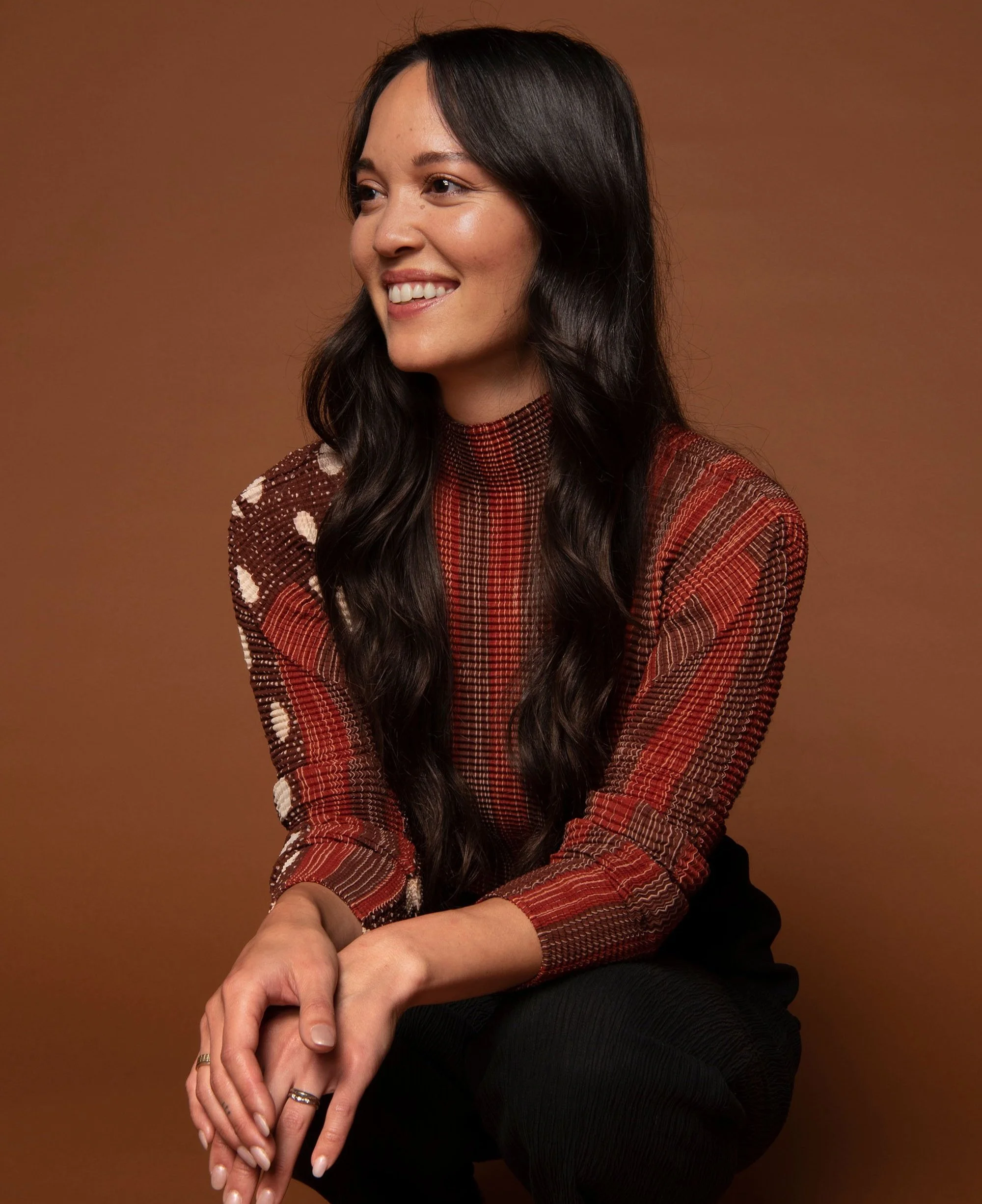
Michelle Nakata-Murray headshot. Photo courtesy of Michelle Nakata-Murray.
Michelle Nakata-Murray is founder and designer of M.Hisae [hee-sigh], a portfolio of fine jewelry evoking inner landscapes, unspoken languages, nuance, balance, and the inherent wisdom in metal, gemstones, and ancient craft.
As an EM member, Michelle’s studio is constantly evolving to Earth-forward practices. We had the opportunity to connect in New York last year, and I was eager to further our conversation as we headed into 2024!
CB: My first question is a popular, but endlessly interesting one: what did your entry into the jewelry industry look like? Also, did you have any industry mentors along the way?
MNM: I’m used to talking about my entry into the industry being post-college, since that’s when I really dove into it as a career path, but my first ever jewelry sale was when I was ten or eleven years old. I designed some earrings and necklaces with Michael’s craft store beads and made about $50 selling them to my aunt and mom’s friends. I even made business cards out of printer paper with Hisae (my middle name) on them. I don’t remember doing anything jewelry-related until much later, in college. During an internship my last year before graduating, I started making bracelets and necklaces out of embroidery thread and hardware store rope, just as a creative outlet. That internship wasn’t paying me much (at least for Southern California standards), so I opened up an Etsy shop around 2009 during the Etsy come-up. I think I’ve always had an entrepreneurial spirit.
After graduating, I moved to New York City to work in fashion in a few different contexts. It was very fun and very challenging in a great way but wasn’t sustainable for the environment and speed that suits me best. Kind of on a whim, I found a listing on Craigslist for a jewelry assistant position for the independent fine jeweler Claire Kinder. Claire Barrett hired me for one day a week to start, even though I had zero metalsmithing experience. She could see how enthusiastic I was to learn, and I could help her with the business side of her line when I wasn’t making jewelry. Claire taught me most of my essential metalsmithing and stone setting skills on the job, along with how to navigate the jewelry district and all the core knowledge and vocabulary that entails.
I honestly see everyone I interact with in the industry as a mentor of sorts, whether it’s one word of wisdom in passing or a jeweler friend who I can bounce things off of on the regular. Everyone does things a little differently, so I try to listen well.
CB: I read a description of your ethos online that was so downright beautiful it made me emotional. Especially the part that read, “She sees jewelry as a powerful tool in honoring desire and utilizing beauty to heal wounds, recommit to oneself, and invite new visions of what's possible.” How has creating or wearing jewelry been healing for you? Also, are most of your clients purchasing jewelry for themselves, or what would you say is the ratio between that and purchasing for others?
MNM: That’s so sweet, I’m really glad it resonated. I remember a turning point a few years ago where I was struggling to find enough meaning in my work to keep going with it. I wasn’t fully ready to set it down, but I have a lot of interests and wondered if I should explore something else. I needed to understand why I chose jewelry over and over throughout my life. It really nagged at me because I’m pretty purpose driven as an individual - finding my own meaning, no matter how abstract, in everything I do brings me motivation to keep doing it. The thing that confused me about jewelry was how much I loved making it and how neutral I was about actually wearing it. Most days before a few years ago, I had maybe one ring I’d wear daily and that’s it. I wasn’t a “jewelry girlie”.
I was working with a healer/coach at the time and she encouraged me to start buying jewelry from other artists I admire to know what it felt like to discover, covet, spend my hard earned money on, and wear jewelry that I hadn’t made myself. This radically changed how I experienced jewelry. It took me out of the physical, practical act of making and into the emotion of jewelry. Buying jewelry this way also introduced me to meaning-making, as well as how incredibly important beauty and beautiful objects are to the human experience.
I feel like the customers that find me also value beauty and meaning-making and I love getting to know them so much. I’d say ninety percent are purchasing for themselves and ten percent are a partner or parent purchasing a gift. But that ten percent got a hint or a link sent to them somewhere along the way…
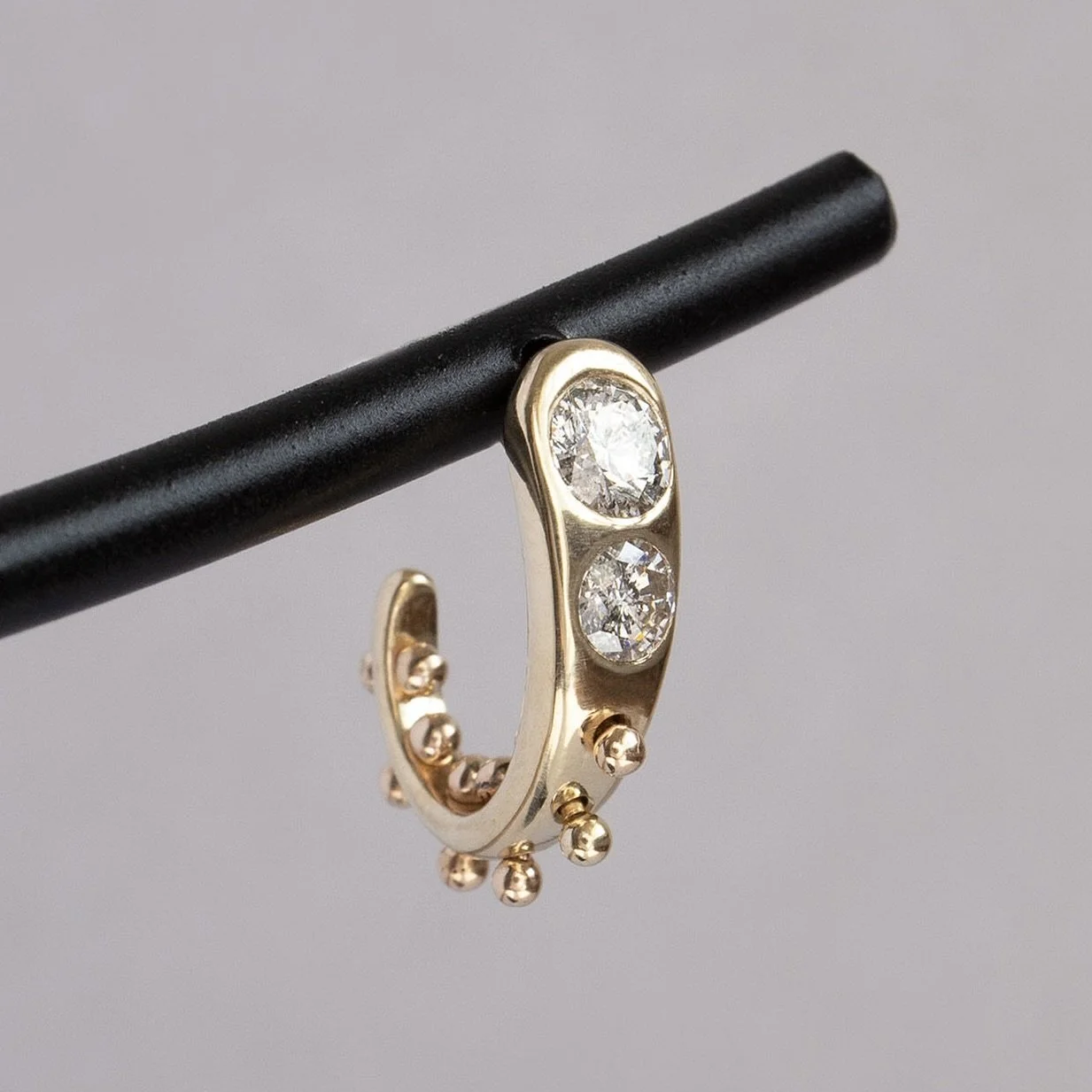
M.Hisae Suki diamond earring. Photo courtesy of Michelle Nakata-Murray.
CB: I’ve been thinking a lot lately about how we need jewelry as a bearer of culture and a throughline to our ancestors. How does your Slovenian/Polish/Japanese heritage influence your designs?
MNM: Me too. A jewelry collection can become a part of your legacy.
I love the idea of record keeping - a little diary of when a piece came into your life and why. Imagine finding what is like a tiny notebook full of these stories from an ancestor. The act of collecting is really beautiful.
My heritage is an integral part of my work. This combination of cultures that I’m from have through lines but are also contradictory in some senses. I think contradictions and tension makes for more interesting work; that feeling of not quite being able to put your finger on something. There’s more room for surprise and interpretation.
I love exploring relics, art, armor, clothing, architecture, and spiritual and religious themes of the cultures I’m from, but then interpreting them in my way for my time. I’ve barely skimmed the surface of this in my current work, but the ideas and thoughts are there. I think they’ll come out more concretely as time passes.
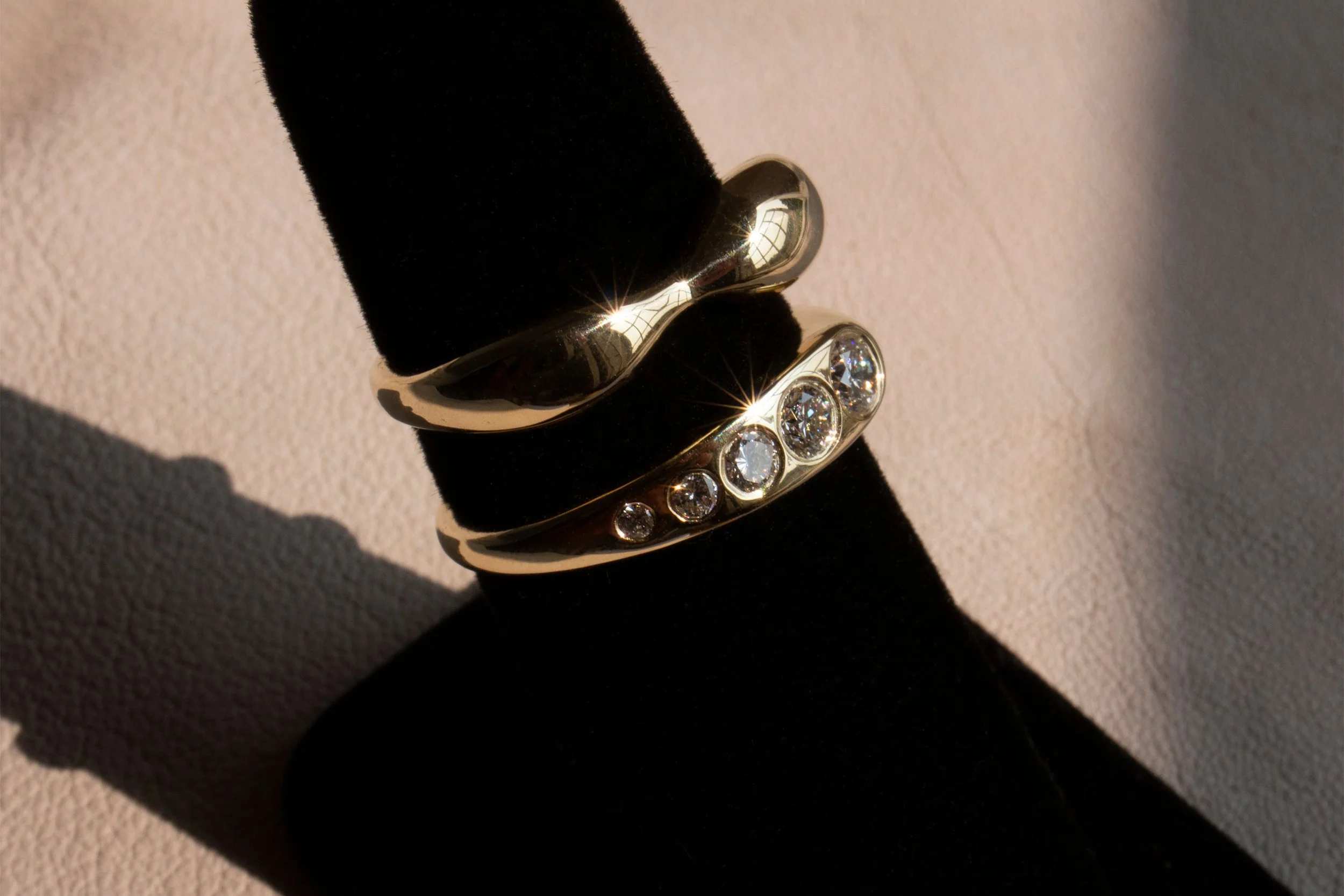
M.Hisae Lila Suprima ring in yellow gold. Photo courtesy of Michelle Nakata-Murray.
CB: We first met in Brooklyn, New York, and just recently got to know each other better during NYC Jewelry week in November 2023. You came to the Reciprocity event panel at the Peruvian consulate where I, along with others, was asked what reciprocity meant to us in the context of our jewelry industry spheres. My turn: what does reciprocity mean to you as a jewelry designer?
MNM: It’s such a great word. As a jeweler, I see it rooted in trust and knowledge sharing. It would be very, very difficult to have long-term success in this industry as an island. I’m still here ten years later because my peers and colleagues were generous with their time and knowledge. I try to pass along the same to others. If we have a rapport, I’m a very open book.
Reciprocity is about celebrating the successes of others while knowing your wins are on the way.
CB: Are there any gem varieties that you don’t work with now, but would like to work with if they were sourced responsibly and available in the sizes you need?
MNM: What immediately comes to mind is alexandrite. The color change quality, that sort of magic about it, captivated me very early on. Its teal and plum palette is so beautiful. Also, red jade. I would be really inspired to work a whole collection around it.
CB: What’s your most highly client-requested responsibly sourced gem, and in what color?
MNM: Sapphire. Green is my most requested with blue in second place. I’ve also gotten more and more requests for yellow lately, which is great, because I love yellow.
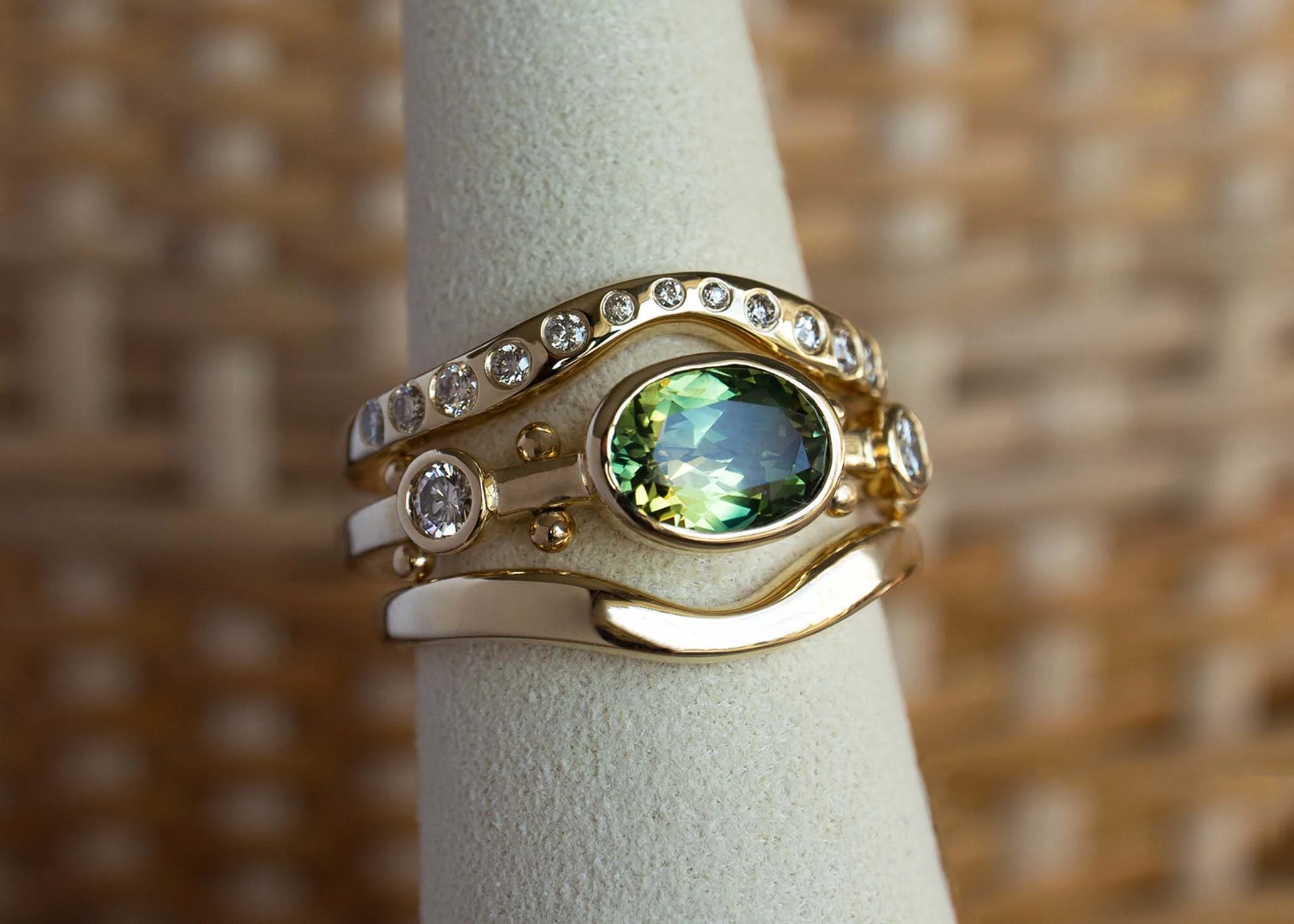
M. Hisae Australian Sapphire and diamond Kaori ring. Photo courtesy of Michelle Nakata-Murray.
CB: What are some of your goals for 2024 (besides settling into your new city, Santa Fe, New Mexico)?
MNM: I’ve always loved mixed metals, so incorporating them is likely on the horizon. I also really want to go bigger in scale. In gold, it’s tough to keep price points in the range I like for my customer, but maybe my mixed metal forays will help me go bigger if I bring silver back into the mix.
I also have a goal of incorporating more semi-precious gemstones into new designs – big, juicy specimens. I work mostly with sapphires and diamonds for durability, but I’m ready to step into more color and variety. I’m really so excited to explore the culture, food, and landscape of our new home in New Mexico; it’s magic. There will be a lot of hiking and camping in 2024.
CB: What is your favorite thing about our responsible gem + jewelry community?
MNM: I love being a part of this community! Everyone is really so supportive and committed to learning and growing and dancing in the nuance of it all. I love that there’s so much potential to create real change, as one person and as a whole. There’s an optimism in this community that isn’t always welcome in other parts of the industry. This shared optimism in creating change, that’s my favorite thing.
CB: Michelle, so great to catch up with you, and thanks for becoming my latest Illuminator!
“We are a small team of passionate jewelry industry professionals and writers. We’d appreciate your support to grow our team and continue to be able to provide the best responsible jewelry content for years to come!”
Editorial Section
What to read next from The Source
Like what you are reading? Please help support our editors and writers today.
Chloe interviewed Jessica Hudson of The Nomad Jeweler on her latest collection that features ASM Colombian gold and Tahitian Kamoka pearls. Read the full article to learn more about Jessica’s story and why she chose to design with traceable artisanal gold and sustainable pearls.