

Marvin Wambua on Gemstone Cutting and Education in Kenya

The content of this article is the opinion of the writer and was written for The Source. *Please Note: Monica Stephenson is the current President of Ethical Metalsmiths.
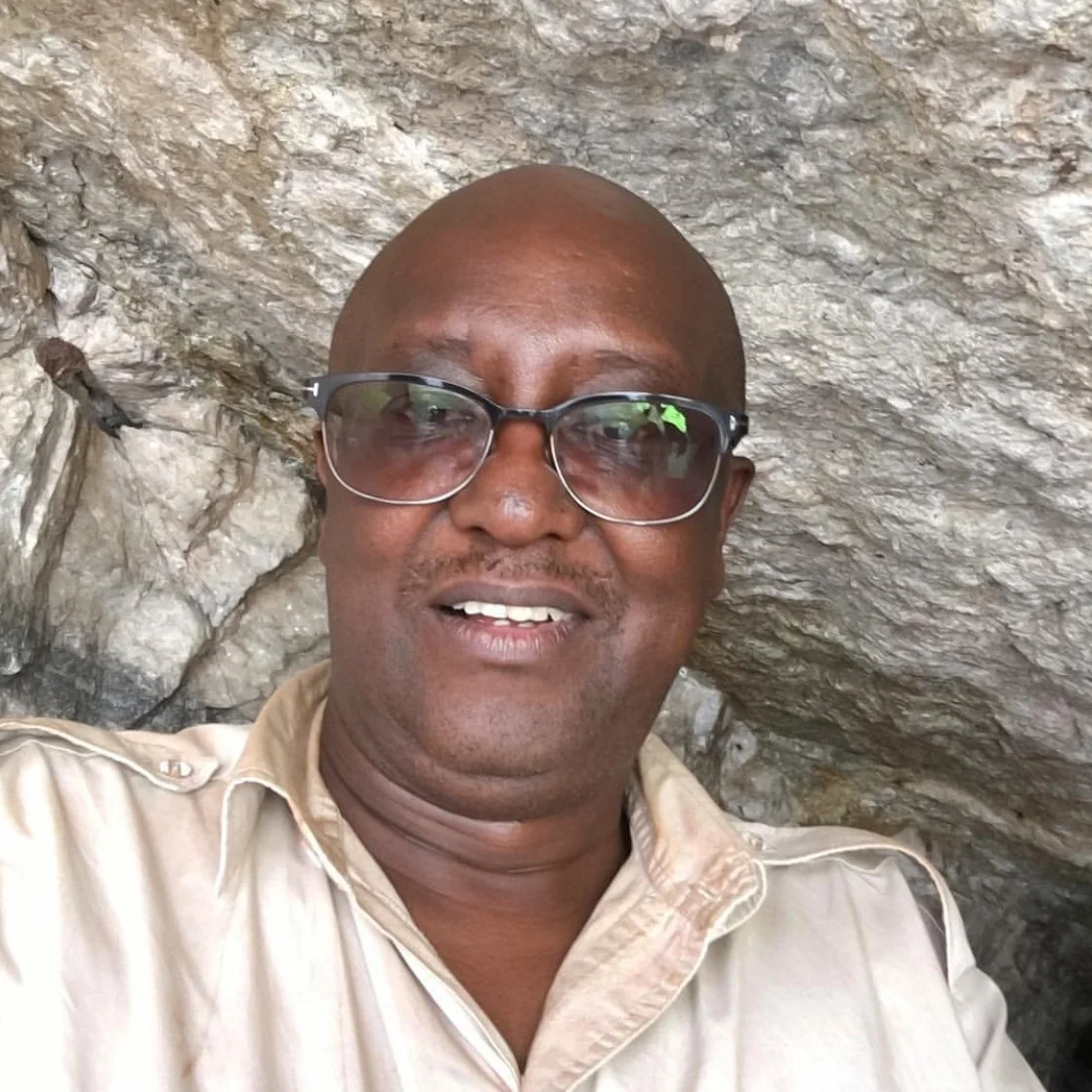
Headshot of Marvin Wambua. Photo courtesy of Marvin Wambua.
Chloe Beaumont: How did you get into the gemstone industry? Could you share a bit of your background?
Marvin Wambua: The way I got into the industry was due to my father, who was trading gemstones, but I didn’t get into gemstones until much later in life. When I was in high school, I used to frequent the city (Nairobi) with my dad, and he would meet with his clients in the big international hotels. That actually inspired me to want to do hotel management. In the late ‘80s, I got an opportunity to study for that in upstate New York at Paul Smith’s College. When I was there, I went into New York City once. At that time, I knew my dad dealt with gemstones, but I didn’t know what they were, really. I ended up on Fifth Avenue looking at windows laced with diamonds and colored stones, and thought, “Oh wow, these are what my dad deals with!” and was intrigued.
Later, when I was living in Maryland, one day my wife got a brochure advertising some class in Bethesda, where a ninety-five year old woman — yes, ninety-five! — named Louise was teaching. I took her class, and one day she noticed my keen interest in gemstones and said, “Marvin, if you are serious about this, you should check out GIA (Gemological Institute of America).”
Once I enrolled in GIA classes, I was hooked. Sometimes, I would get some rough and cut gemstones from my family in Africa to sell. I would get frustrated often because the stones were nice, but not cut well at all. I had three friends who I used to sell rough to who were all cutters — Ginger, Jared, and Judith. One day, when we were at Ginger’s place, she showed me some glass that she had Portuguese cut. For ten minutes, I could not take my eyes off that thing! She told me, “You know, if you put your mind to it, you can do this.”
CB: So you took her advice and went to learn how to cut!
MW: Yes, I started looking for places where I could learn how to facet after that. One day I got a pamphlet advertising cutting classes in Baltimore, about forty-five minutes away from me. I took the class there taught by Steven Weinback, who I’m pretty sure is still faceting, while working towards getting my GG (Graduate Gemologist degree) through distance education with GIA. I took my time with that, but enjoyed it the whole time.
Later on, I moved back to Africa, and now I’m here in Nairobi. I have many friends who come to Kenya and we go visit mines together. I also help run a lot of [educational] trainings with GIA, such as the ones required by the Moyo [Gems] program. On Friday, I went to eastern Kenya, about a two-and-a-half hour drive from Nairobi, for a training. We taught the local miners how to examine rough and what constitutes a good gem.
Most miners here don’t know how to separate what they find into different grade groups. They think when they put everything together, it will all sell. You have to let them know that everybody is looking for something different in the gem industry. We teach them that there are people who are looking for very fine gem quality, and others who buy for cabochons or to make beads. Our class focuses mostly on the 4C’s (Color, Clarity, Carat, and Cut).
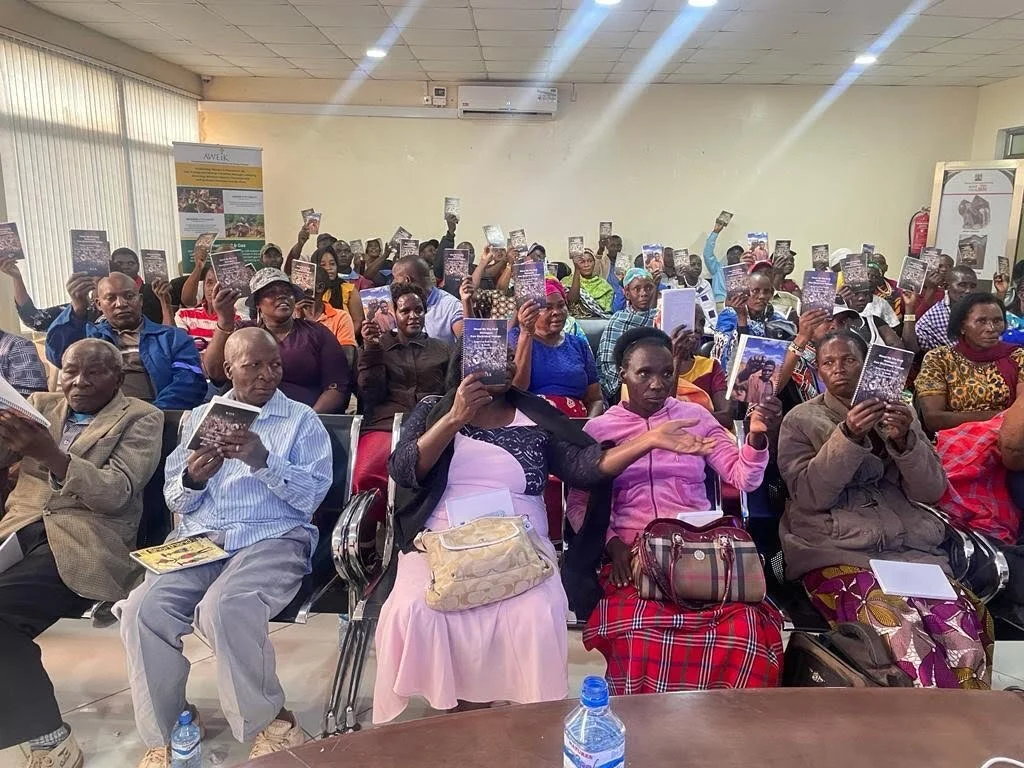
Attendees of a GIA training in Kenya holding their GIA gemstone guidebooks. Photo courtesy of Marvin Wambua.
CB: I’m sure they can do so much with that knowledge after the training, since they know more about what they have. As we saw during the Moyo Gems Kenya Market Days, we still needed to give further feedback, but at least they have that base starting point.
MW: Yes. When we did the most recent GIA training, there was one gentleman who came there with quartz. He contacted me after that, and it just so happened that one of the guys who buys quartz crystals was here in Nairobi. Yesterday, the miner brought his quartz to my office and did business right there. I was so excited! Now, he knows where to sell his material.
It was the quickest [education to business] turnaround from one of these trainings that I’ve ever seen.
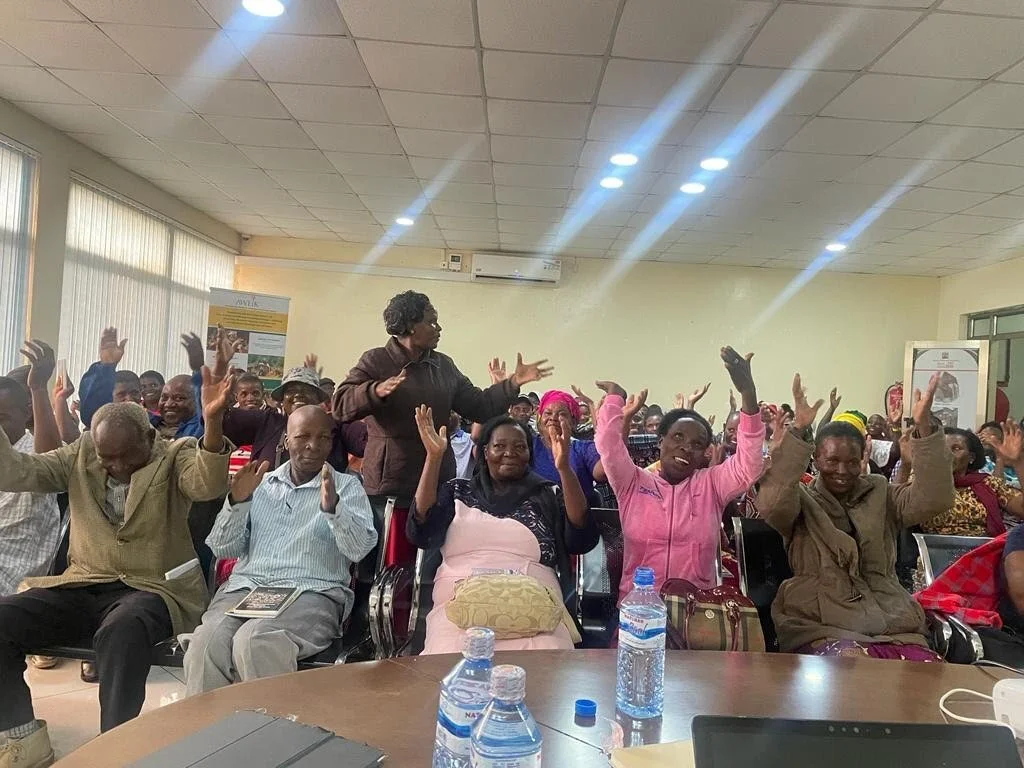
Miners celebrating at a GIA training in Kenya. Photo courtesy of Marvin Wambua.
CB: That’s so great to hear.
MW: Yes, when they did business together, it was really fulfilling for me to see. This guy was just in my class, and here he was selling and exchanging numbers with the buyer. In the future, they’ll do more business together.
CB: What is your favorite part of the cutting process, if you have one?
MW: Wow. Well, I have to admit I don’t like pear cuts — I have someone else do all those for me! For me, the biggest moment is when I get the stone off the dop and do the final polish. When I’m cleaning the stone after the last stage to see how it came out, it’s a magical moment.
You get a piece of rough and try to imagine how it will come out when cut, but you can’t fully know until you go through the whole process. Some stones can surprise me. Every time, when I finish a stone, it’s always that “Wow” moment. “Did I really just do this?”
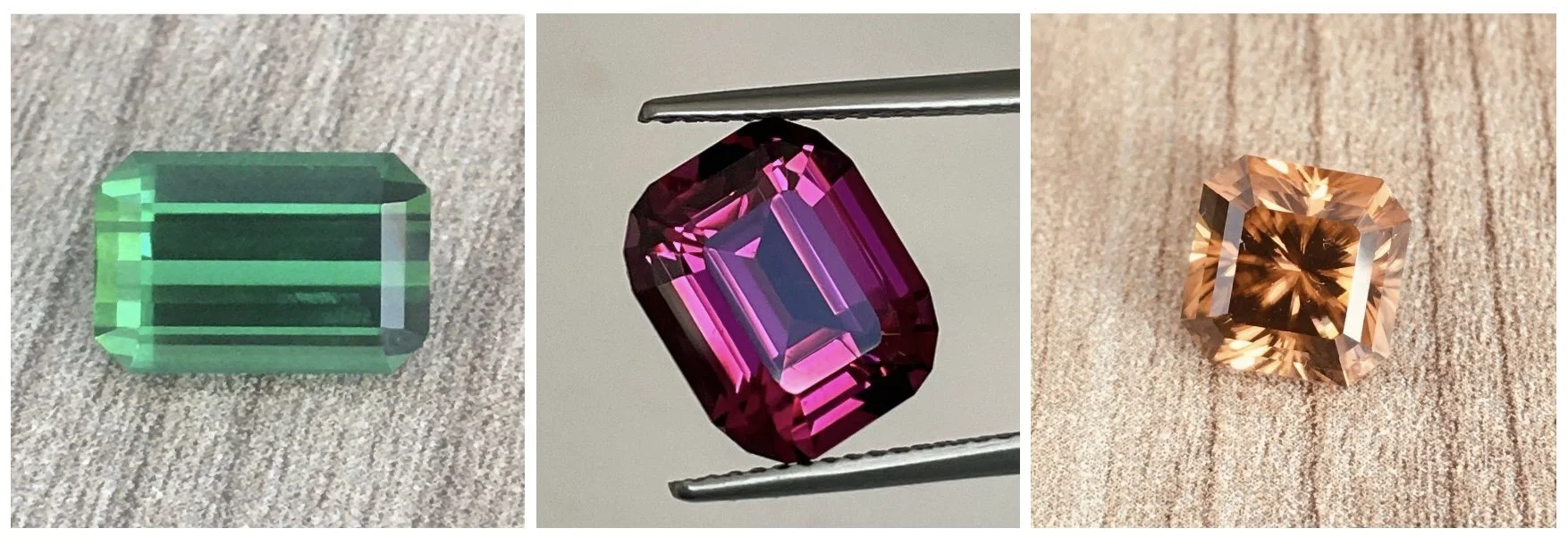
Congo tourmaline, Malawi Rhodolite garnet, and Tanzanian Zircon cut by Marvin Wambua. Photo courtesy of Marvin Wambua.
CB: How long does it usually take you to cut one stone?
MW: It depends on what I’m cutting. If it’s a round brilliant, it takes a very short time. Other stones have many facets, and take several hours to do just the pavilion. For simpler stones, it usually takes an hour to cut the pavilion and another hour to do the crown.
CB: I can guarantee that most people do not have any idea how much time and skill it takes to transform these rough stones into the final beautiful gems. Cutting is in another world, to most people!
MW: You know it’s funny, I didn’t originally picture myself as a cutter. I always thought I would be the guy going around selling gemstones from his suitcase and making big money! That was the “in” thing back then. There were not a lot of cutters in America, but then the industry started changing. But when they first started, these stones were just awfully cut. Now, everyone wants well-cut stones across the board; no windows, no bowties, no nothing.
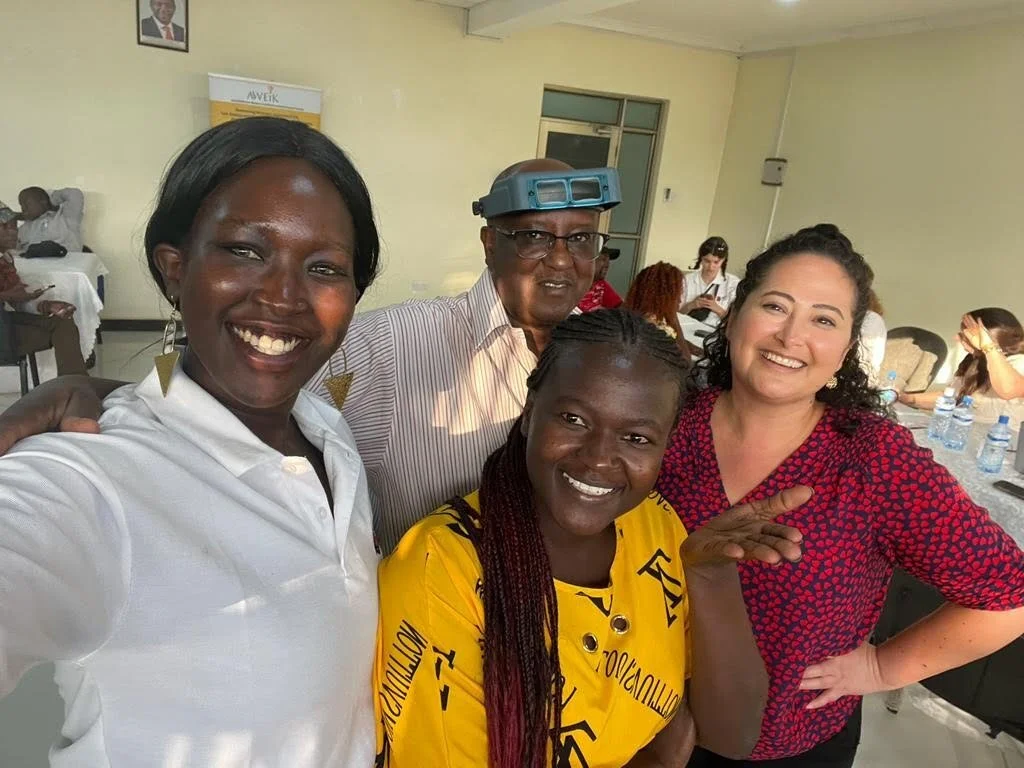
Michelle, Marvin, Maureen, and Cristina at Kenya Market Days in Voi. Photo courtesy of Marvin Wambua.
CB: Last time when I was in Kenya, you were thinking about hiring an emerging woman cutter. Do you have an update on her situation?
MW: Yes, we have good news: I just got her a job with a big dealer in Nairobi who needed somebody immediately. Gladyss is going to be driven to Nairobi this week. The owner needed someone to help with polishing, so we thought it would be a good first step for her.
CB: Perfect. Where did she begin learning?
MW: So Gladyss actually grew up in the Mwatate Children’s Home. Carol, a gemologist and gem cutter, has collaborated with a German lady who bought a brand new cutting machine and has helped train mostly women to be cutters. Gladyss was the one who caught on the fastest and started cutting right away. She goes to the Voi Gem Center every day, even though she’s not getting paid, just so she can continue her practice.
CB: With that kind of work ethic, I’m sure she will be successful.
MW: Yes, I think so — our hope is for her to grow to be an independent cutter. In Kenya, there is a real shortage of cutters.
CB: Would you say that is the biggest need of the industry in Kenya?
MW: Well, yes, but some things need to change in order for that to happen. Most people prefer to sell rough, because it’s so much cheaper to get into.
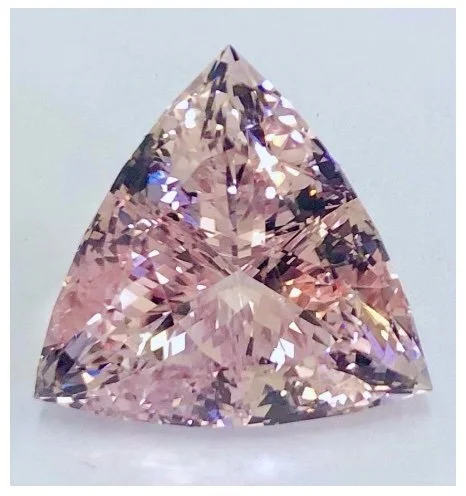
Ethiopian Morganite Trillion cut by Marvin Wambua. Photo courtesy of Marvin Wambua.
CB: Plus the time it takes to learn to cut well. However, more Kenyan cutters is definitely what we want to see, because then more stones can be cut locally and more of the value of these stones can be kept in the country.
MW: Exactly. That is what we encourage as well when we host these trainings.
CB: It was so great to be able to get your advice at the buying table for Moyo Gems Market Days, when we weren’t 100% sure if a certain piece of rough would be OK to cut. What did you like most about getting to be there?
MW: This was my first time at a Market Day [buying on behalf of gem trader Emmanual Piat of Maison Piat]. When we originally started training in the Tanga region, Robert [Weldon] and I were having the miners tell us, “Okay this is great but we don’t know where to sell our gemstones.”
Monica Stephenson knew who Robert was and vice versa, and I encouraged them to meet up. I think that’s part of how Moyo Gems was born. GIA was there for a purely educational purpose — we needed buyers. One day we were driving from Arusha to Tanga and I remember getting excited and telling Robert, “I think I have a solution for our women [miners] in Tanga. Why don’t we introduce them to Monica and Roger [Dery], who are already coming to Kenya and Tanzania?
At the Tucson show that year, they met and the rest is history.
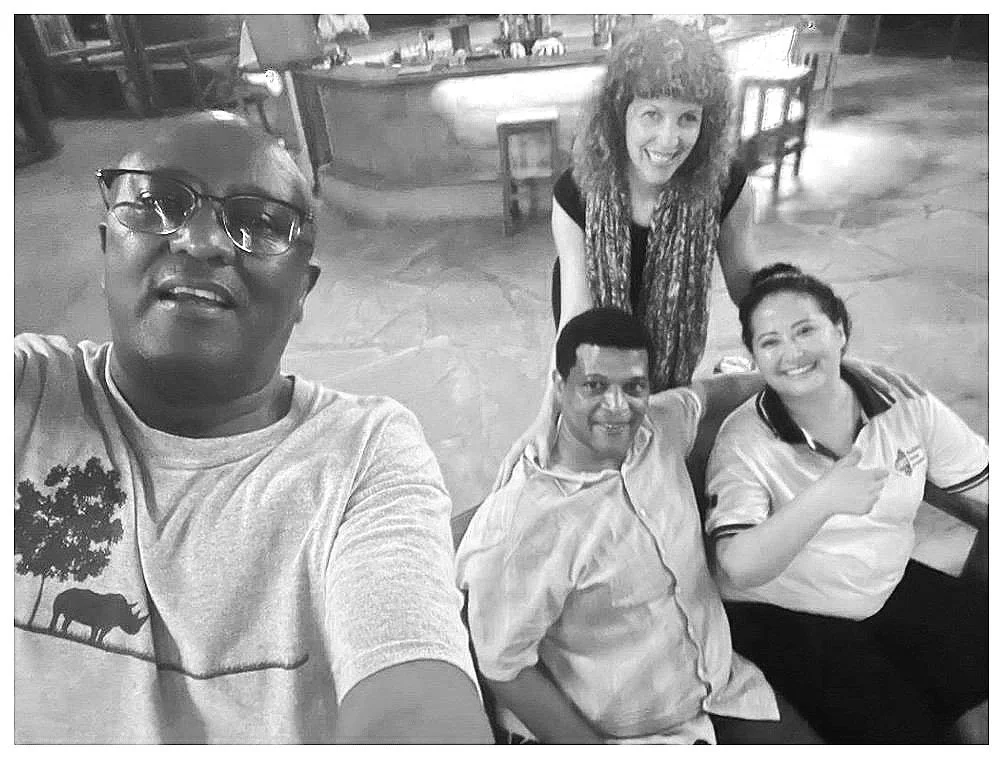
Marvin, Monica Stephenson, Norbert Massay, and Cristina Villegas. Photo courtesy of Marvin Wambua.
CB: I love that you got to come to Market Days finally and get to see how far everything has come. Marvin, thank you so much for the updates and for sharing more of your jewelry journey with us!
Comments Made Prior to 09/22
Davie Kavala 2 weeks ago · 0 Likes
So inspiring... How can I contact you? I am from Malawi +265888228535 whatsapp
Editor In Chief 2 weeks ago · 0 Likes
Thank you Davie!
Are you trying to contact me, (Chloe) or Marvin?
Editorial Section
What to read next from The Source

What do beekeeping and fish ponds have to do with diamond mining?