

Sourcing Responsibly: Alrosa, the KP, and the RJC


The Source has decided to repost this piece because we highly value discussion around the subject of what it means to truly be responsible, in both words and actions. Note: This article reflects the opinions of Kyle Abram and Marc Choyt of Reflective Jewelry, and do not necessarily represent the opinions of the EM Board.
Section author Kyle and Marc Choyt co-authored our latest post (which will also be published in Jewellery Business) to address how three major players in the jewelry industry have conducted themselves alongside an ever growing push for “responsibility.” This is definitely a “don’t-miss” article, especially as the Ukraine-Russia war has prompted renewed focus on the diamond industry.

Chloe Beaumont, Editor-in-Chief of The Source
Alrosa, the KP, and the RJC
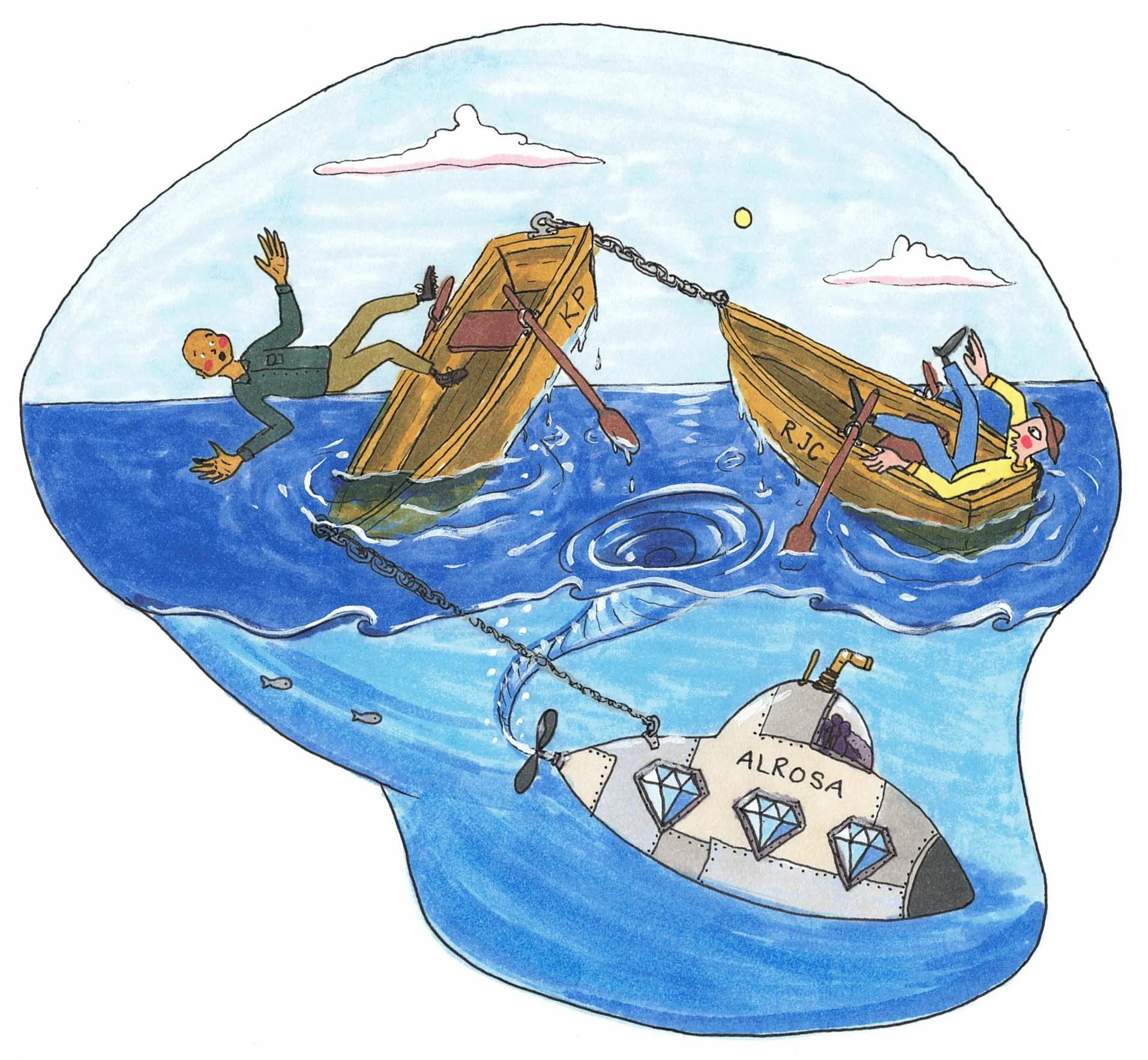
Earlier in 2022, the Russian invasion of Ukraine threatened to pull under both the Kimberley Process and the Responsible Jewelry Council. Illustration by Alyssa Lown.
In 2004, the Russian submarine B-871 was christened the “Alrosa” — aka, “The Diamond Submarine.” The Russian Navy was honoring the diamond mining company by the same name for its years of financial support. Alrosa (the company) provides about 30% of the global diamond supply. It’s 1/3 state-owned, and generated $943 million in net profit in 2021. Alrosa is also a poster child of “responsibility” and patriotic support for the Russian Federation.
In 2016, two years after the Alrosa (the submarine) supported Russian forces in the annexation of Crimea, Alrosa (the diamond mining company) became a certified member of the Responsible Jewelry Council (RJC). The RJC’s Code of Practices covers “…not only standard finance and legal compliance issues, but also ethical business practices, such as anti-corruption, human rights, decent labor conditions, social responsibility programs and protections of the environment.”
Alrosa sat as vice chair of the RJC from 2018 to 2022. Alrosa’s CEO, Sergei Ivanov, is the son of a former Russian Minister of Defense and Chief of Staff, and was one of the first batch of oligarchs targeted in sanctions by the Biden administration in 2022.
Alrosa maintained its RJC certification even as the company failed to respond to a July 2021 tailings spill at the Catoca mine in Angola, of which it owns 41%. The spill devastated aquatic life, killed twelve people, and made thousands sick in both Angola and the Democratic Republic of Congo.
In early March of this year, after facing industry-wide backlash due to Russia’s invasion of Ukraine, Alrosa voluntarily abdicated its position as vice chair of the RJC. A month later, the company again voluntarily suspended its membership to the RJC.
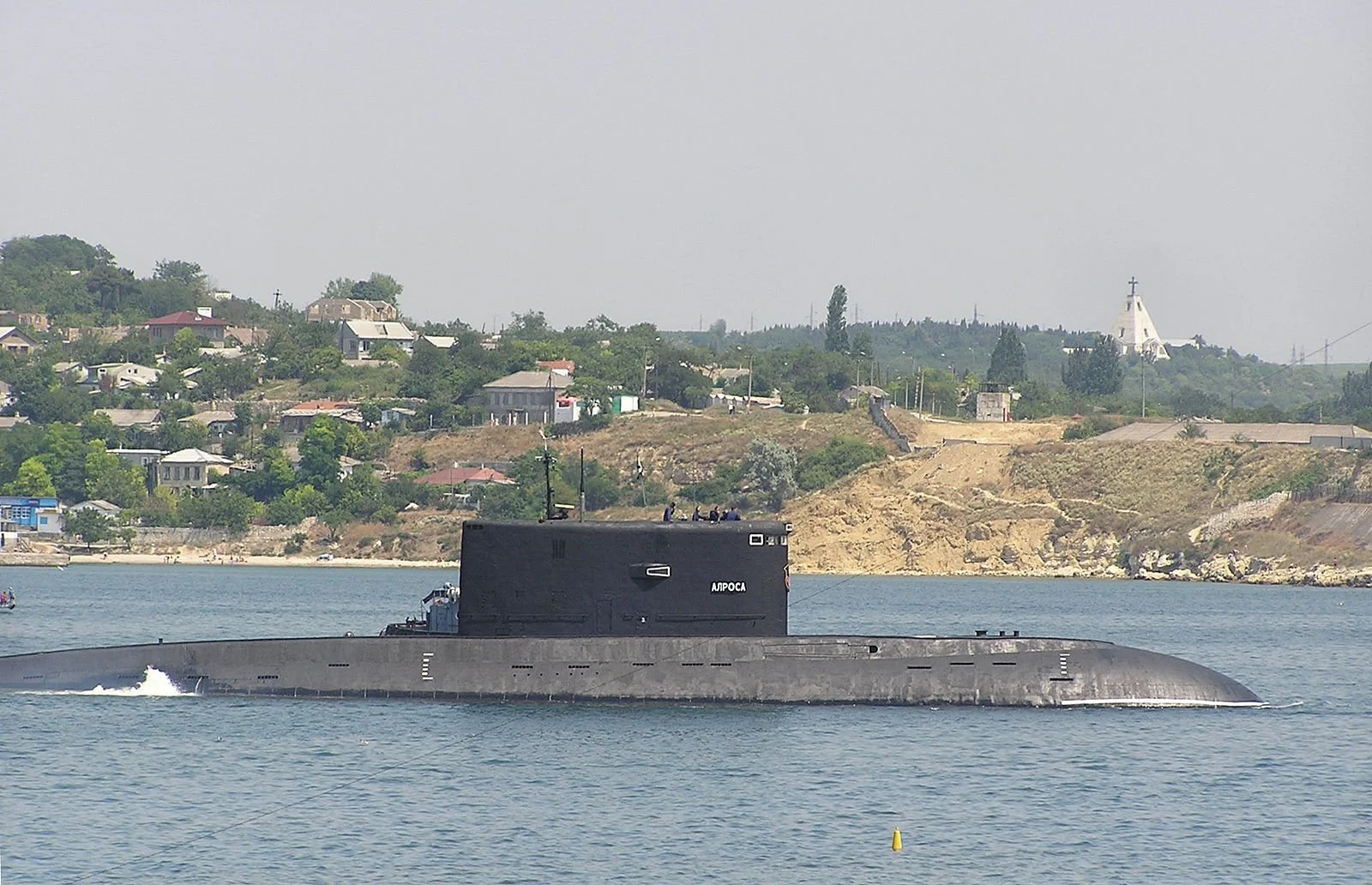
Caption: Russian submarine B-871, aka the “Alrosa.” Photo from Wikimedia Commons.
The RJC subsequently issued a statement on Alrosa's departure, which describes a "comprehensive, third-party legal review to ensure [the RJC] had the appropriate authority, within its constitutional documents, to take action,” and asserts that "Taking any action prior to the delivery of the legal opinion would have exposed the RJC to significant legal risk.”
The RJC’s position, thus, is that it did not know whether it had the legal authority to suspend or remove Alrosa's membership — which implies it had never previously considered suspending or removing any participant's membership in its 17-year history.
At the conclusion of this statement, Chair David Bouffard re-asserts that the RJC’s mission is "...to ensure all jewelry is responsibly sourced.” Of course, he’s 100% right. But the question is, who precisely is the RJC “responsible” to?
The RJC functions as both a trade association and certification agency. It would seem its “responsibility” is to the business interests and shareholders of their membership, including Alrosa, which also extracts uranium for Russia’s nuclear weapons program.
“Responsible” Sourcing
The historical context of the term “responsibility” as it pertains to jewelry sourcing can be traced back, at least partially, to the diamond industry’s response to blood diamonds.
In the 1980s and ‘90s, De Beers Diamonds was attempting to maintain their near-monopoly of the global diamond supply chain by buying up rough diamonds from any and all sources that came to market both in Africa and around the world. In this same approximate timeframe, Amnesty International reported that 3.7 million people died in wars funded at least in part by these diamonds.
A 2000 article in the New York Times, "Controversy Over Diamonds Made Into A Virtue by De Beers," outlined what has since become a blueprint for “responsible” sourcing: De Beers began “promoting itself as the squeaky-clean crusader for guarantees across the industry that ‘conflict diamonds’ — as they are also called — be kept out of the world of luxury goods.”
By linking their diamonds back to large-scale mines under their control, De Beers (and later, other mining companies) was able to brand itself as a crusader of “responsible” practices under the banner of traceability and transparency in a contained supply chain. Pragmatically, this birthed a new model of “responsibility” that bypassed exploited and impoverished small-scale diamond miners at the root of the troublesome "blood diamond” sourcing.
By 2009, small-scale diamond mining again became an issue, this time centered on the Marange diamond fields of Zimbabwe. The documented rape and murder resulted in Global Witness and other framers of the Kimberley Process (KP), including Ian Smillie, resigning from the scheme. But with no objection from the RJC, the industry scrambled to certify those diamonds as “conflict free” under the KP umbrella.
Until Alrosa, the blood diamond issue was never applicable to large-scale diamond mining. And how this situation ultimately plays out remains to be seen. But Kimberley Process certification, which requires consensus to pass any measure (and which does not apply to cut diamonds), is structured to maintain the status quo. And despite repeated calls from the Kimberley Process Civil Society Coalition, itself a part of the scheme, no action has yet been taken.
After all, the KP is still performing its main “responsibility” perfectly well. (That is: maintaining consumer confidence.) Jewelers know its effectiveness is rarely questioned by a customer — and the term “conflict free diamond” remains a nearly flawless marketing narrative.
And on another front: in the USA, despite President Biden’s 2022 sanctions, loopholes the size of cutting centers in India and Belgium mean it is still perfectly legal to buy and sell diamonds from Alrosa.
Sadly, this inaction from the industry on seemingly every front is by no means out of the norm.
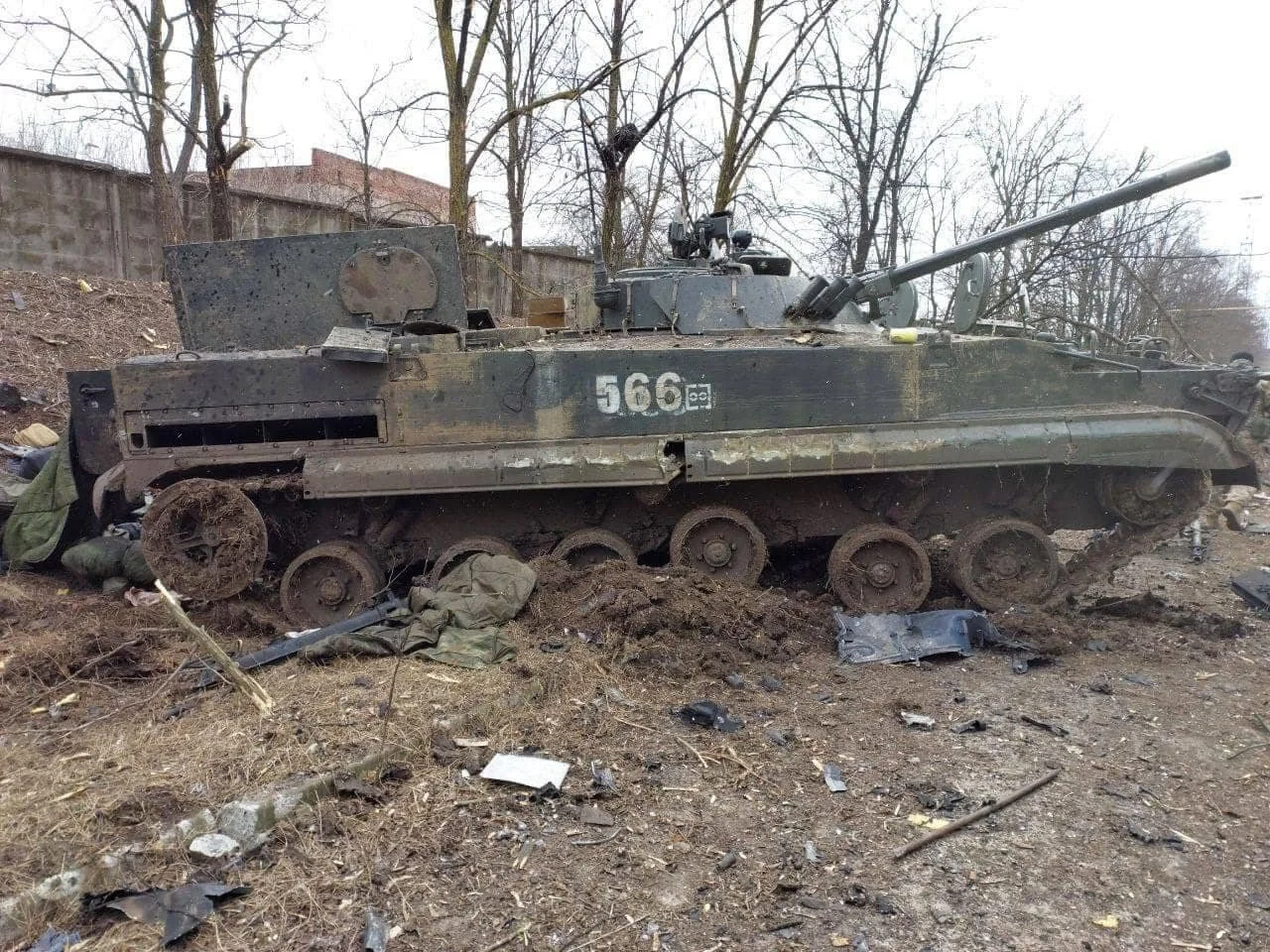
Caption: A Russian tank destroyed by Ukrainian troops in Mariupol. Photo from Wikimedia Commons.
The Morality of “Responsibility”
For Gen Z consumers — who represent the near-future of diamond purchases — it’s nearly impossible to discern how to buy an engagement ring that closes the gap between sourcing and symbolism.
With Reflective Jewelry representing one of a few small companies that pioneered the North American ethical jewelry movement since 2005, it’s been amazing to watch ethical sourcing become a hot trend with real consumer support. But, it’s tiring to still not see any significant change in the supply chain.
In large part, the jewelry industry seems confident in its abilities to hold the wool over the public’s eyes. Whether this be through the “conflict free” diamond narrative, the false arguments swirling around “ethical recycled gold” (e.g. claims that recycled gold reduces current mining, or is the sole ethical solution), or fabricated and vague claims of “commitment.” Like the RJC, these narratives and claims are responsible in the sense that they protect business interests. But this kind of “responsibility” has no bearing on the morality the word often implies.
Like the term “conflict free,” the term “responsibility” is ambiguous.
Morality in our industry would involve truth and reconciliation. Restitution. Bringing together the executives responsible for purchasing blood diamonds with the victims who go about their lives with one arm. A new narrative does not mean wrongs have been righted.
The KP bypassed the critical foundation of truth, reconciliation, and restitution in favor of moving forward; and today’s “responsible practices” are the strange fruit borne as consequence. We live in an age of deep interconnection with unfolding paradoxical relationships. Our industry is full of “responsibility,” but lacks a grounded coherent morality rooted in our common humanity.
At the time of publication, The Warzone reports on the modernization of B-871. Perhaps today, as you read this, the brave and ‘responsible’ sailors in the Alrosa are lurking in the Black Sea, gearing up to join the war against Ukraine now equipped with the 3M-14 Kalibr subsonic cruise missiles with a range of 1500 km. The funding for the warheads (weighing 450 kg) was, in part, from the engagement ring purchases of tens of thousands of North Americans.
In the words of a Ukrainian diplomat, “Russian diamonds sponsor killings.”
Comments Made Prior to 09/2022:
Susan Crow: Well written Kyle – Your article explains the circularity of the money behind Russian diamonds and their invasions on many levels.Russian diamonds don’t have to be mined in Russia to qualify as Russian diamonds/blood diamonds.
Thank you for including the devastating 2021 Russian owned Catoca Mine spill in Angola that flowed into the DRC and eventually into the Congo River Basin, the 2nd largest River Basin in the world next to the Amazon.Where are those people now? How has the chemicals they were poisoned with affected them? If you google Catoca Mine spill, there are no current news articles, even though this was one of the worst mine spills in the world. We move on to the next catastrophe.
Kyle Abram 6 days ago · 0 Likes
Thank you, Susan! You ask important questions that I fear we'll never have answers to.



.jpg)
Something we rarely talk about to the extent that it is almost taboo is what happens with a break-in, burglary or even a hold-up: How do we deal with the aftermath?