

Brad Brooks-Rubin on the Kimberley Process and Sustainable Development

The content of this article is the opinion of the writer and was written for The Source.The following conversation has been edited for content and clarity.
Does the Kimberley Process Work at All?
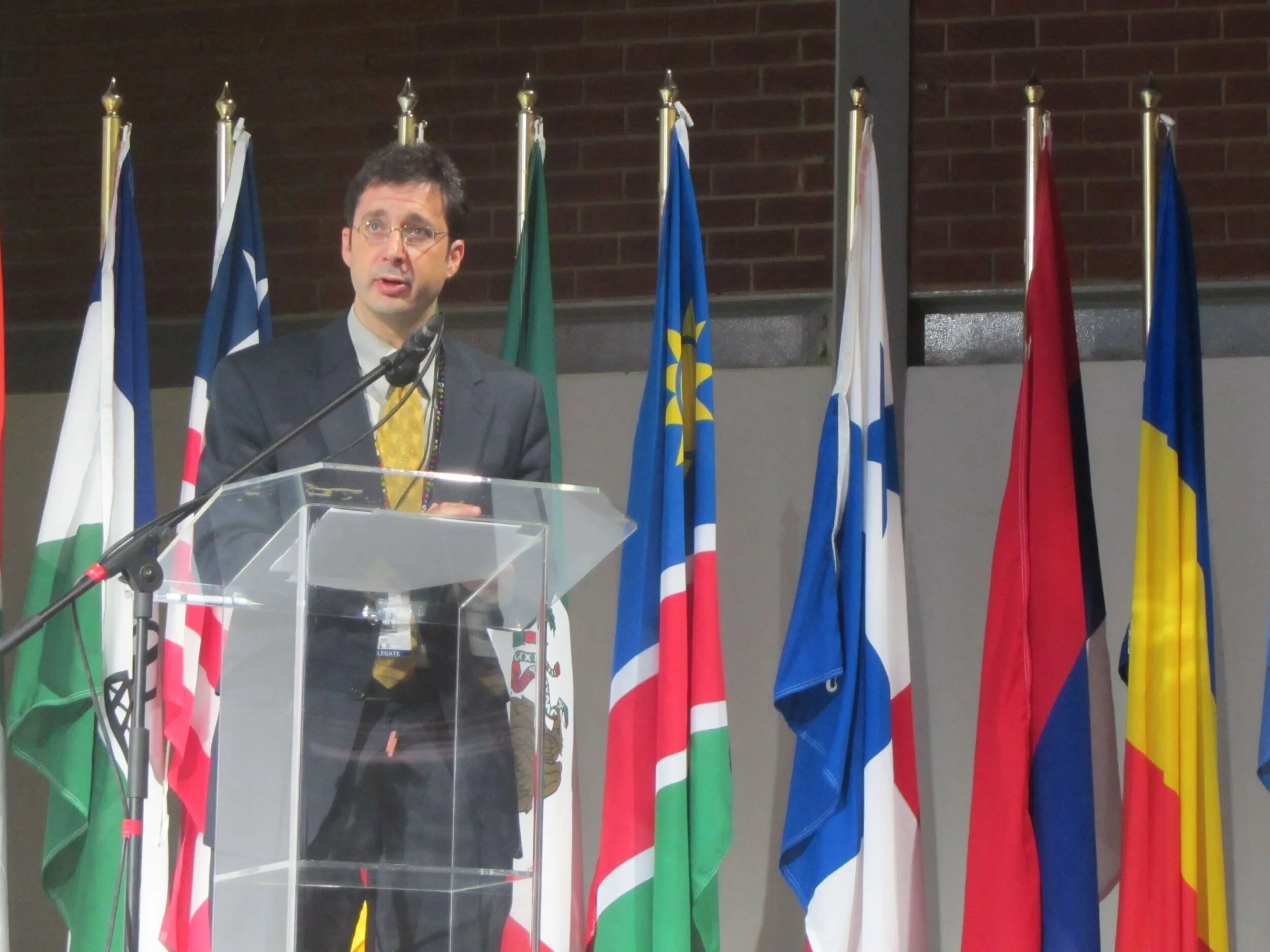
Brad Brooks-Rubin representing the United States at the 2013 Kimberley Process Intercessional 2013 meeting.
Brad Brooks-Rubin is currently General Counsel at The Sentry (@TheSentry_Org), an investigative and policy team that follows the dirty money connected to African war criminals and transnational war profiteers and seeks to shut those benefiting from violence out of the international financial system. He formerly worked for GIA as their first Director of Global Development and Beneficiation, as well as for the US Department of State as the Special Advisor for Conflict Diamonds. Brad has also been an attorney at two law firms and is a graduate of Washington University in St. Louis and Georgetown University Law Center.
Chloe Beaumont: First off, I’m very curious to hear: how did you transition from practicing law to representing the United States in the Kimberley Process (KP)?
Brad Brooks-Rubin: Yes, so after graduating from law school, I worked at a law firm for about 6 years, and then I started working for the Treasury Department in the Office for Foreign Assets Control, which is the agency that administers economic sanctions programs. When I got there, my personal background was a specialty in the Middle East; I had done a lot of work on Israel and Palestine, as well as having studied the Middle East in college.
In classic US government fashion, when they asked me what I was interested in, I said, “Well, I’m really interested in the Middle East” and they said, “Great, you’re going to work on Africa.” It turned out to be fortuitous for me, though.
I started out working on various sanctions programs towards Sub-Saharan Africa, including Sudan and Liberia, which had a diamond component. I also worked on the Democratic Republic of Congo, which involved gold and various militias. The Treasury Department administers a small component of US implementation of the Kimberley Process. I started going to the inter-agency meetings because nobody else at Treasury cared about it that much. Conflict diamonds were sort of a forgotten issue; the Blood Diamond movie had come and gone, and so the issue had sort of come and gone in people’s minds, too.
When the person who had the job of representing the US in the KP was due to leave, they were having trouble finding a replacement. They asked me if I would make the switch from Treasury to State to fill the position. At the time, my wife was working at the State Department on refugee issues, and my kids were at the State Department daycare, so it was kind of perfect. Not only that, but I truly did find it very interesting, and it became my first opportunity to work in a non-legal setting. Out of all the jobs I’ve had, that time at the State Department for me was the one I enjoyed the most.
CB: That’s awesome that you were able to do that.
BB-R: Yeah, all the training on wordsmithing and negotiating really paid off!
CB: I don’t know if you heard much about it, but I wanted to bring up the latest KP meeting. I don’t know every single detail about it, but from what I have read and heard, it seemed like a complete disaster, with China even leaving the meeting at one point. At EM we are always talking about how the term “conflict-free” has become meaningless and how the Kimberley Process desperately needs reform. Many of us were disappointed to see that several countries are balking at any sort of reform or broadening the definition of “conflict-free” and honestly don’t even want to be a part of this KP process anymore. What are your thoughts on this---is there hope for the KP to be reformed? Is there even a point to having it anymore?
BB-R: I’ve been arguing for the past few years that it’s time for the KP to be shut down. My reasoning is not really because there’s absolutely no hope for reform. Although when the US was Chair of the KP in 2012, we tabled the proposal to change the definition, and here we are 9 years later and they are not much further along.
My feeling is that the KP has been proven ineffective at doing the one job it was created to do. It’s been 8 years since the KP declared that there were conflict diamonds coming from the Central African Republic, and they have not been stopped. Tens of millions of dollars are spent every year by governments trying to implement this failed system.
The fundamental problem with it is that it is rooted in a model that has failed. Stone by stone or parcel by parcel certification just doesn’t work. When you look around at other systems that are being implemented to stop one problem or another, they are all due diligence systems, not product-by-product certification systems. It made sense 20 years ago---that was the only system around so they went with it. Also, the definition of “conflict free” made sense back then because that was the biggest problem they were fighting. I understand why it happened, but at this point we have better models.
To your previous point, yes, there are several countries that have no vested interests in seeing the KP reform or broaden. I mean, the fact that Russia was Chair this year is a joke. You might say it’s not a joke because they are one of the biggest producers of diamonds—but I would say it’s at least inappropriate that they are Chair. Russian oligarchs and their proxies are responsible for atrocities in the Central African Republic and have even gone on the record saying that the KP should just stop trying to prevent conflict diamonds from getting out of the country.
It is disappointing to hear that’s how this latest KP Intersessional meeting went---at least it was on Zoom so they weren’t wasting millions of dollars on travel just to yell at each other!
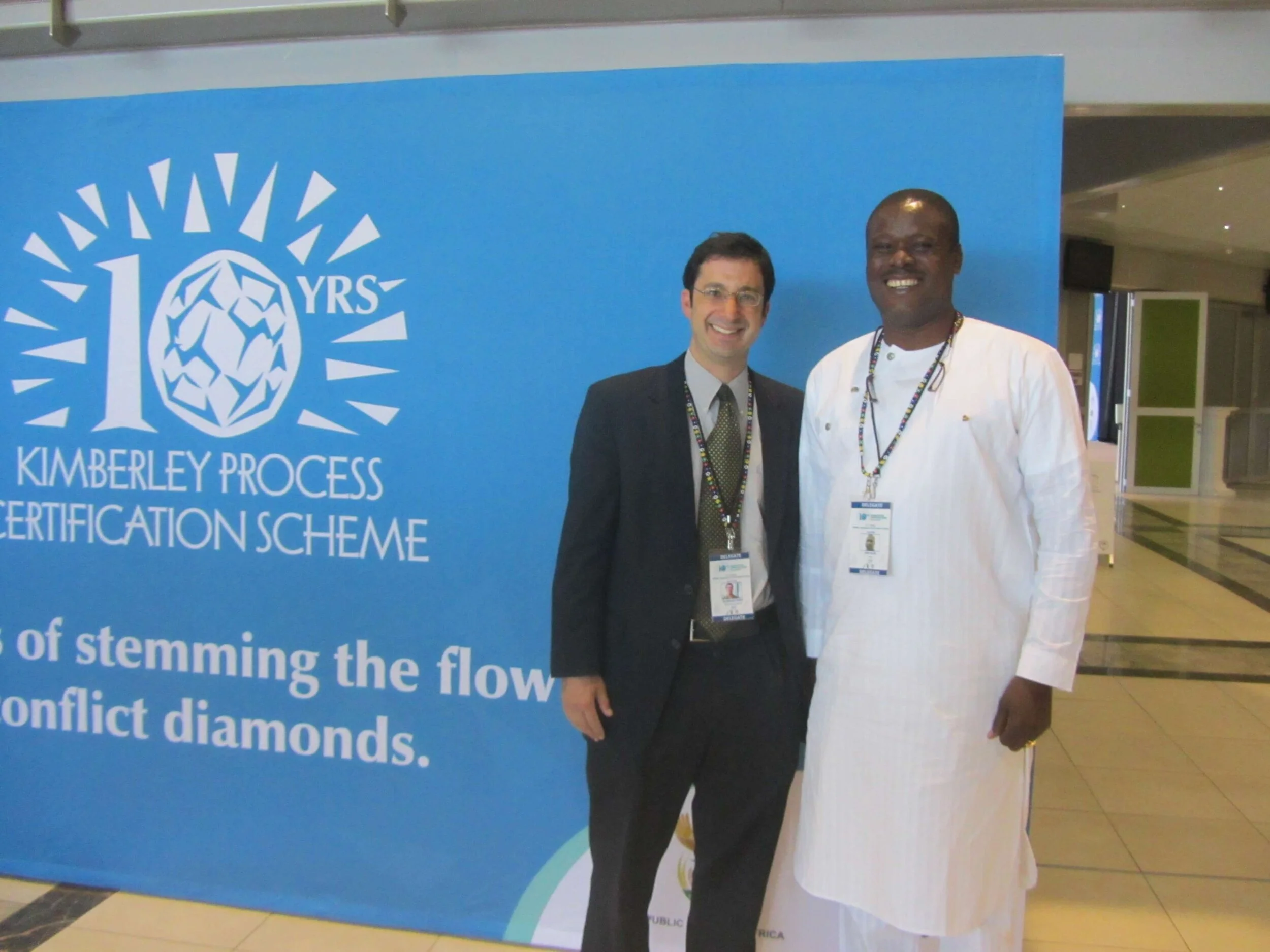
Brad Brooks-Rubin and Seth Klaye, the KP representative from Ghana in 2013. Photo courtesy of Brad Brooks-Rubin.
CB: Exactly! Do you think the KP was ever a strong process or has it always had tons of loopholes?
BB-R: Yes, I do think it was once strong. If you look at the first five to six years, it suspended Congo-Brazzaville for failing to have a sufficient system. It started to devolve with Venezuela around 2008. The Zimbabwe example went in a lot of different directions, but I’d say we did a pretty good job of negotiating around Zimbabwe in 2009. You had representatives from many countries who were serious about the KP and really cared about it. Once those people started rotating off, the new batch of people that came in cared a little less about it and had different agendas. The KP doesn’t have any institutional fortitude because of the lack of a secretariat, so it’s easy for it to weaken.
Early on, there were surely complaints. You can find Global Witness reports in 2006 and 2007 saying the system was pretty weak. But for the time, it was still remarkable what they were able to do. It just didn’t keep up the good work, and the politics of East vs West and North vs South have divided it.
CB: We truly have such a global supply chain in the diamond industry, so I can imagine it would be hard to be dealing with that many different countries with so many different interests. Yet, we have a responsibility to have due diligence like you mentioned previously. It’s amazing to me how there is so much misinformation surrounding the term “conflict-free;” I’ve seen one prominent jeweler declare on their website that “Conflict diamonds basically don’t exist anymore because the KP covers 99.9% of diamonds.” It’s so confusing to consumers, because it makes it seem like there are no more problems whatsoever surrounding diamond mining!
BB-R: Right. I mean, the thing is, statistically that is correct. But, like you said, it’s not a broad enough definition of “conflict.” It’s a sly trick that a lot of the industry promotes. If you define conflict in this extremely narrow manner, then sure, we are doing a great job. You are called Ethical Metalsmiths, not Conflict Free Metalsmiths for a reason.
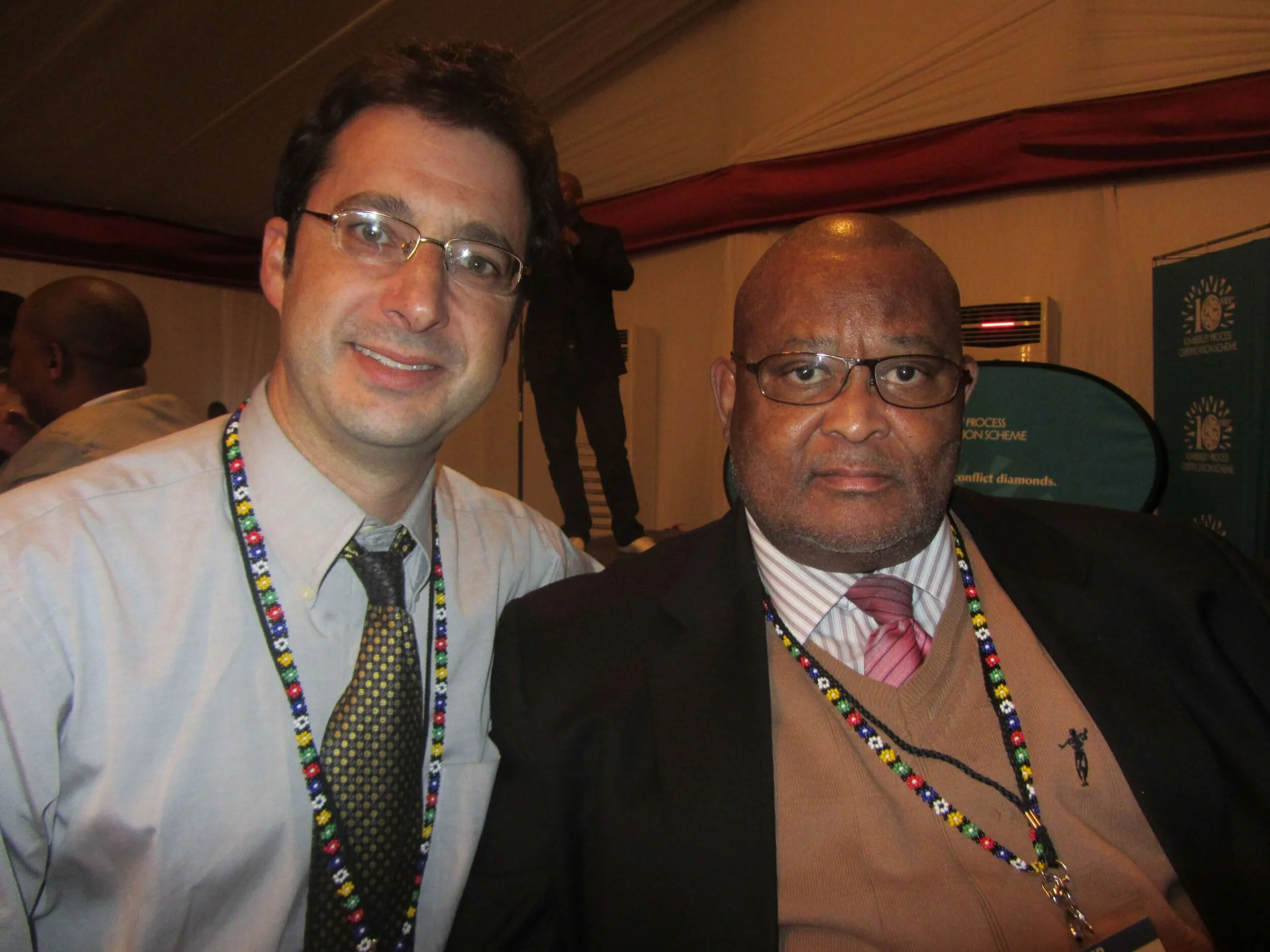
Brad Brooks-Rubin and Welile Nhlapo, the KP chairman from South Africa in 2013. Photo courtesy of Brad Brooks-Rubin.
CB: I think a lot of times for people in the US and rich Western countries, we feel so far removed from countries in Africa where there are conflicts and problems around diamond and gold sourcing occurring. What are some of the main conflicts that you were fighting then and are currently fighting now.
BB-R: The main offender right now is the Central African Republic, even before the coup in 2013, there were ongoing concerns about militias being involved in the diamond trade. It’s a country we are focusing a lot on at The Sentry right now. We actually just collaborated with CNN and did a report on the Wagner Group, which is a company of mercenaries connected to a Russian oligarch who is quite close to Putin. It’s sad, but I always say that if it weren’t for the name, nobody would know where this country is, that’s how obscure it seems to most Americans. On the flip side, the US has actually had successful development programs there; I was able to visit the country in 2011 and they really were promoting sustainable development. It’s almost all been pushed aside by the conflict now.
As I’m sure you know, gold is still a major driver of conflict in Eastern Congo. Zimbabwe doesn’t have conflict in the same way, there aren’t anti-government militias, but the Marange diamond fields are something to keep an eye on mostly because of the broader epidemic of corruption in Zimbabwe.
And then there’s Venezuela, which although it is a small producer of diamonds, has not even pretended to care about putting controls in place. The situation has been very concerning for several years---especially regarding illicit gold coming out of the country.
The last thing I’ll say in terms of places to follow is that you’ve also got to be aware of centers like Dubai, which is where most illicit gold and diamonds head before they go to India or Europe. When the KP was formed, the UAE wasn’t a member because it wasn’t a major trading center back then like it has been since around 2005. There was a huge amount of investment from the government in this sector, and a big reason why it became so popular among other countries is because they knew Dubai would trade with anybody. They do have a code of conduct for their gold trade, on paper, but recently the LBMA have raised concerns and threatened to cut off trade from Dubai.
CB: At the Source we’ve done previous articles (See Christina’s article here) on recycled gold and how Dubai basically accepts dirty gold, fashions it into something that looks like jewelry, and then ships it out to other countries and refineries can then claim it’s “Recycled Gold” when it’s just dirty gold in another form.
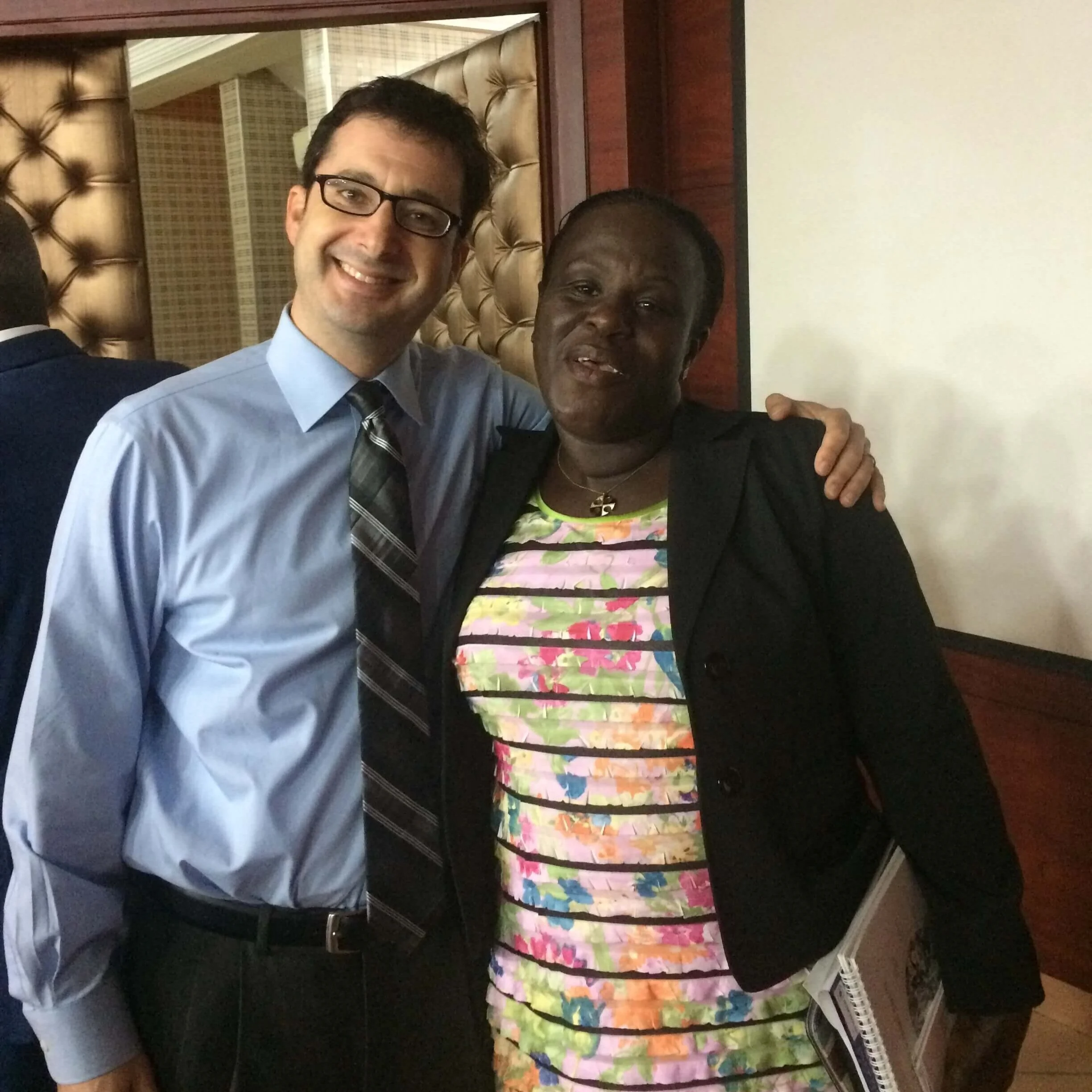
Brad Brooks-Rubin and Madame Fatoumata Thes at a KP-focused workshop in Cote d’Ivoire. Photo courtesy of Brad Brooks-Rubin.
BB-R: That’s exactly like what has happened with the KP and diamonds because the KP allows for “Mixed Origin” stones. What has happened historically is that parcels, say from South Africa, will show up in Dubai. Then Dubai receives some diamonds from Zimbabwe, and they can mix those stones in the parcel from South Africa and write on the certificate “Mixed Origin” before sending them to India to be cut. It’s not exactly the same as the recycled gold dilemma where once the gold is melted you have zero way of determining origin, but unless someone is checking every single diamond in that parcel, conflict diamonds can end up on the market.
There are some cases of enforcement; in 2012 we had someone from the Revenue Division of India come to the US and do a presentation at the KP meeting about how this was happening. The Indian KP representatives were furious because we kind of set this up without them knowing---sure enough, that guy was never to be seen at another meeting again. There just isn’t enough enforcement or investment in the auditing companies that would be taking a look at these diamond companies.
To be fair, I don’t think it’s most diamond companies that are involved in schemes like this, but it only takes a few bad actors. Companies like DeBeers can afford to pour tons of money into positive initiatives like GemFair and they aren’t yet getting the ROI that they would normally expect from other business ventures; but they are sticking with it. With colored gemstones there usually isn’t the level of production consistency that would make such ventures economically viable.
My view has always been this (which some people might disagree with): Pick one thing and do it well. If you’re a jewelry designer and you want to focus on net-zero carbon emission producing jewelry, and you’re not as certain about the human rights conditions surrounding your gemstones, be honest about it. Tell people, “We are focusing on climate because we think it’s the most important issue and we can show you the science behind it.”
Similarly, if there are companies that are focused on ensuring that their stones and gold are forced labor, child labor, human trafficking free, but they spend a lot of money importing them so they are not net-zero, then they should be honest about that.
Consumers are learning more and more, yet they prioritize different issues, which I think is okay. I would love to see more brands that are honest and transparent about what they are and what they aren’t.
It’s hard to do everything! I’m sympathetic to companies who say, “We have audit fatigue, and standards fatigue, and so on.”
For me, sustainable development is what is most important, which is why I’m buying a Moyo gemstone.
CB: What is the thing you are most proud of that you were able to accomplish as Director of Global Development and Beneficiation for GIA? I’ve heard wonders about the Beneficiation program from Robert Weldon.
BB-R: Yeah, GIA has enormous potential to be a part of solutions, they have so much expertise and willingness. The thing I would point to that I’m most proud of is the educational picture booklet for miners that we worked on and brought to Tanzania. The booklet’s purpose was to educate miners on how to distinguish valuable rough and to teach them about what happens in other parts of the trade so that they could potentially earn more from what they found.
My intervention was to take this informative booklet and to partner up with a development organization who can do some baseline research on what’s happening in these communities (socioeconomic indicators) and to ensure we are working with the right communities and not inadvertently causing problems. I also wanted us to be able to track statistics from this community before we introduced the book and after, to see if it would make a difference at all. I was able to connect GIA to PACT and Cristina Villegas, who helped them introduce this program, which did raise several socioeconomic indicators.
Based on that program’s success, Cristina started the idea for Moyo Gems!

An artisanal miner looking at a rough gem guide produced by GIA. Photo by Robert Weldon/© GIA.
CB: Amazing. When Robert did a talk about the book at GIA while I was studying there, my mind was blown to hear that this book helped triple some of the people’s living standards. I mean, that is incredible.
BB-R: Yeah. Robert Weldon and Jim Shigley were already pretty far down the road with this book when I stepped in. Suggesting the partnership with a local organization was really the last step to make it sustainable. We really need more people in the industry like them who care, and whose interest is “How do we ensure that everybody is benefitting from these products?”
I was thrilled that we were able to help advance living standards. But it’s also great that we now know that the one tool we provided (not 100 different types of aid or intervention) actually works because we carefully documented and measured it. That’s part of sustainable development; even if it hadn’t been successful, we could then have the data to say, “Actually, this doesn’t work” and be able to tell that to other people.
CB: So true. Brad, thank you so much for making time to share your insights and knowledge with me, and thank you for being an Illuminator!

What do beekeeping and fish ponds have to do with diamond mining?