

Colombia's Fairmined Gold Route

The content of this article reflects the views of the writer, and not necessarily those of Ethical Metalsmiths. This article was written for The Source
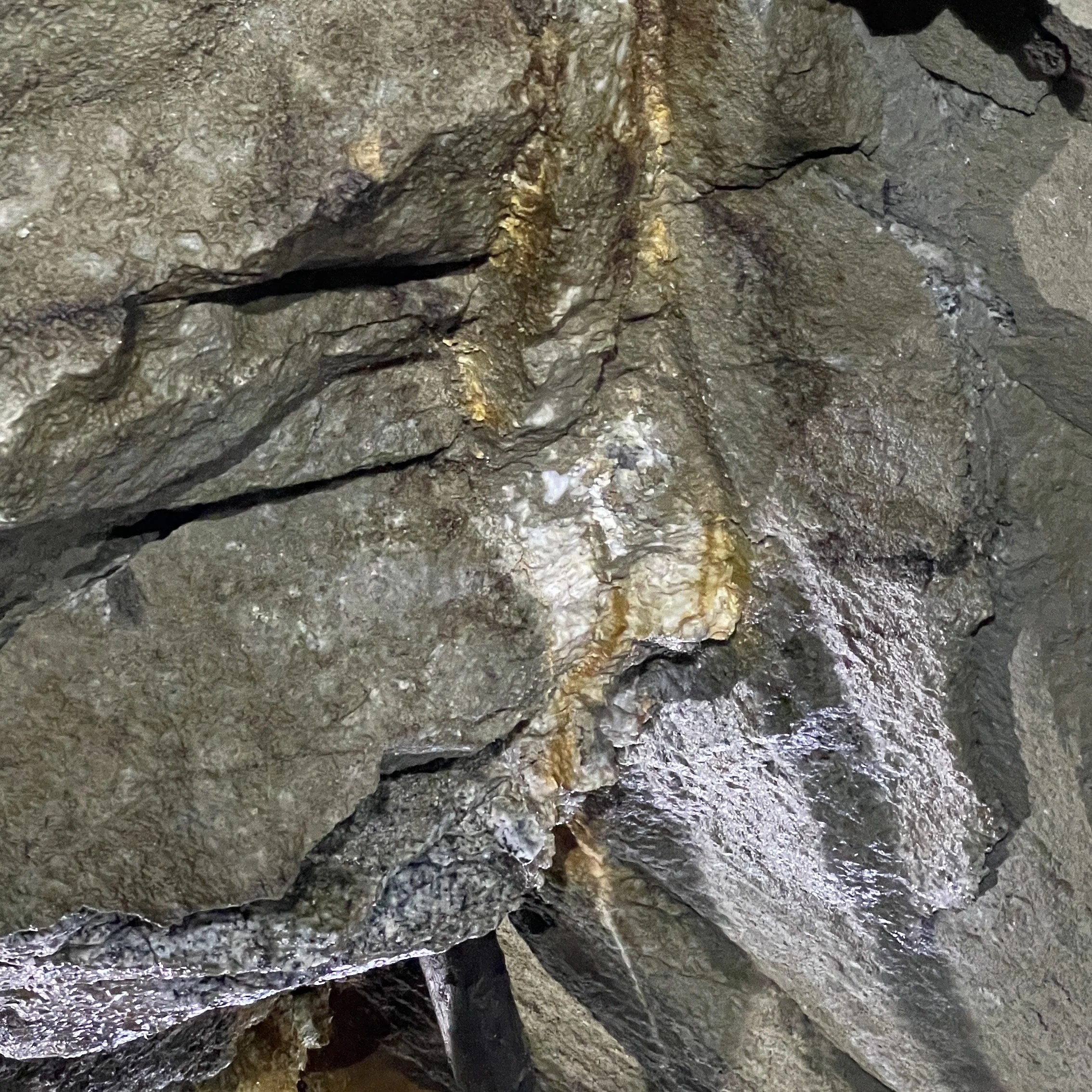
Gold vein. Photo courtesy of Noën Jewellery.
My recent trip to Colombia was an intense roller-coaster ride: there were a lot of ups and downs and unexpected changes, but it was an incredible adventure.
We got to meet Fairmined Gold miners and hear their stories, visit a museum with the largest gold collection in the world, and even swim in the desert in a pool filled with natural springwater.
Before I begin, some perspective is needed….
Colombia’s local elections took place in October. With an unruly president, the situation in the territories where the mines are located in the rural mountainous Andes was uncertain — and to an extent, unsafe. I guess a short insight into the political history of Colombia would explain the situation a little better.
This piece, entitled “How peace efforts are making a difference (or not) in Colombia,” published in February of 2023, also offers good insight on the infighting between armed groups. This August, the government signed a 6 month ceasefire with ELN (National Liberation Army).
So, now that you have a bit of insight, you will understand why both visits to the Chede and Iquaera mines were canceled for the safety of both the Fairmined miners and the Fairmined jewelers. Although, I have to say, I never felt unsafe at any point during the trip.
The Iquera mine even received a phone call from the local district mayor to tell them they had knowledge of the visit of a delegation of 20 international jewelers, and he wanted to know if they had the permission to receive such a visit. How this information was leaked or how they had found out about our visit was unclear, and who else knew was a mystery.
We were experiencing a glimpse of what the Fairmined miners deal with regularly. To some extent, this is an accepted part of their reality.

General information on Chede Mine. Photo courtesy of Fairmined.
At the last minute there was an opportunity for a small number of the Fairmined jewelers to visit the Chede mine very early on Monday, September 25. The miners had organized and volunteered to collect the jewelers at the hotel and drive them up to the mine in their own cars. This was in order to keep a low profile and be as inconspicuous as possible. The trip would be completely at the jeweler’s own risk, and without the consent or backing of Fairmined/ARM.
I chose not to go. I stayed for the day excursion with another group of Fairmined jewelers, and we met a group of the Chede miners who drove down to Popayan to meet us for lunch. We spent the afternoon together exchanging stories — which was in itself an awesome time, as we got to see their personalities and get to know them on a more personal level.
From the discussions we had the evening prior to the Chede visit, Anny and Sébastian (wife & husband team, owners of the Chede mine) gave a presentation about the history of the Chede mine, their struggles, and their commitment to the Fairmined certification.
They are extremely proud of being Fairmined certified and part of the Fairmined family. They not only invest a lot into their miners’ safety and general wellbeing, they also invest in the local community. They have a lovely neighbor for whom they built a stone house for her and her children to live in. They also upgraded the local retirement home in a neighboring village, and invested in a games room and playground for the local children. Alongside mining, around 15 miners have invested in a coffee plantation on the grounds of the mine.
“Coffee?!” I hear you thinking. “Well, what does coffee have to do with mining?” Plenty! A handful of the Chede miners started growing coffee plants to generate a second income. It was evident that they were very proud of their coffee, which in turn would be great for us Fairmined jewelers to be able to buy and serve to our clients.
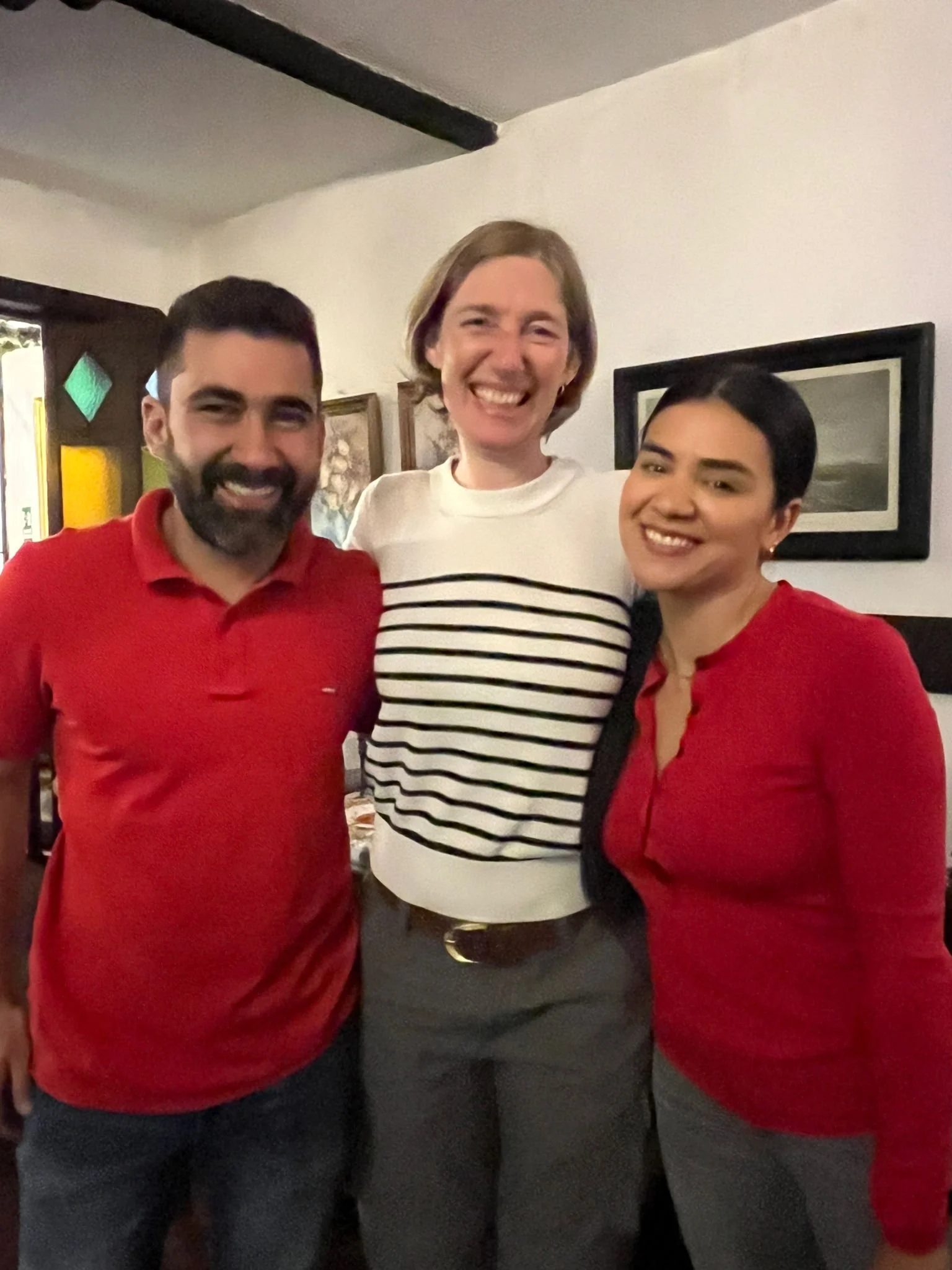
Sebastian, Saskia, and Anny. Photo courtesy of Ofrenda Jewelry.
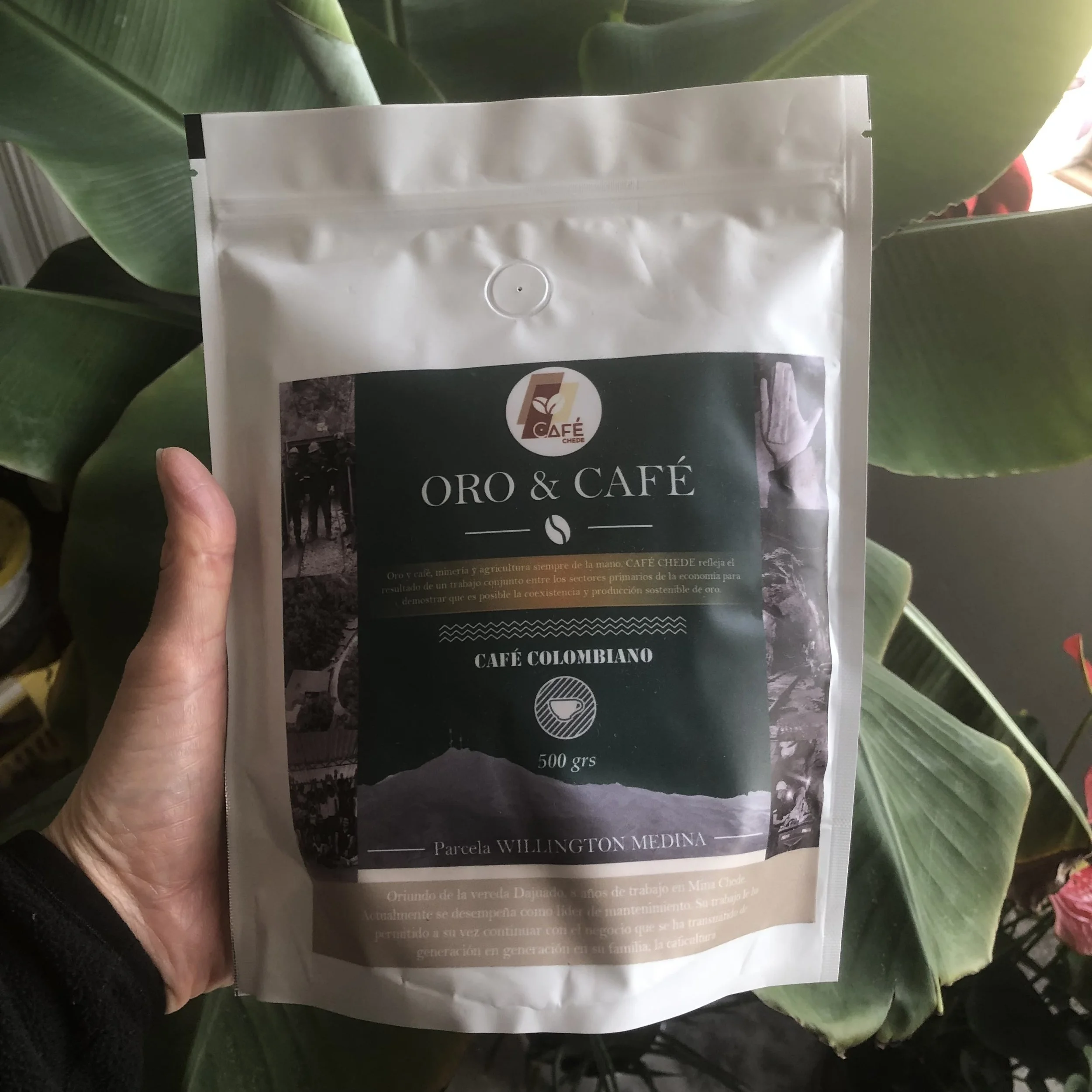
A bag of Colombian coffee. Photo courtesy of Saskia Shutt.
Right now, Anny and Sebastian are working on the marketing process, so that they can find enough buyers for all 15 coffee growers. In the long run, the idea is to create a brand and build a self-sustaining business. All the plantations belong to their miners, and they have 15 miners who are producing coffee. Mina Chede paid a better price than the market, and they assumed the rest of the costs — including threshing and roasting. Every plantation is approximately 1 hectare.
Chede also works meticulously on their waste management. After the gold has been extracted, the rocks are crushed using cyanide in a controlled and contained environment. Before they dispose of the rock waste, they neutralize all the cyanide. There are two types of rock waste, one which still contains tailings (just like I saw in the alluvial mining in Peru last year) and which is left for the neighbor to sort, which gives her enough to make a living from. (The tailings are too fine for extraction at Chede.) The other rock waste is either taken away by construction companies, or the miners use it to repair the local roads in the area — as the government neglects to do so.

Mina Chede maintains the roads. Photo courtesy of Fairmined.
Another way the Chede miners are continuously investing in their community is through the purchase of a large plot of Amazon rainforest for the sole purpose of conservation. Unfortunately, even there, informal miners chopped a few of the trees down. They have offered the informal miners jobs to become Fairmined miners, but they are not interested. The Chede miners are continuously fighting an uphill battle against greater odds, and yet they believe in what they do with a fierce passion. It is inspiring and humbling.
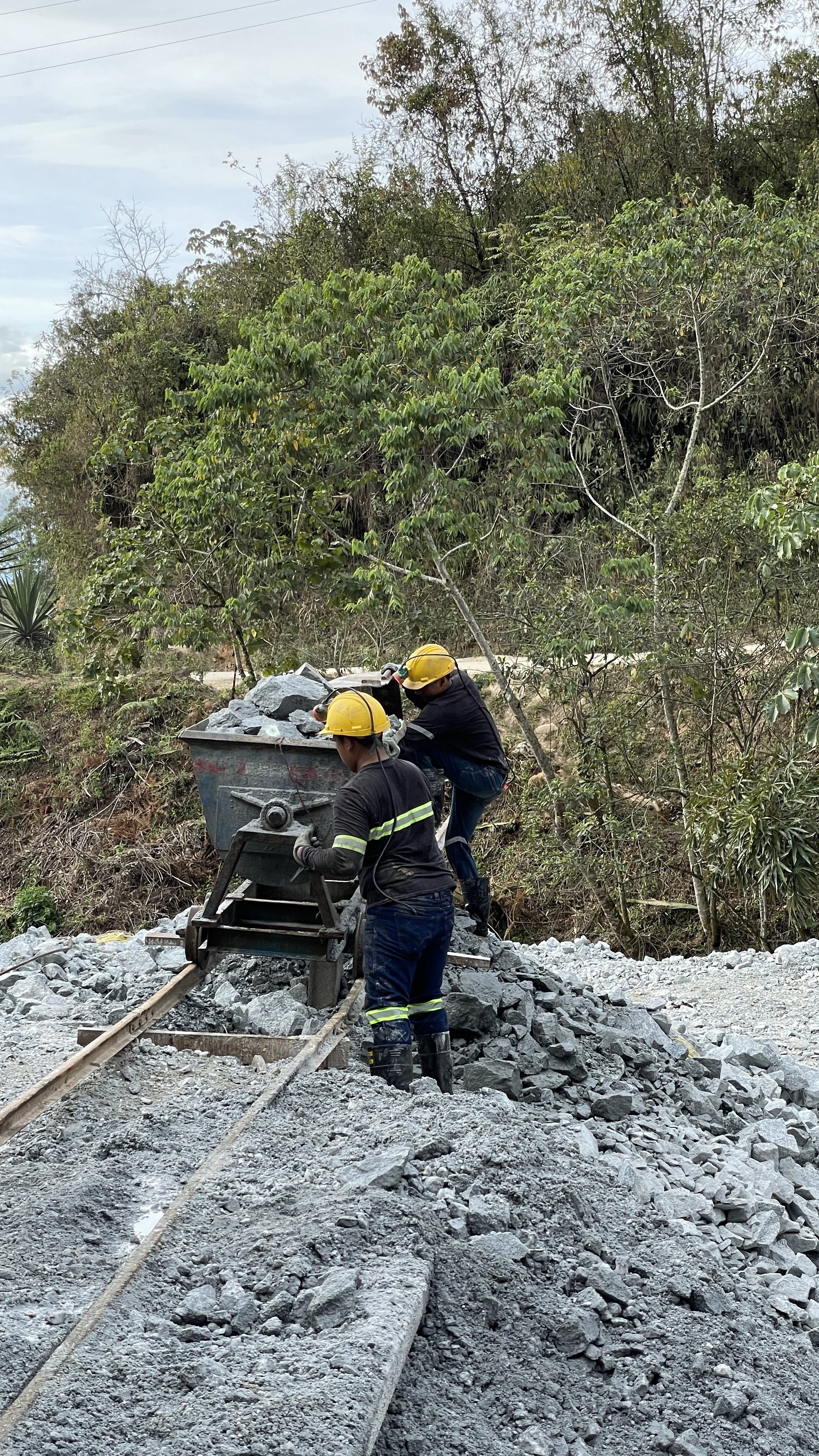
Mining at Mina Chedé in Colombia. Photo courtesy of Noen Jewellery.
Finding buyers for their gold is another issue they have. I was shocked to hear that it has been over a year since the Chede mine has sold their gold to Fairmined certified refineries. For the last year they have sold their gold into the mainstream, because the demand for Fairmined is so scarce. By selling this Fairmined gold to mainstream rather than Fairmined refineries, they do not receive Fairmined premiums.
This leaves me to question how we, as a Fairmined family, are going to turn this around?
How do we as jewelers promote Fairmined to our customers, so that we can increase the demand?
We need to create more awareness, not only with our customers but also with other jewelers. This is not an easy task; if I look at the amount of jewelers that are Fairmined certified in Belgium, there are 14, but only a couple of us actually promote and talk about the Fairmined Initiative on our websites. How is the greater public going to become aware of what Fairmined is and what it means to buy Fairmined, if Fairmined certified jewelers don’t make it visible?
It is heartbreaking to hear these stories, while these miners remain so motivated to continue to uphold the Fairmined standard and maintain their certification. Chede has been certified since 2018, and eradicated the use of mercury in 2015. This is precedent-setting in their country, as the government only officially banned the use of mercury in Colombia in 2018.
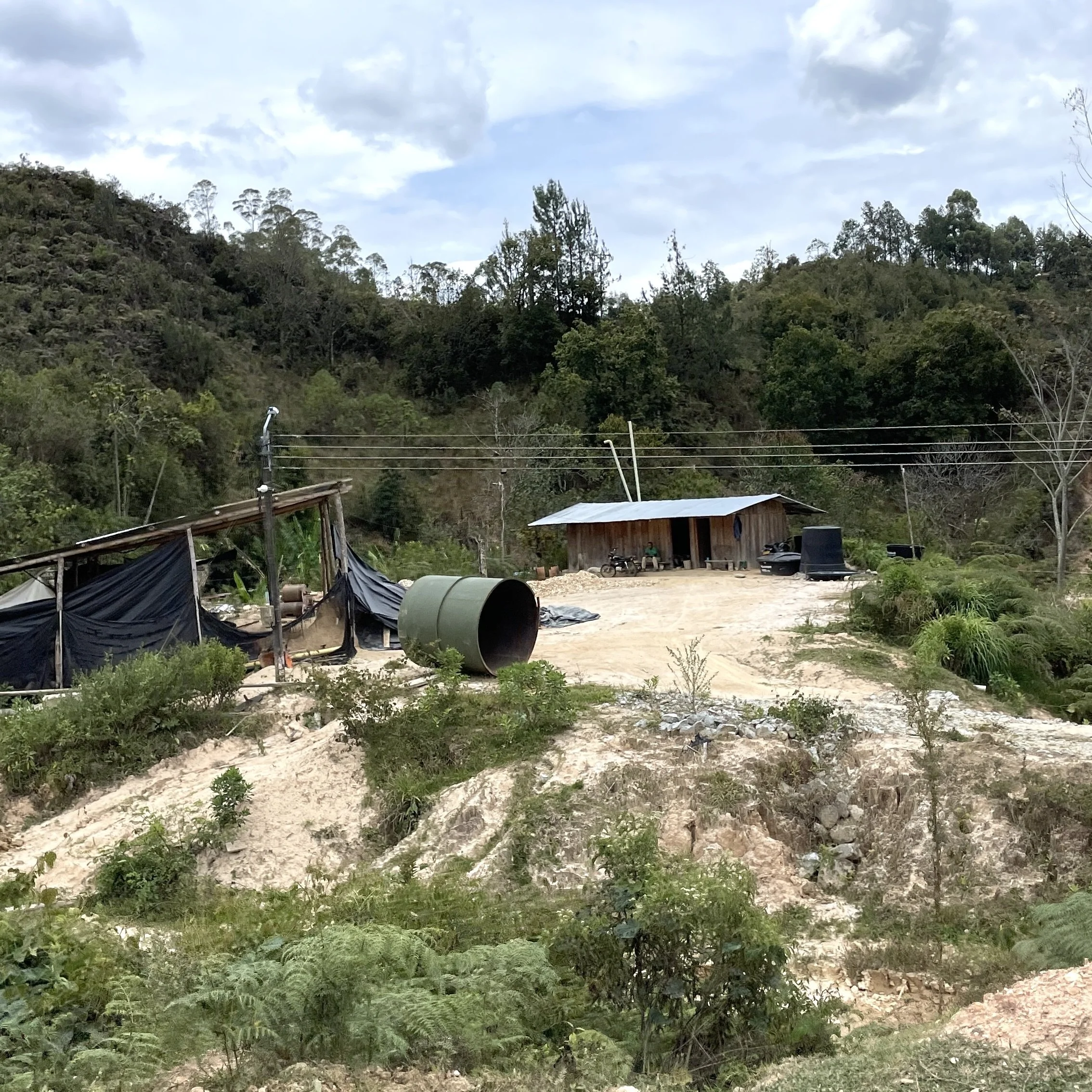
Driving up to the Chede mine, the group of jewelers also saw the illegal mines in plain sight. Photo courtesy of Noën Jewellery.
This is Hector, he’s one of the miners who met us for lunch, which I previously mentioned. He used to be an informal (illegal) miner, before he became a Fairmined miner. He said when he was younger, he didn’t have a care in the world — but with time he realized that there was more to life. He really wanted to become a Fairmined miner; their reputation is well known among the mining community. He is happy that he now has full health care, medical insurance, and a pension, and he remains very proud of his choice to become a Fairmined miner.
Anny explained that they currently have 3 illegal (or informal) mines on the property, and there is nothing they can do about it. A lot of the people leave farming behind and turn to informal mining because it is more lucrative. The question here is, how do they get the illegal gold into the mainstream? Very simply really: by turning the gold into jewelry and selling it to pawn shops, who in turn sell it to the refineries and it disappears into the “recycled” gold mainstream. To find out more about recycled gold, read my article from May 2023 on recycled gold.
On Wednesday, September 27, we met the Iquera miners in a boardroom in the city of Neiva, where we listened to their story — which is similar to the Chede miners’. Iquera also invests in the safety of their miners, and is continuously improving their facilities to ensure the wellbeing of their miners and surrounding communities. Iquera miners have also generated a second income by means of planting a coffee plantation, of which they are extremely proud, and we were all given a small box of coffee to take home with us.
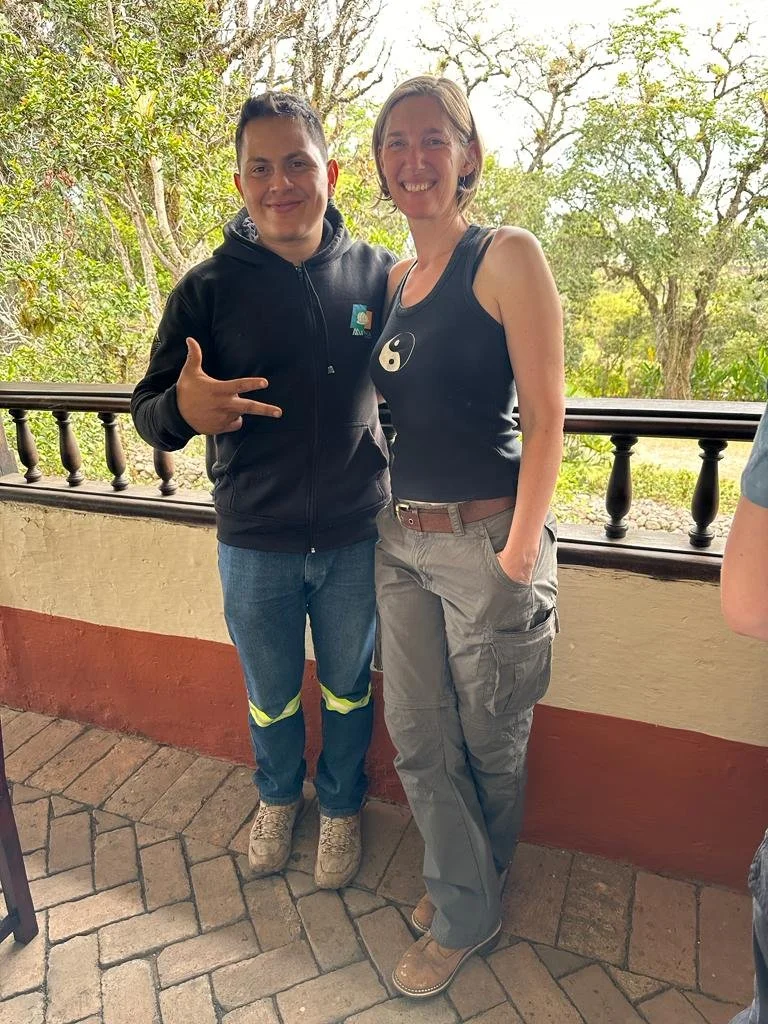
Hector and Saskia Shutt. Photo courtesy of Ofrenda Jewelry.

Mina Chede aerial view. Photo courtesy of Fairmined.
The Iquera mine is situated in a district which is generally peaceful — but they were the miners who had to cancel at the last minute, due to the unexpected phone call inquiring about our visit. Instead, the Iquera miners came to us. We spent an inspiring and interesting evening listening to their way of life, and how they are proud to be Fairmined certified. I even learned that this is the mine where my silver comes from.
“Okay,” I hear you thinking now: “but isn’t Iquera a gold mine?” Yes it is, but for every kilo of gold extracted at the Iquera mine it may also contain 7% of fine silver as a by-product. This makes Fairmined silver even more precious, and very scarce. I am proud to have a handful of bespoke pieces made in Fairmined silver, originating predominantly from the Iquira mine.
On Saturday September 23, the first day of our trip, a handful of us had the opportunity to visit Museo del Oro in Bogota on a guided tour. It boasts the largest collection of gold pieces under one roof. I could have meandered for many more hours, fascinated by the tools (which haven’t changed much over the centuries, apart from what they are made of).

Tools at the Museo Del Oro in Bogota, Colombia. Photo courtesy of Saskia Shutt.
At the end of our trip we spent the morning talking with Andres Castellanos, one of the founders of a Fairmined certified refinery, Fairalloy. Seeing the step-by-step process of how gold is refined before it ends up on my bench was fascinating. Listening to Andres talking about how he works and the pride he has for being Fairmined was inspiring. Fairalloy is also the first refinery to produce the solution for Fairmined gold plating.

Andres Castellanos. Photo courtesy of Saskia Shutt.
The interesting thing about Fairalloy is that they only buy gold from ASM (artisanal and small-scale mining) sources; 80% of what they process is from Fairmined and the other 20% from two other ASM sites. They only export 100% Fairmined gold and Fairmined silver products.
Fairalloy is the third refinery in the world to have been certified as a Fairmined supplier, and they are also the only refinery offering gold potassium cyanide (the solution required for gold plating) with a Fairmined certificate. This is the only traceable gold potassium cyanide in the world, the others available on the market today are all blended from other materials.
“Saskia, we wanted to express our heartfelt gratitude for taking the time to visit our production plant. Having you here was truly a pleasure, and it's incredibly inspiring to witness your dedication to comprehensively grasp the Fairmined supply chain. This commitment reflects your unwavering commitment to being a responsible and ethically conscious jeweler. Your on-site experience is truly invaluable, and it adds an extra layer of depth to our understanding of the Fairmined supply chain.”
~Andres Castellanos of Fairalloy. From a comment on Saskia’s post on LinkedIn.
To conclude: I am surprised that I had a very different sense from this trip to Colombia compared with my Peru trip in 2022. I wonder if it is because in Peru I visited all 3 mines; Cecomip, Oro Puno, and Cruz Pata (the last of which has managed to eradicate its mercury use and is now fully Fairmined eco certified — read more about it in my article from May). Although the miners were open with sharing their thoughts on selling their gold, the focus was very much on the mining process, how the mines operated in a circular model, seeing how the miners worked, the protective gear, the living quarters on the mining premises, etc. This was all work-related, and left me thinking; “if I had visited the Chede and Iquira mines, then my experience of the human side may have been obscured by my curiosity of how an underground mine operates and how they excavate the gold, and how they neutralize the waste and work to protect the environment.”
Due to the unrest and consequent the cancellations of the visits to the mines, my Colombian trip was very different — it was deeply insightful on a social level. I felt heartbroken, for example, about what I heard about the difficulties in selling their Fairmined gold. I was able to not only find out about their pride as Fairmined miners, but also hear their concerns and struggles with keeping the Fairmined dream alive. On the other hand I saw the huge positive impact Fairmined has on the workers, communities and environment. I am very grateful for the very short-lived experience of meeting the miners and connecting on a personal level.
To see a list of Fairmined gold suppliers, click HERE.
To learn more about Fairmined’s impact, click HERE.
Please consider joining Ethical Metalsmiths and its future excursions, conversations, and gatherings! No, you don’t need to be a metalsmith! And stay tuned for more details about Radical Jewelry Makeover’s Rejewelry competition; it will cap off with an in-person event during NYC Jewelry Week and we hope to see you there!
Wrestling with what constitutes an “ethical” person, practice or industry? We are too, and we invite you to join the conversation!
“We are a small team of passionate jewelry industry professionals and writers. We’d appreciate your support to grow our team and continue to be able to provide the best responsible jewelry content for years to come!”
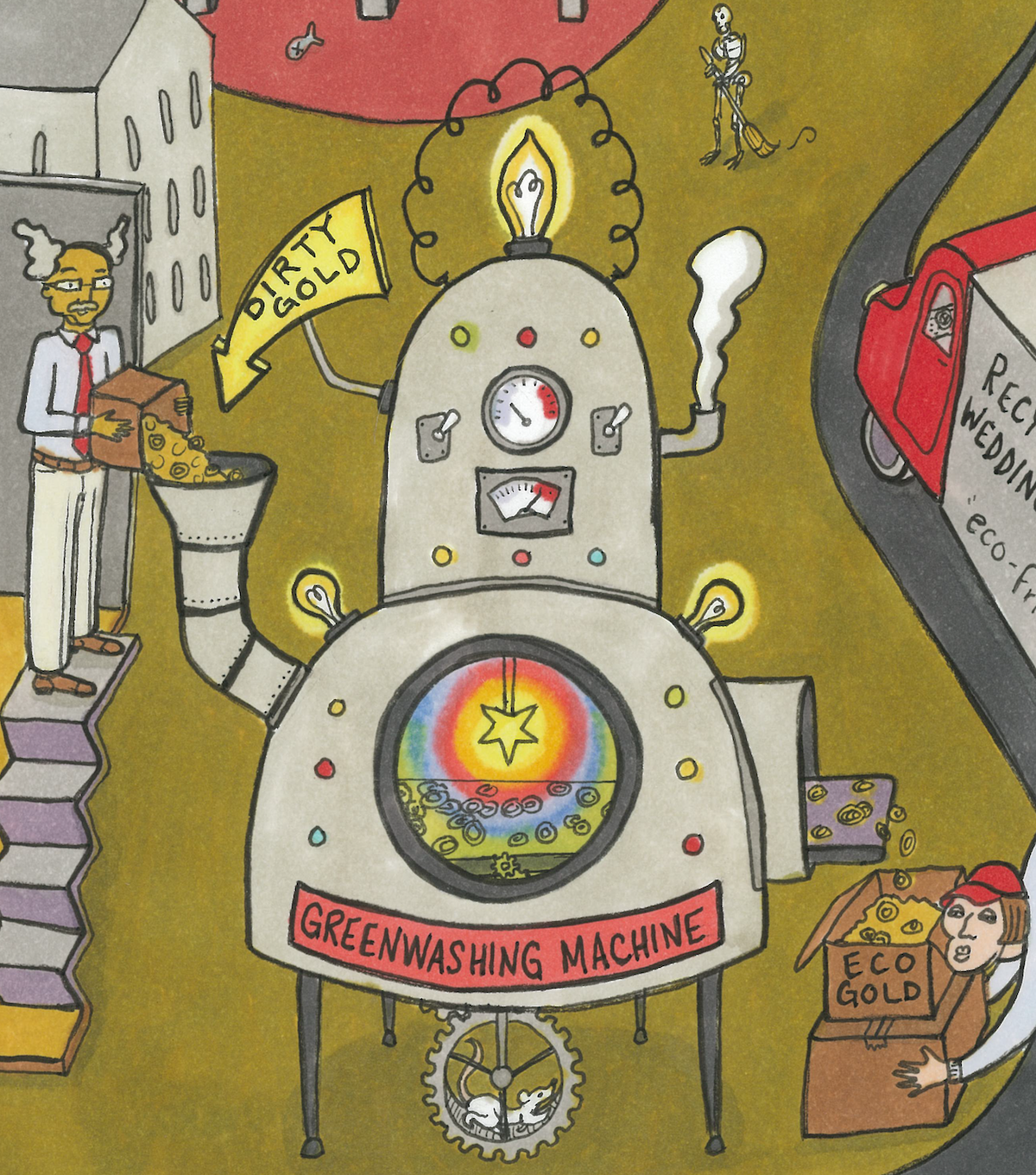


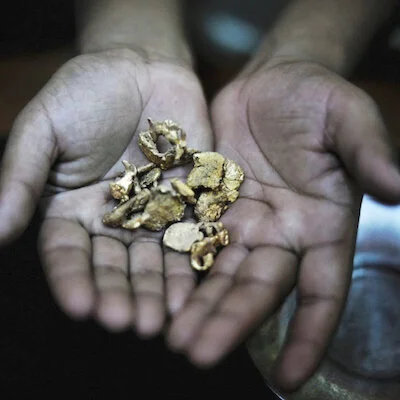
Chloe interviewed Jessica Hudson of The Nomad Jeweler on her latest collection that features ASM Colombian gold and Tahitian Kamoka pearls. Read the full article to learn more about Jessica’s story and why she chose to design with traceable artisanal gold and sustainable pearls.