

Chicago RJC 2023: Takeaways and Next Steps

The content of this article reflects the views of the writer, and not necessarily those of Ethical Metalsmiths. This article was written for The Source.
As per usual, this year’s Chicago Responsible Jewelry Conference (CRJC) was eye opening and powerful.
It was a weekend where we came together to learn and discuss how to make our industry more inclusive, fair, transparent, connected and accountable. Chicago also enables a mosaic of little moments in between the sessions where we can bond, share resources, and get re-energized.
CRJC graphic courtesy of Andrea Hill.
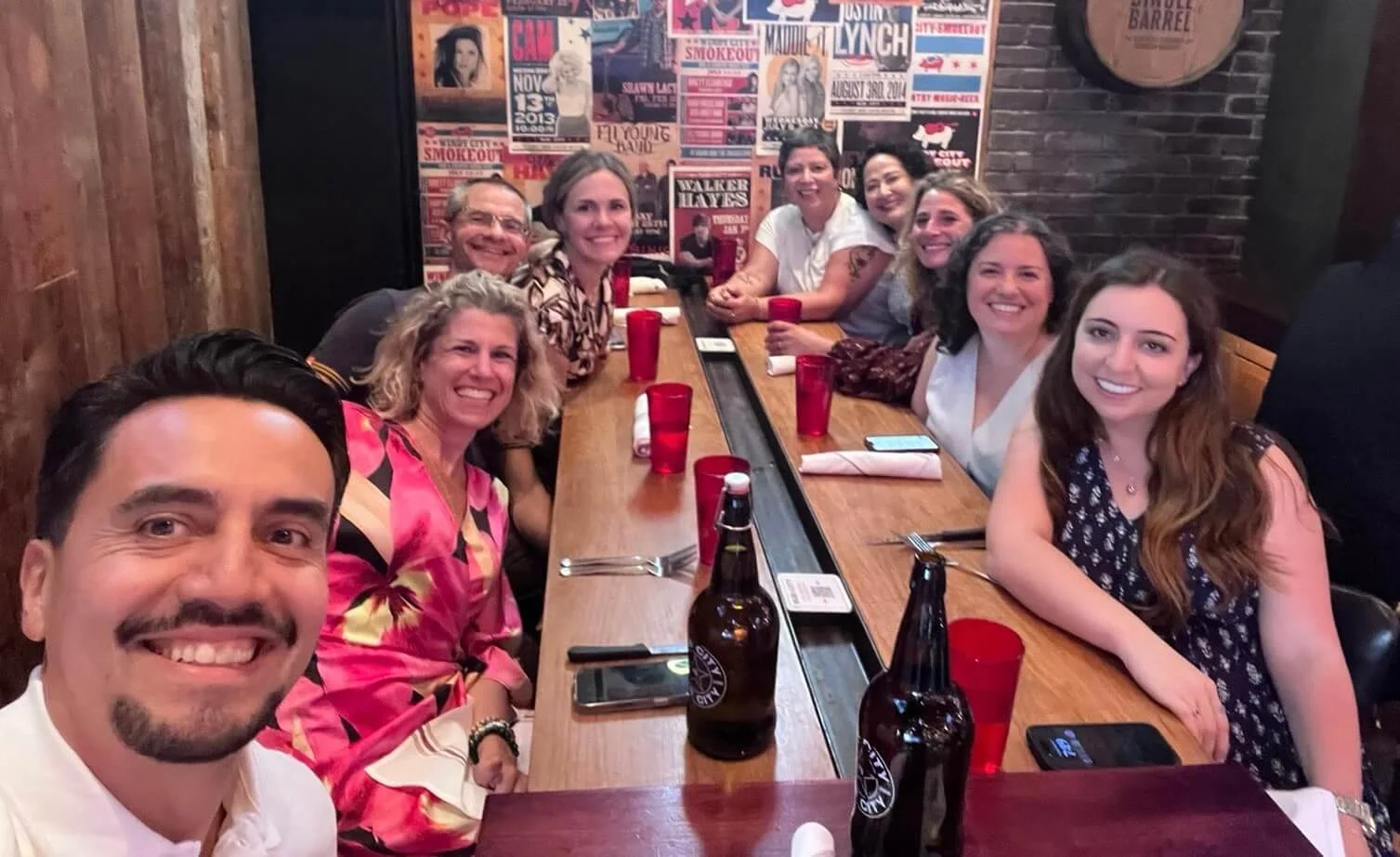
Good food and good company after Day 1 of the CRJC. Photo courtesy of Jay Moncada.
That all being said, it was clear we need to build on this momentum and get our messages out to the larger jewelry industry.
Without further ado, let’s dive into my top three takeaways from the conference and actionable next steps in further detail….
#1. Proof protects our industry, storytelling advances it.
“We protect the industry by bringing human-centered stories with real proof that people can connect with” ~ Cristina Villegas, Director of Sustainable Markets at Pact
There has been a lot of talk about various certifications and blockchain recently, and for good reason: proof of our responsible sourcing and traceable supply chains will only help reinforce trust throughout the industry and is expected by Gen-Z in particular. In an age where anyone can say anything they want on social media and carefully curate a brand image, those who can back it up with evidence will no doubt rise to the top of the noise.
As Cristina mentioned, when this proof comes in tandem with storytelling focused on the people behind the product, consumers have the chance to personally connect with what you are selling; it becomes more than just a pretty object but something imbued with meaning.

Pauline Mundia, Sejal Karavadia, Jessica Hudson, and Cristina Villegas on the Opening Markets for Artisanal Gemstones Panel moderated by Anna Samsonova. Photo by Chloe Beaumont.
Sejal Karavadia, Director of Procurement and Vendor Management at Brilliant Earth, echoed this sentiment, “knowing and seeing pictures of the actual people mining the gems really creates a connection and has resonated with our consumers.”
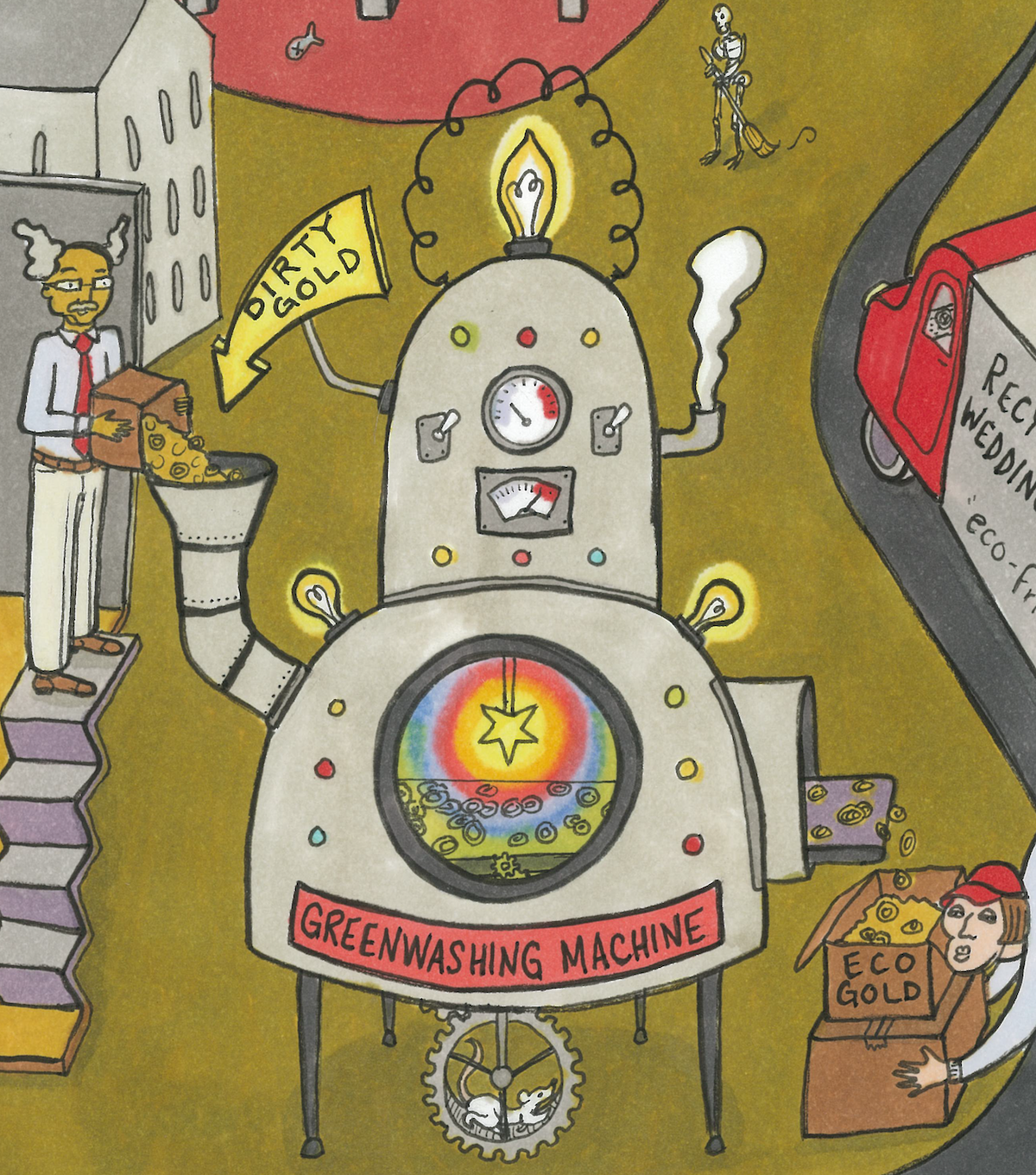
I don’t think there is a singular “golden certification” or most superior way to storytell, but rather it’s a case of quantity and quality: as long as the certifications you get are legitimate and the stories you tell aren’t simply greenwashing.
Suggested Action Steps Regarding Certification:
Consider becoming SCS Certified. SCS Global Services’ “Responsible Source– Jewelry” certification category applies to “the entire supply chain from refiners and manufacturers to fabricators, jewelers and retailers. Product categories include fine metals, alloyed metals, gemstones, findings and jewelry.” If you are in the diamond sector, they even have a specific Certified Sustainable Rated Diamond certification.
Consider joining the blockchain movement. Gubelin Gem Lab’s Provenance Proof is a Blockchain platform built for both gemstones and jewelry. In short, it is a “digital ledger that can offer a permanent, tamper-proof record that traces a gem's journey, from the mine to the end-consumer and even beyond.” Provenance Proof has also developed a certificate for retailers to present to end consumers that shows them the entire journey of their chosen gem/jewelry piece.
Consider starting the process of becoming B-Corps certified. I say “starting the process” because it is complex and time-consuming but would potentially serve your business well! Upon becoming certified, not only can you signify to clients that you value social, environmental, and governance best practices, but you also get to join a local B-Corp community which is great for networking and collaboration.
#2. Responsible gemstone sourcing is as nuanced as the source countries themselves.
In a panel focused on source countries, Eric Braunwart, founder of Columbia Gem House, reminded everyone that “there isn’t one way to approach [responsible sourcing]. Instead of asking about what amount the miners are getting paid, focus more on HOW they are getting paid–and is that fair?”
Few professionals understand that sourcing gems fairly from different countries isn’t an “apples-to-apples” situation better than Eric, who has been a leader in responsible sourcing for decades. In Madagascar, one of the countries he sources from, miners are actually primarily farmers, and gemstone mining is a secondary source of income. This further proves Eric’s point that it does not always make sense to exclusively focus on what amount the miners are receiving for their gems; miner’s needs vary from country to country and even region to region.
Pauline Mundia of Virtu Gem mentioned that in some countries like Zambia, there has been a gender disparity in mining and women are often taken advantage of, with “only the men taking the best stones to go sell at market.”
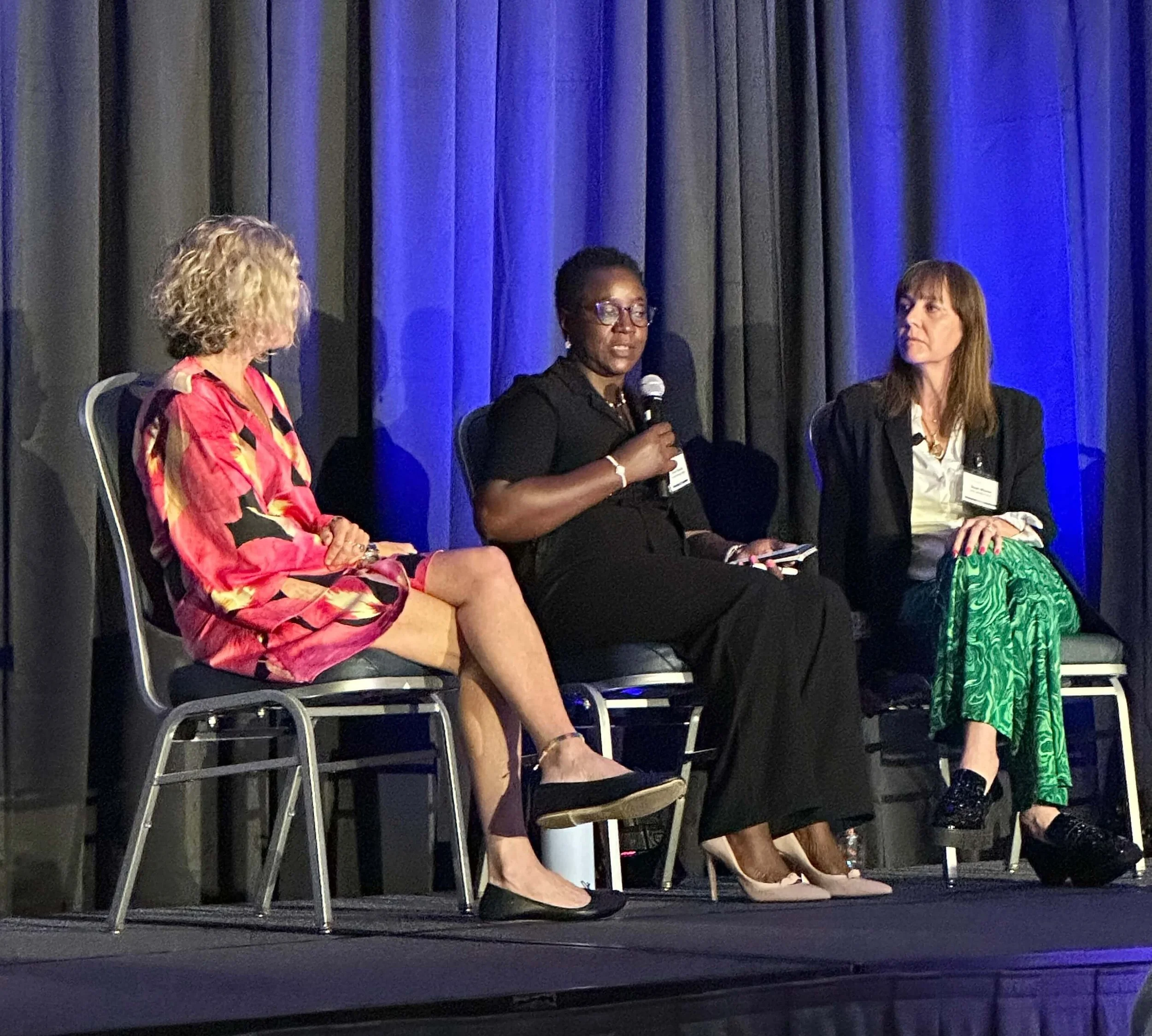
Abigail Sibanda and Susan Wheeler give an update on the situation in Marange, Zimbabwe on a panel moderated by Brandee Dallow. Photo by Chloe Beaumont.
Fellow panelist Susan Wheeler, co-founder of Virtu Gem and founder of the Responsible Jewelry Transformative, emphasized the importance of partnership and said that Virtu Gem “works with in-country traders who know the systems better than we do.” She also mentioned that cutting gems in Malawi to retain value locally has been a challenge because of a shortage of cutters, but in other countries like Kenya, that was not a problem at all.
Once the gems are cut, then they have to be exported, which is another area that is not always ethical and straightforward. Stuart Pool, founder of gemstone company Nineteen48, pointed out that Sri Lanka has a good legal framework for exporting gems in place due to the country’s very long history of gemstone mining. This is a direct contrast to the testimony attendees heard from Chiko Manda the previous day about how the vast majority of mainstream aquamarine gets smuggled out of Malawi.
This firsthand evidence is continued proof that one can’t simply say, “all our gems are responsibly sourced because of “fill-in-the-blank” reason.” To deem a source “responsible” requires understanding, at least on a basic level, the circumstances in the source country.
If you are a designer, you don’t have to be a research expert on every country that you buy gems and precious metals from, but you should be able to trust that your suppliers are aware of these nuances and have done their own due diligence. If you are a gemstone wholesaler who wants to increase transparency in your supply chain, don’t let the lack of perfection or easy answers stop you. Focus on what you can find out and areas where you can increase positive impact, and then effectively communicate this to your clients.
Suggested Action Steps Regarding Responsible Gemstones:
If you are a retailer or a designer and you would like guidance on what questions to ask your gemstone/metals suppliers, EM has compiled a useful guide for you!
If you are a gem or precious metal supplier, there are local trade organizations you can partner with to help retain value and advance skills in the source community. (One example of this would be TAWOMA in Tanzania, whose offshoot TAWOMA Youth is equipping young women ages 18-25 to learn how to facet gems).
Don’t be afraid to collaborate. It’s hard to find every solution that makes sense for your business on your own! Great success can happen when companies work together and are a part of a community that freely shares resources and answers each other’s questions about anything and everything “responsible”. Ethical Metalsmiths is one of these communities, along with Fair Luxury in the UK.
#3 Fairmined Silver is just as important as Fairmined Gold.
“We have an opportunity to shake up the paradigm in the system with [responsible] silver. We can afford it [the premium], the miners shouldn’t have to shoulder that burden” ~ Will Nevins-Alderfer
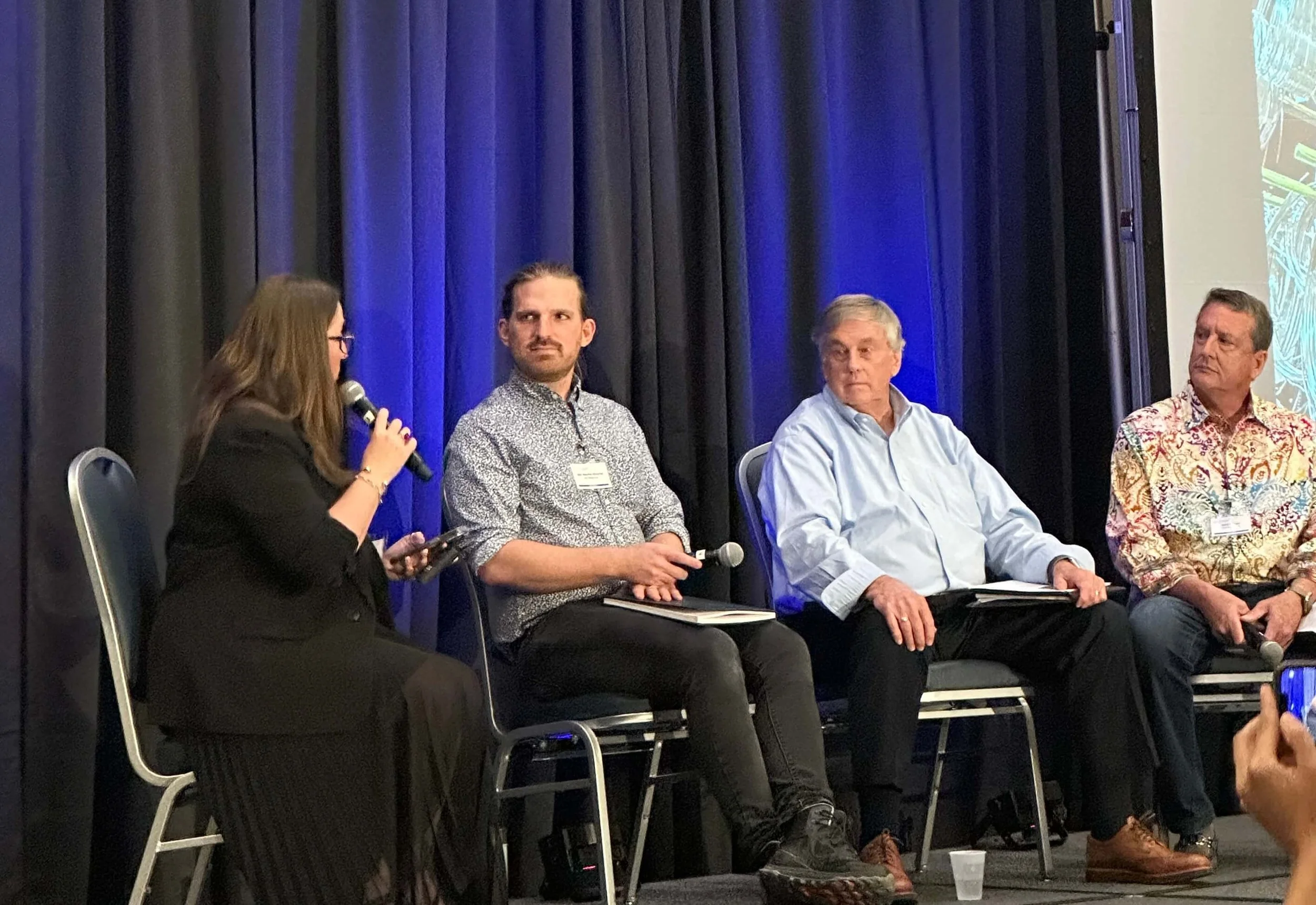
Will Nevins-Alderfer, Mark Hanna, and Tory Hoover on the Responsible Silver panel moderated by Holly McHugh. Photo by Chloe Beaumont.
I was pleased to listen to a panel on Responsibly Sourced Silver, a topic that is discussed far less frequently than gold sourcing. Tory Hoover of Hoover and Strong, Will Nevins-Alderfer of W.R. Metal Arts, and Mark Hanna of Richline Group sat on this panel and raised many good points throughout the discussion.
A few key facts:
72% of mines where silver is coming from mine other things as well as silver (such as lead, zinc or gold).
Globally, silver is mined much more than gold is.
There is far more mercury and/or cyanide required to get silver extracted when compared to gold.
Currently, there are a few places online (Hoover and Strong, Fairever and Fairalloy) to buy Fairmined silver that is being mined as a byproduct of Fairmined gold. Beyond that, Will mentioned his desire to start a buying consortium, like the Fairmined Gold initiative started by Ethical Metalsmiths in 2013, to bring Fairmined Silver to the US market.
Taking into account how prevalent and toxic silver mining is, it is more important than ever that we continue to talk about responsibly mined silver. Even with the Fairmined Silver premium sitting at around three to five times the price of the silver currently on the market, to Will’s point, jewelers can still afford it because the cost of silver is so low.
Tory later pointed out that Mexico is a huge producer of silver and would be a good place to begin efforts to support ASM (artisanal and small-scale mining). At Hoover and Strong, he said that they choose not to charge customers more for Fairmined Silver and just consider the premium “value added.”
No matter how you might decide to approach the topic in your businesses, the bottom line is this: silver miners shouldn’t be ignored just because what they are working so hard to mine is worth less than gold.
Suggested Action Steps Regarding Responsible Silver:
Consider how you might integrate Fairmined Silver into your jewelry collections if you design in silver. Perhaps find a few pieces that you could “test out” in Fairmined Silver.
If you are interested in joining the buying consortium led by Will Nevins-Alderfer contact will@wrmetalarts.com for more information. (As of the time of this writing, Will has already held one informational Zoom for interested jewelers, but I am sure he would host another if there was enough interest!)
2. When you are shopping for silver jewelry for yourself or others, bring up Fairmined silver! Many jewelers in the United States still have never heard of Fairmined gold, let alone Fairmined silver. You just might influence them to do more research on the topic and decide they want to become Fairmined Certified.
3. Keep asking companies such as Hoover and Strong to supply Fairmined silver consistently—and then actually purchase it from them. As noble as they may be, if they don’t have enough demand from jewelers, they simply cannot keep it in stock.
In conclusion, there are many steps you can take to advance your credibility, corporate and social responsibility, and knowledge on responsibly sourced materials that include and go beyond the topics outlined in this article.
I’m aware that if you are reading this, there is a high chance you are already generously giving to local USA charities and international organizations as well. You should be proud to talk about it online or in person. Even if not every client or industry colleague you have resonates one hundred percent with the organization you chose to partner with or give to, people will sense that you genuinely care to better our jewelry industry and humanity in general. You never know who you could inspire to pay it forward!
To purchase the virtual replay of the Chicago Responsible Jewelry Conference, click here.
For even more resources, visit EM’s Resource page.
Are you an EM member looking for another way to get involved? Join the Action Coalition.
“We are a small team of passionate jewelry industry professionals and writers. We’d appreciate your support to grow our team and continue to be able to provide the best responsible jewelry content for years to come!”
Editorial Section
What to read next from The Source
Like what you are reading? Please help support our editors and writers today.

Interested in becoming a member?
Enroll in our Affiliate Program
Christina Miller’s Foundations for Sustainable Jewelry Practices
If you're interested in being a part of this incredible program, enroll today!
Something we rarely talk about to the extent that it is almost taboo is what happens with a break-in, burglary or even a hold-up: How do we deal with the aftermath?