

Jalnar Dhanani on Creating Purposeful Jewelry

The content of this article reflects the views of the writer, and not necessarily those of Ethical Metalsmiths. This article was written for The Source. Please Note: Chloe Beaumont currently works at ANZA Gems.

Cheers to three years of The Source! Looking back on what we’ve built since our pandemic-era launch brings me immense gratitude and joy. We hope to continue to grow and bring you the best responsible gem and jewelry content each month for years to come! From all of us, thank you for your support and for continuing to share our articles worldwide.
Stay curious,

Chloe Beaumont EDITOR-IN-CHIEF
Jalnar Dhanani is a jewelry designer born and raised in Chattanooga, Tennessee whose namesake brand, Jalnar, is inspired by Palestinian women and the tastes, textures, and traditions held dear. I hope you enjoy our conversation below where we talk about her design and sourcing process, encapsulating Palestinian culture, and storytelling (among other things!).

Portrait of Jalnar Dhanani. Photo courtesy of Stefen Pompee.
Chloe Beaumont: You have a degree from FIT (Fashion Institute of Technology) and spent over a decade living and working in NYC. I’ve heard that this was a challenging time period in your life. What were a couple of the biggest challenges you faced during this time, and how did you overcome them?
Jalnar Dhanani: Yes, I had wanted to live in New York for the longest time and so I moved there straight after high school to do the two-year design program at FIT.
There are a few moments that stand out because they were negative ways I was treated that I had to navigate. In retrospect it feels like racism; but I felt that I got scolded and written up more. One boss simply told me I “wasn’t cool enough” to work there. Someone else made me deal with the cockroaches because, “she’s from Tennessee, she can handle it.” I honestly don’t even know what that means! I felt like I was constantly pushing back on and pushing through whatever work environment I was in.
The hardest time for me was when my brother passed away unexpectedly in September 2017. I was working for a pretty well known jewelry brand at the time, and I had been working there for almost three years at that point. I had two days of paid time off remaining until the following April. I was given three days of paid bereavement (the maximum they would give me). So, I took those five days to grieve with my mother and I was back on the workbench on the sixth day.
One of the first interactions I had when I got back was an email saying I needed to work a day unpaid because they alleged I had been gone for six days, not five. I sat at my bench crushed because my only sibling had just died, and they were arguing with me over whether or not I had missed one day (which I later showed I hadn’t).
I realized through the grief and feelings of depression that followed that I had to get out. Trying to gear up to trust myself to take a leap and start my own business was really hard, and I did not feel ready, but I just had to. Plus, I knew my brother would have wanted me to.
CB: Wow. I’m so sorry about your brother and that you had to deal with all that horribleness. Living in New York City can be hard enough, honestly! I love how you specifically mention family members on your website that served as inspiration for different pieces.
Where do you source your gems and materials from mostly?
JD: Sourcing is one of those things that I feel like I’m going to be working on and learning about forever. That being said, here are the companies that came to my mind the fastest: ANZA Gems, Agere Treasures, Hoover and Strong, Columbia Gem House, and Perpetuum Jewels. I think anyone who claims to be doing it one hundred percent right one hundred percent of the time is either lying, or they don’t know they are lying! But I think it’s important to partner with companies that volunteer really detailed information, not just about where it came from, but also what processes it has undergone, who cut it, what the cutting facility is like.
One thing I’ve been thinking about specifically is the term “recycled.” When you use the term recycled, you’re referring to turning waste into something usable. I personally don’t consider taking diamonds out of an old piece and resetting them into a new piece recycling; those diamonds weren’t going to get thrown in the trash. In that instance, I would call that a repurposed or even simply a reset post-consumer diamond. I didn’t take the diamond and transform it completely into a new thing. I know some people wouldn’t think it’s that important to be that specific, but I think that’s the only way to work towards a general improvement in transparency.
CB: Totally. I actually haven’t heard someone use the term “repurposed diamonds” yet, and I really like that.
Like you said, we are all learning, none of us can claim perfection. We have to give ourselves permission to shift and change.
I’ve been following you for a while and have seen how the new Jalnar brand that has emerged is quite different and deeply influenced by your heritage. I was surprised to learn that for many years of your life, you actually thought you were Jordanian, not Palestinian. That’s a huge revelation, to think that you are one ethnicity for most of your life and then realize that’s not true!
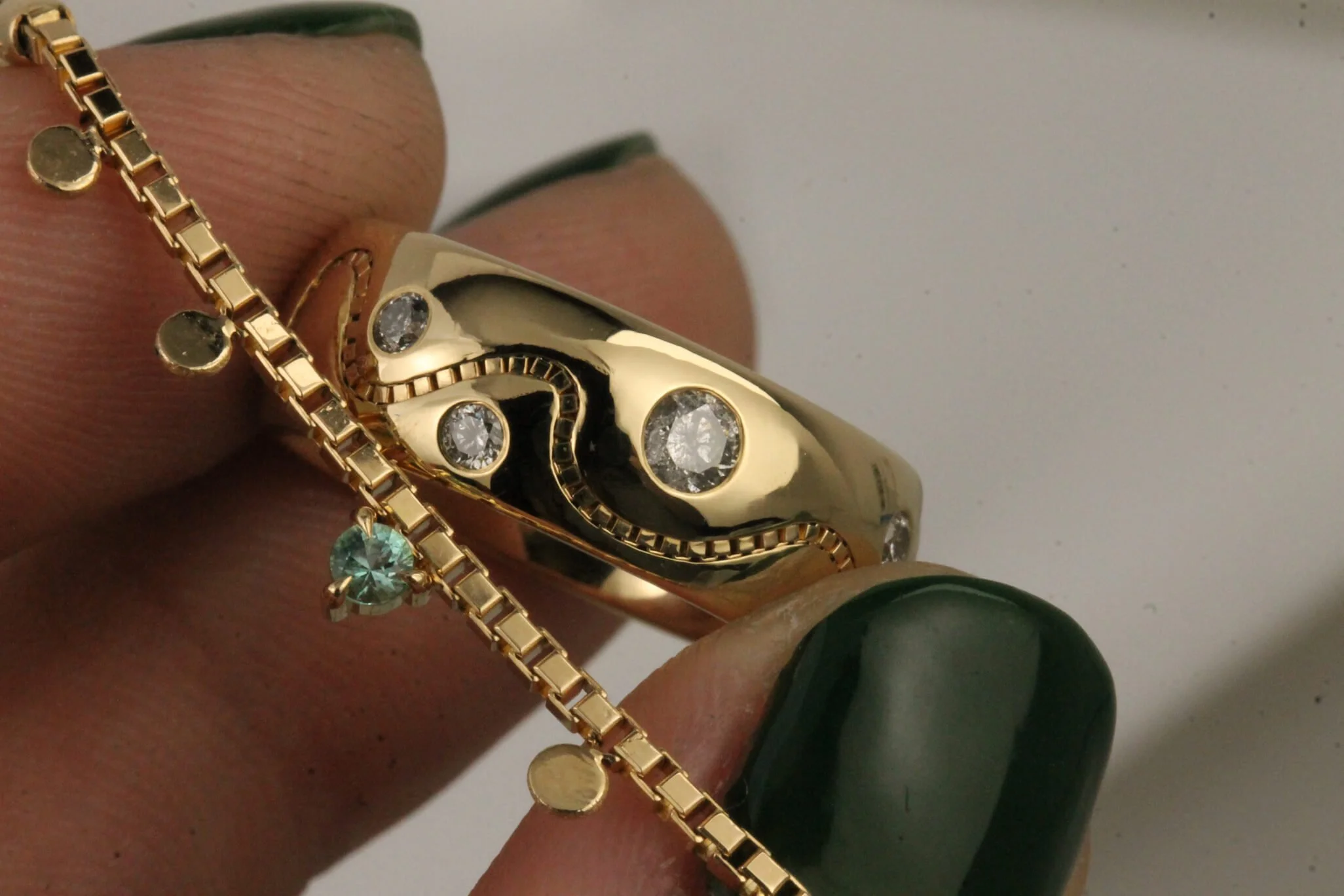
Taqsim ring and Manar bracelet. Photo courtesy of Jalnar Dhanani.
JD: It was really confusing. It was partially due to family trauma, but partially due to the fact that I grew up in evangelical Christian areas in which people have their own motives for wanting the creation of the state of Israel. So it wasn’t really safe for me to outwardly say I’m Palestinian, and that wasn’t something that my family wanted me to have to explain. I grew up knowing that some bad stuff had happened to my family, but not exactly what or why; it just wasn’t talked about.
I also grew up in an overwhelmingly white bubble and I purposely distanced myself from anything that made me stand out. I wasn’t curious about why I was different because I hated being different. I knew that I was Palestinian in my early twenties, but I was so focused on school and work after that and just trying to establish myself. Once I finally started delving in, it was like pulling a thread that just keeps unraveling; I got to hear stories from my mom I would have never otherwise been told.
I’ll get stuck in the thought process, “Jewelry is not that important. What am I really doing here? Is this helping?” Often I just want to drop everything and move to Palestine.
CB: Well this segues into my next question, which is why did you choose to use this jewelry brand to educate people about Palestinian culture and heritage?
JD: It was starting to feel unauthentic to just be focusing so much on my former brand, Benchmark, that was heavily based in production. I didn’t feel like I was making art, and I desperately wanted that. I wanted to play around with Palestinian motifs and learn how to create things like the keffiyeh pattern on metal, but I just didn’t have time or energy.
My veil earring design happened simply because I had extra box chain and I wanted to do something creative with it. With these new pieces, it’s fulfilling even to just see them on a screen. I feel so much better about why I go into the studio every day.
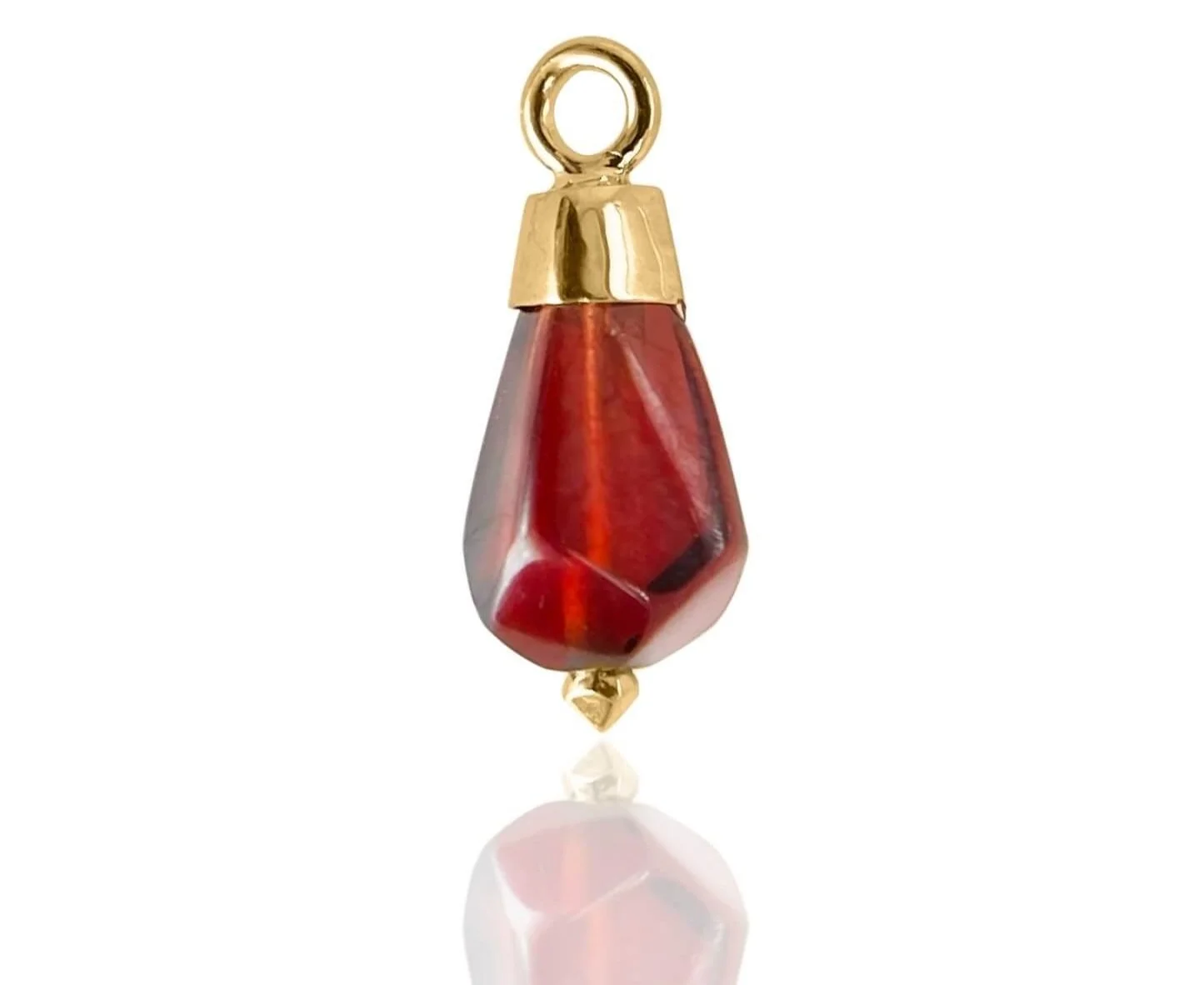
Pomegranate charm. Photo courtesy of Jalnar Dhanani.
CB: Yes, you mentioned wanting that fulfillment and sense that you are doing something that has an impact. Even just that need to do something you actually want to do, period!
JD: But there’s always the question of: Is that selfish?
CB: I had that internal struggle for a few years in college. I actually walked away from everything remotely creative including switching my major and giving up an internship. I had to figure that out for myself, but guess where I ended back up! It’s really great that you gave yourself permission to really explore that and now you get to merge two things you are passionate about. Do you think making jewelry helps you process things?
JD: For sure. Keeping my hands busy is really helpful to slow my brain down and help me have the space and time to process things.
CB: On another note, how do you navigate balancing activism for Palestine and promoting your jewelry brand? I think it takes a lot of guts to do that. Has it ever gotten hard?
JD: Well, I don’t view myself as being an activist at all, but basically every Palestinian I know who’s online shares a feeling of obligation to talk about Palestine. It’s not that we want to at all, it’s that we understand that most people might only know one Palestinian person. I’m probably the only Palestinian that most of my followers follow. I’ve been told, “I had no idea about anything Palestinian before finding your jewelry.”
CB: It sounds like as hard as it can be, if someone is being exposed to issues that they’ve never heard of before it’s still worth doing. I feel like people in Western nations have a tendency to think there’s no hope for them to even begin to understand the situation with Israel and Palestine, or they are afraid of being accused of something, so they avoid the topic altogether. Honestly, I knew very little about either until very recently.
JD: If I had a penny for every time I heard, “It’s just too complicated!”
CB: Right. It’s easy to walk through life and ignore history, even our own personal histories. I think it’s important to do the work and educate ourselves.
Do you have a favorite piece from your beautiful new collection, and if so can you share more about its meaning and why it’s your favorite?
JD: It’s tough, I have a lot of favorites! I usually don’t get attached to my work, but this collection is so much more personal. The Maysa Pendant is special to me because it’s named after my Aunt Maysa, and it’s engraved with pomegranates since she uses them in her vibrant, beautiful dishes. Also, Jalnar actually translates to “blossom of the pomegranate tree.”
The Zarifa ring with the coins is another one that was inspired by Palestinian headdresses. These pieces are tedious to make but very gratifying to see finished.

Zarifa Ring. Photo courtesy of Jalnar Dhanani.
CB: You donate 5% of the sales of your jewelry to an organization called Gaza Mutual Aid Collective. Can you talk a little bit about this organization and why you decided to pick this one in particular to donate to?
JD: I’m a huge believer in mutual aid; I get really sketched out donating to big organizations where I don’t feel guaranteed that it’s going to the right place. Gaza Mutual Aid Collective is a grassroots group of local people working to extend financial assistance to people living in Gaza whose lives have systematically deteriorated to the point where they can’t get basic needs met. All the funds they raise go directly towards things like medicine, or housing materials needed to rebuild.
CB: How have your clients been responding to your pieces?
JD: A lot of the motifs, for example the keffiyeh motif, is something a lot of people have resonated with because that pattern is such a staple for Palestinians. Other people have connected over things our families have in common. One friend shared that the olive pendant, Zaitoon, resonated with her because she’s Italian and loves olives! She identified with the piece coming from a totally different culture, which I think is really cool and beautiful. The biggest compliment I’ve gotten is that it’s unlike anything people have seen before.
My lifelong goal is actually to open a jewelry school in Palestine.
CB: Okay, that is seriously amazing.
JD: This is not an industry that is open and supportive to a lot of brown girls! So I really want to do that someday.
CB: Are you currently mentoring anyone right now or are you involved in any mentorship-type programs? If not, would you like to in the future?
JD: I’m currently not, but I am happy to, if anyone is interested! Especially if it can be done remotely.
CB: Last question: I know that you just got back from an intensive at New Approach Jewelry School. How was it, and would you recommend it to other jewelers?
JD: It was my first experience there—I was convinced I would be so lost and not be able to do the advanced pavé class! But that was not the case at all. Jason was an amazing teacher and I would definitely recommend it. It was definitely an investment, but I’m very glad I did it because I’m blown away by how much I was able to learn in two weeks.
CB: That is good to hear and I hope other jewelers consider attending. Jalnar, it’s been such a pleasure talking with you, thanks for becoming my latest Illuminator!
“We are a small team of passionate jewelry industry professionals and writers. We’d appreciate your support to grow our team and continue to be able to provide the best responsible jewelry content for years to come!”
Editorial Section
What to read next from The Source
Like what you are reading? Please help support our editors and writers today.


Something we rarely talk about to the extent that it is almost taboo is what happens with a break-in, burglary or even a hold-up: How do we deal with the aftermath?