

Can Jewelry Be “Sustainable?”

The content of this article is the opinion of the writer and was written for The Source
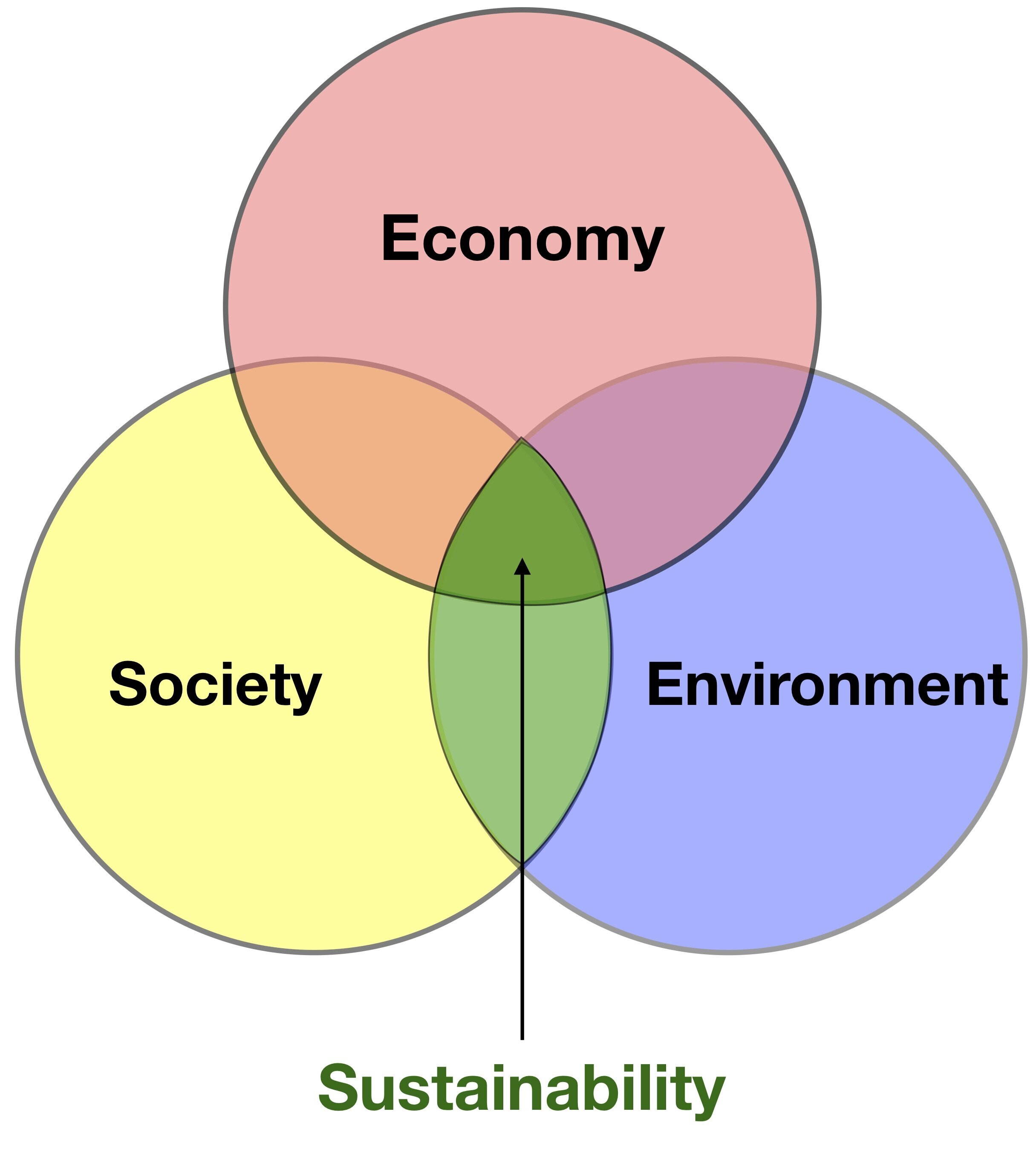
Here is one suggestion of what “sustainability” might mean; do we mean “sustainability” for a business? For social and economic development? For the environment? All of the above? Credit: Wikipedia Commons
What does the word “sustainable” mean in the context of jewelry?
Do we mean a thriving jewelry business, one that we hope will endure for generations to come? Do we mean that miners, their families and communities will have jobs indefinitely, based on their own country’s natural resources? Or does the word “sustainable” make us think about a continual, nonstop and renewable supply of something?
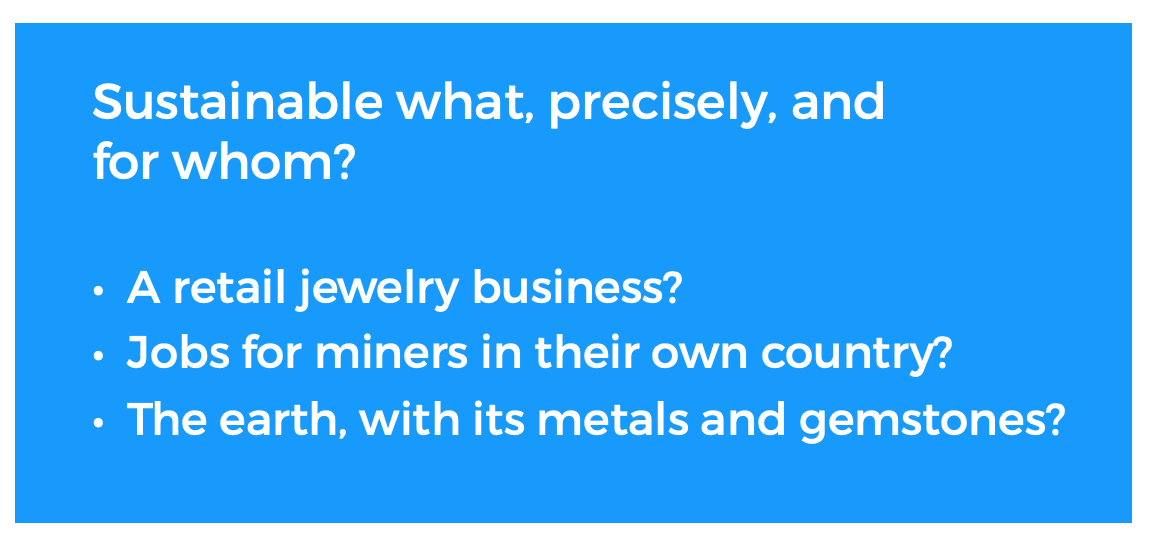
If we contemplate the latter idea -- the renewable or endless supply of something -- can we even use the word “sustainable” when talking about metals and gemstones? Who gets to define the term? The word “sustainable” is lobbed about quite regularly, even though a cloud of vagaries follows in its wake.
Who gets to define the word “sustainable”? One definition that is cited frequently in Europe and in the US comes from the United Nations, via its Organization of Economic Cooperation and Development, or the OECD. The OECD has promulgated Sustainable Development Goals, or SDGs, which encompass social, economic and environmental goals. Although the word “sustainable” makes sense in the context of the UN, it may feel rather remote or academic if you are a consumer and come across a brand selling its “sustainable gems” or “sustainable jewelry.” Does the jeweler (or gemstone dealer) explain what they actually mean when they use this word?
This researcher acknowledges the irony of asking who gets to define a word and then going ahead and offering definitions. I welcome your feedback here and your alternative definitions; I’m especially eager to hear from people in regions closest to natural resources, who may not have benefitted much from those resources thus far.
Google, citing Oxford Languages (in its online dictionary Lexico.com) defines the word “sustainability” as: “[T]he ability to be maintained at a certain rate or level. The avoidance of the depletion of natural resources in order to maintain an ecological balance." Merriam-Webster’s online dictionary hews closely to Oxford’s. Looking beyond a dictionary definition, how have jewelers approached the word?
The Jewelry Glossary Project is a helpful compilation of key terms as they relate to the jewelry industry. (Full disclosure: several advisory council and board members of EM worked on the Jewelry Glossary Project.) The website, jewelryglossaryproject.com currently suggests ten definitions, and more are expected. It defines “sustainability” as:
“Practices that protect environmental integrity and promote human health in the sourcing, production, sale, and distribution of jewelry.”
EXPLANATORY NOTE: The processes related to sourcing, production, sale, and distribution of jewelry components can be sustainable. However, extractive practices of finite resources in the jewelry industry such as gold and diamond mining are inherently environmentally unsustainable.”
In a nutshell, it’s challenging to reconcile the word “sustainable” with precious metals and gems. Regardless of which definition you use, please check if your business partners, clients and vendors are using the same one. If we use the word “sustainable” without explaining what we mean, we seem to undermine the industry’s credibility.
Whose interests do we have in mind, as we settle upon a definition of critically important terms? When we talk about “sustainability” or “responsibility” are we considering all the players in the jewelry supply chain? For example, have we asked artisanal gold miners how they define the words? Are we open to hearing the answers? I have been researching this question, and am yet to find a succinct answer; if you have thoughts on this, please share them.

A helpful question to ask yourself is “Sustainable for whom, exactly?”
A few things come swiftly to mind when talking about “sustainable” gemstones, starting with pearls and lab-grown diamonds. Certain pearls may actually be sustainable, at least in terms of their limited impact on the environment. High quality marine pearls require clean water, and the oysters in turn can help keep the water clean. It is a symbiotic relationship that exists in some pearl farms, but not all. Much has already been written on this, and a good place to start reading is here. A lot of companies are also touting their lab-grown diamonds, but the jury is out on whether they are “sustainable.”
An enormous amount of energy is consumed to create the requisite conditions of heat and pressure; factories are essentially creating the conditions of a volcano. If these factories are located in regions or countries without environmental regulations, there is no easy way to determine the environmental impact. Another problem is that it leaves behind the thousands (if not millions) of miners who depend on mining to survive. As attractive as vintage or antique pieces are, there is still high demand for newly-mined gemstones and the desire to support small-scale miners.
Some of you may be rolling your eyes by now, others throwing their hands up in the air and wondering if they should even continue buying materials and making jewelry at all. There are reasons to continue buying materials and making jewelry, in addition to the pleasures of aesthetics and creation. Countless numbers of people around the world make a living by extracting, processing and selling metals and gemstones. Many want to continue doing so, especially if they can do so safely and while fairly compensated.
Finite materials like metals and gemstones are generally not “sustainable.” If someone uses that word for jewelry, what do they mean? Graphic Design by Deborah Aruta, used with permission.
Rachel Garrahan recently highlighted these topics in British Vogue. Her article in the September 2020 issue included the following:
“Understanding what is truly meaningful in terms of sustainability is a tough area to navigate for those inside this complex industry, let alone consumers on the outside. The key, says Laurent Cartier, senior gemologist at the Swiss Gemmological Institute, is to look beyond marketing claims and demand substantive figures that back them up. While certification by bodies such as the Responsible Jewellery Council, and pledges to meet the Sustainable Development Goals set by the UN are useful frameworks, they are not enough. “If people are going to use terms like sustainability or responsibility, it has to be about the impact your practices are making, and showing how you measure that impact,” he says.”
(Full disclosure: the British Vogue article also mentions Moyo Gems, of which Monica Stephenson is a principal. Monica is president of the board of EM.)
The British jeweler Pippa Small summed up the topic well when she observed, also in the British Vogue article of September 2020, “If you overclaim, you pull everyone down.”


What do beekeeping and fish ponds have to do with diamond mining?