

Why the World Bank is Interested in the Jewelry Business

The content of this article reflects the views of the writer, and not necessarily those of Ethical Metalsmiths. This article was written for The Source. Note: Monica Stephenson is current President of Ethical Metalsmith’s, and Cristina Villegas is an EM Board Member.
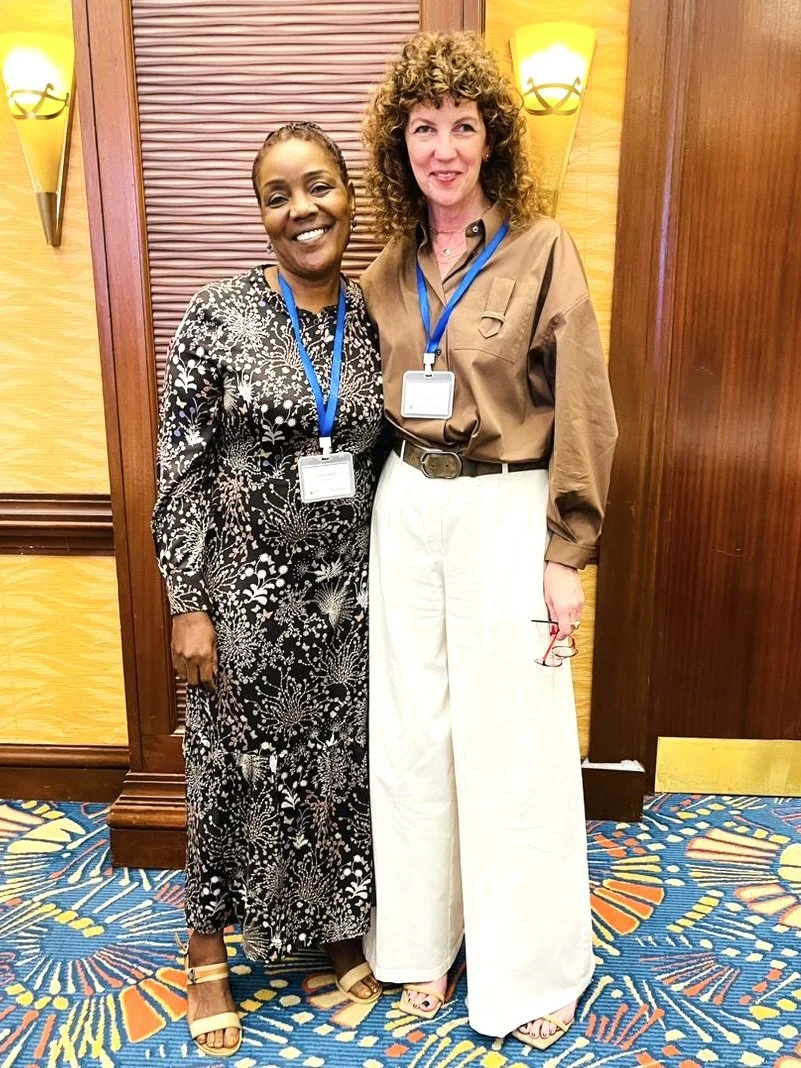
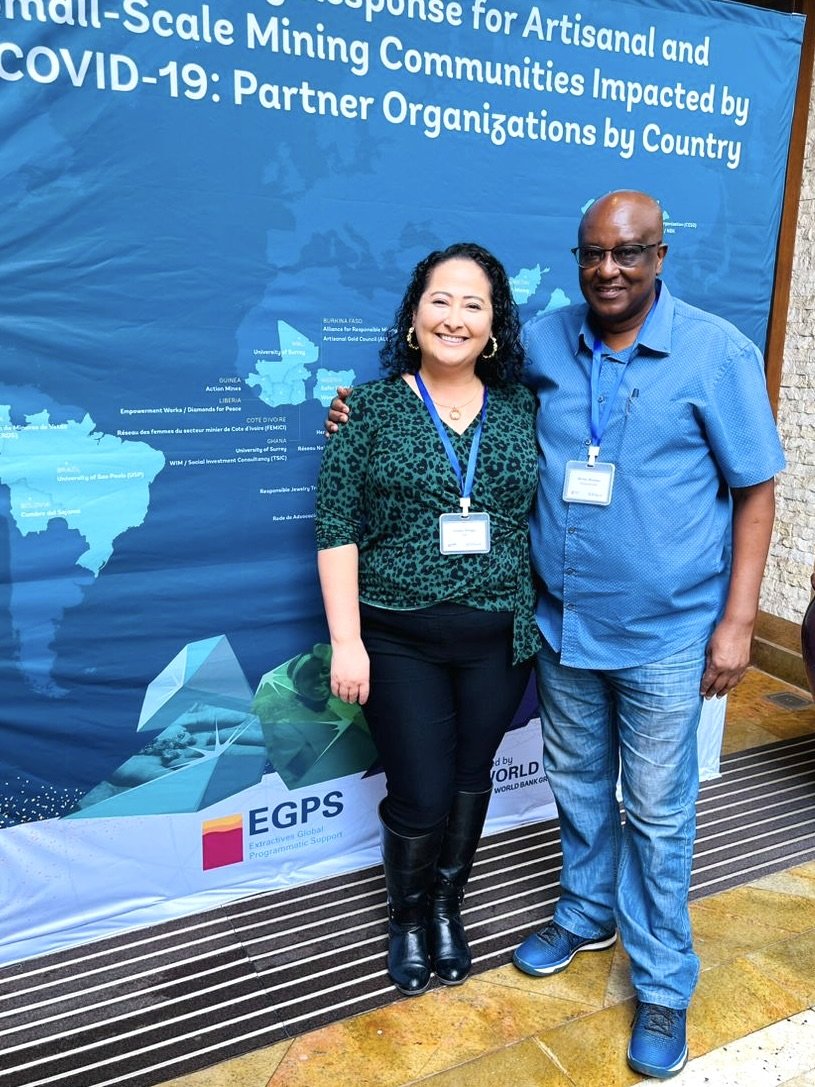
Salma Kundi (right) and Monica Stephenson (left) at the World Bank Conference. Cristina Villegas and Marvin Wambua pictured on the right. Photos courtesy of Monica Stephenson.
In December 2022, I attended the World Bank conference in Nairobi, Kenya (Business Unusual: What Future for Artisanal and Small Scale Mining Post Covid-19?). The global pandemic beginning in 2020 put a spotlight on the plight of artisanal mining: already isolated geographically, the subsistence nature of these communities and their vulnerability was magnified by Covid-19. As the world shut down, international buyers left mining regions, and production or processing costs in mining regions often increased due to the decrease in provider competition. There are similarities in challenges affecting many mining communities the world over including the lack of access to equipment, financing, markets and information about safe mining; these gaps widened to chasms during the pandemic.
During the conference, The World Bank put a spotlight on the work they did from 2020 to 2022 as they invested money and resources to develop programs to connect with artisanal miners all over the world, serving many different minerals and extractives. Reaching and helping marginalized artisanal miners meant recruiting change agents on the ground in their communities. It also required an inclusive approach to empowering communities; a departure from the typical Western-style approach of top-down trickling of resources, where someone in an office far removed from an area of impact decides on a course of action without input from the affected community. Solutions needed trust and understanding on the part of the funders as well as the miners.
The main catalyst of intervention by the World Bank and their partners was to provide Covid-19 prevention information, supplies, and even food assistance to communities early in the pandemic, but what unfolded were robust communication networks that have helped far beyond Covid-19 impacts. The connections spurred by these interventions really highlighted occupational health and safety issues that are inherent to artisanal and small mining (ASM). Gender-based violence—often a serious issue in mining sites—increased during the pandemic in many areas due to economic pressures. Covid-19 is now considered an economic threat to livelihoods by these communities, versus a health crisis.
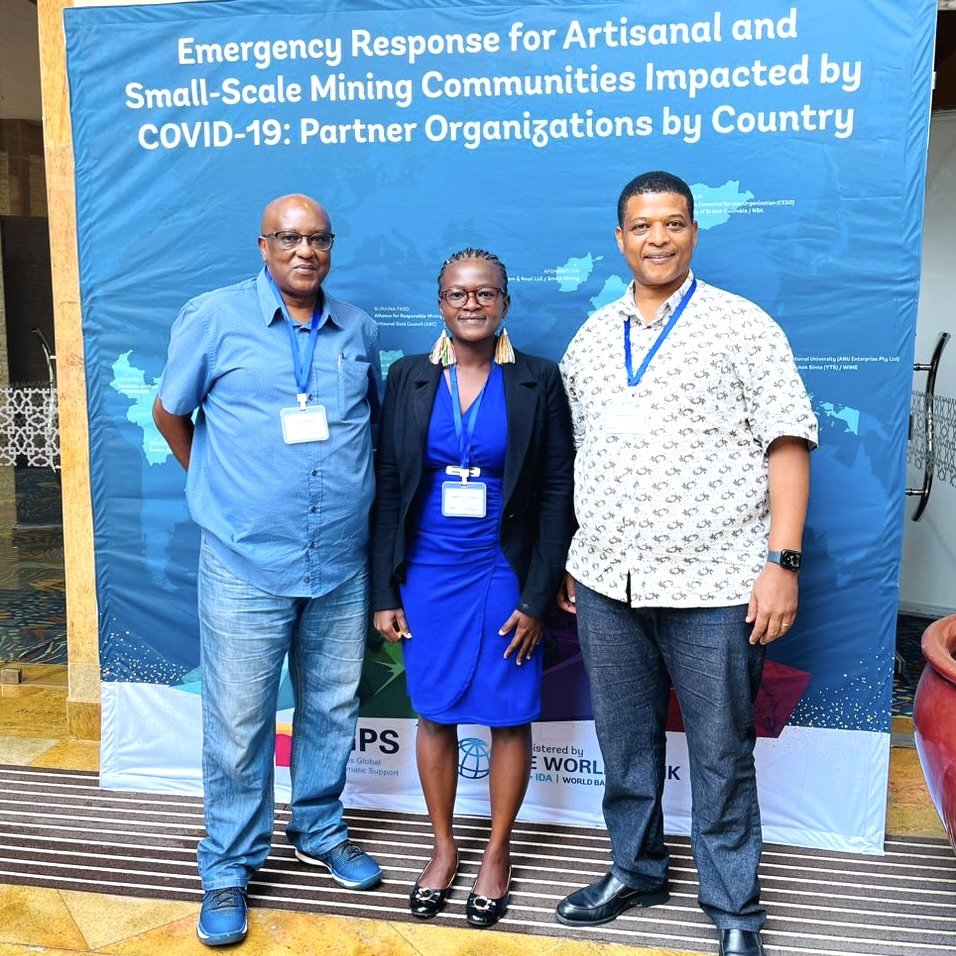
Marvin Wambua, Maureen, and Norbert Massay at the World Bank Conference. Photo courtesy of Monica Stephenson.
The World Bank EGPS funded many projects in many diverse countries. Using local partners such as miner’s groups, women miners associations, and NGOs, they trained trusted representatives to take messaging, and in some cases aid, to very isolated communities. I was very impressed with the representation at the conference of artisanal miners from around the world: miners were in attendance from Kenya, Tanzania, Sierra Leone, Zimbabwe, Ghana, Uganda, Ivory Coast, Bolivia, Indonesia, Peru, among other countries. Translations were provided as many languages were represented.

Cristina Villegas presenting on Moyo Gems. Photo courtesy of Monica Stephenson.
A number of solutions used technology to link these vulnerable communities: the Responsible Jewelry Transformative founded by Susan Wheeler connected women via a WhatsApp group that hosts Tuesday message conversations of a very dispersed group of women through the Marange Women’s Alliance. This was organized during the pandemic in response to major issues, including gender-based violence, affecting women located in a large-scale diamond mining region in Zimbabwe. Women just need a phone and connectivity to share about issues and explore possible solutions. This in turn leads to better awareness of their own rights and the community that can support individuals going through crises. Another group in Nigeria created an app that allowed women to connect with help desks of trained operators about gender-based violence incidents, which uses GPS to map the locations and connect the women to lawyers in their region.
At the end of the two days in Nairobi, the World Bank organizers asked what attendees would commit to doing after leaving the conference. My main conviction is the realization that we are a global community, and by connecting via technology, we can catalyze action through data and sharing information. It takes trust and local partners to co-create programs. I left with a commitment to find ways to enable more women to access micro-financing for markets and tools, as well as issues directly affecting their health and safety. There is a lot of need, but the idea of bottom-up solutions where artisanal miners control their own destiny and have skin in the game is where my heart leads me. The miners are just as interested and invested in these solutions as we are.
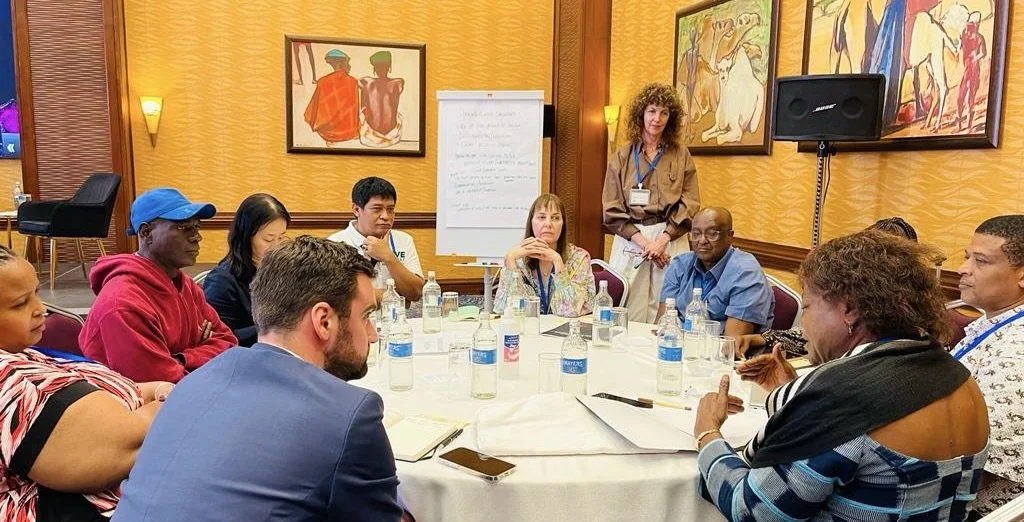
A breakout session at the World Bank ASM conference. Photo courtesy of Monica Stephenson.
World Bank organizers also asked if there is a different word than “formalization” that could apply to ASM development. Formalization can be a loaded word that has been overused in development circles. I like the idea of using “empowerment” as opposed to formalization, which has less colonial overtones and implies the need for internal and external effort and participation.
In late 2022 I had the opportunity to have a few formative conference experiences, from Conversations in Park City, to the Chicago Responsible Jewelry Conference, culminating with the World Bank ASM conference. One of my biggest takeaways is that technology will be instrumental in linking the artisanal supply side more directly to the distribution side of the industry. It’s already happening. Marginalized mining communities get greater access to the market, pricing transparency, and can connect not just with a global market, but with each other as well.
The conferences really highlighted that however we interact with gems or minerals, we need to remember that these gems, rocks, specimens, and minerals all come from somewhere, which means they come from someone. The World Bank invests not in minerals, but in the people and inclusive systems who bring these to market. Knowing that the miners have been enormously affected by the pandemic, climate change, and inflation, consider what sort of insight you need to make a purchase. Who does it benefit, and how much does the person mining it profit? What if you could connect more directly with the person who mined the gem you are admiring? What if you could see an image of their mine, or hear or see their challenges that they overcame to get this particular gem to market? Greater transparency and connection of the mining side and the market side will be beneficial, even essential, for the entire industry.
“We are a small team of passionate jewelry industry professionals and writers. We’d appreciate your support to grow our team and continue to be able to provide the best responsible jewelry content for years to come!”
Something we rarely talk about to the extent that it is almost taboo is what happens with a break-in, burglary or even a hold-up: How do we deal with the aftermath?