What's My Climate Footprint? Climate Calculators Can Help

The content of this article is the opinion of the writer and was written for The Source
Yep, we all have an individual and collective impact on the environment.
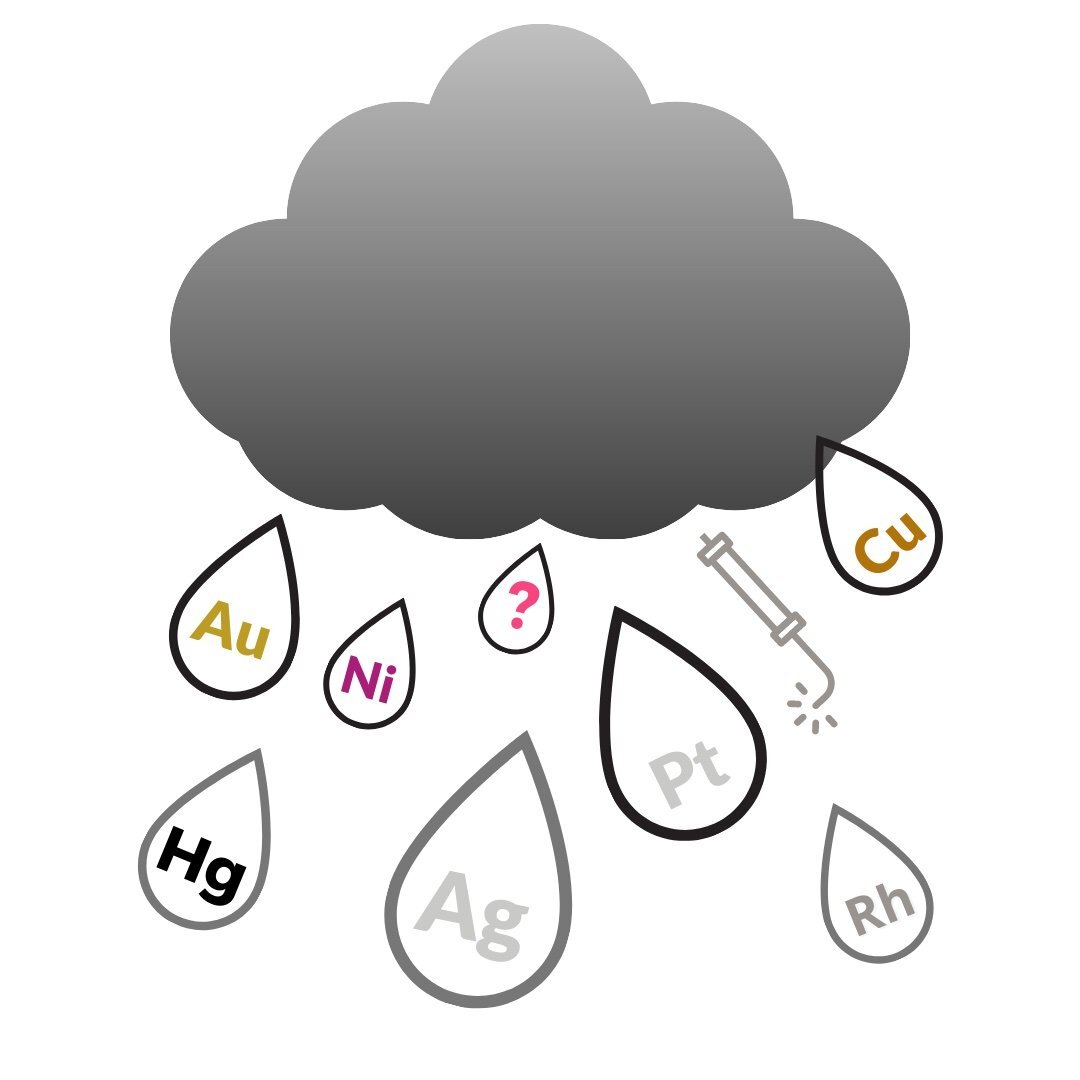
What is the environmental impact of precious metals, extractive industries and of makers? Graphic design by Christina Malle.
How can we actually measure our specific impact?
No need to hire anyone or pay for this assessment; there are free tools to measure how we’re doing.
Please chime in and add other tools or sites you’ve found in the comment section after this article, as you try to measure your own climate footprint. Full disclosure out of concern for your online privacy: please do your own due diligence before entering these sites. Some do ask probing and sensitive questions (e.g., about finances) so please research the sites before you share any sensitive information with them.
EM is not endorsing any of these sites per se (and neither is this author!); this is meant to help jump start your research!
Thank you for reading and for considering your impact on climate and on the environment!

The website Carbon Footprint has a calculator for individuals and households. It also calculates how much of a carbon offset your footprint would equate, and makes it easy to purchase said commensurate carbon offset. They suggest it as a gift, too! The 21st century and secular version of coal in a stocking?!

EDF has a travel footprint calculator, which you can find here. EDF’s site says “Good news: traveling is back! The bad news: our travel leaves a trail of greenhouse gas footprints. Fortunately, you can lighten your travel impacts in three simple steps: reduce, calculate, offset.”
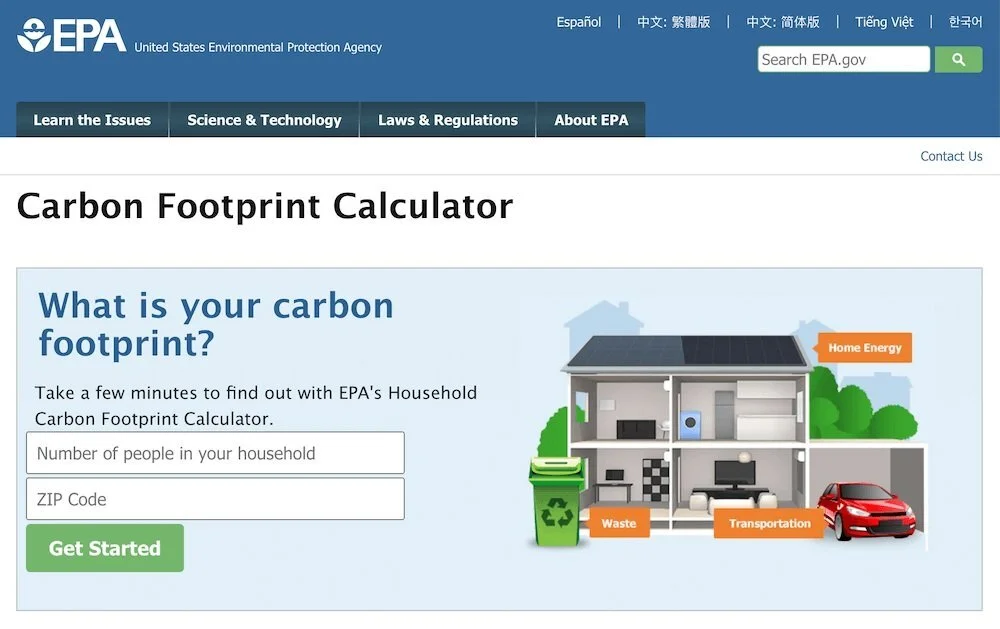
For people in the United States, the EPA’s calculator is one place to start. It also has a link that claims to test a car’s actual efficiency. The car’s efficiency test may, apparently, differ from what a car manufacturer claims about the efficiency of a particular make or model.

From their website: “What's your carbon footprint? Use this interactive calculator to find out—and take action.” The second question, after asking the number of people who live in the household, is “What is your approximate gross annual household income?” Not to be too cynical, but….. was it the advancement team that added this question to the questionnaire?
This is not the only calculator that includes questions about household income. The University of Berkeley also has revenue as one of the first questions on its calculator for the impact of a business. Thank you to The Source’s Niki Grandics for pointing out that higher income is correlated to higher income in climate calculations. See, for example, Oxfam’s site, citing data and studies from the Stockholm Environment Institute. That said, I do wonder whether sharing personal information is a wise choice on these sites; another tool could present a range of incomes and a range of increased or decreased impact.

This site presents its calculator in several languages: the Calculator is currently available in Chinese, English, French, German, Hindi, Italian, Portuguese, and Spanish.
The site claims that you can measure your ecological impact and it also claims to present some solutions.
Carbon Footprint of a Small Business
What if you would like to measure the climate or environmental impact of a small business? I’m leaving large businesses aside for now, since they seem to have sufficient resources to research these topics on their own.
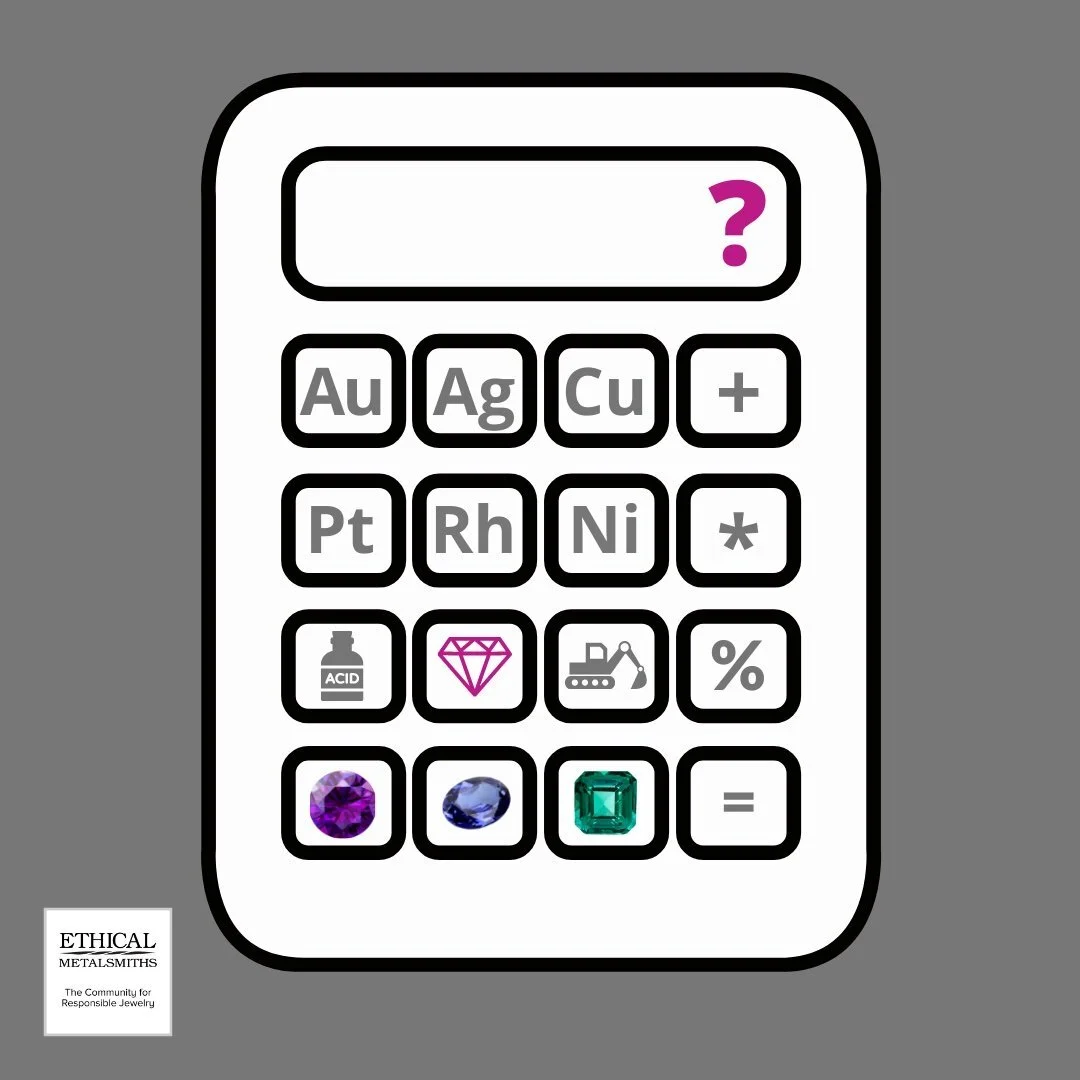
How can we calculate our impact on the environment? Graphic design by Christina Malle.
The University of California at Berkeley’s CoolClimate Network includes plenty of online resources. The CoolClimate site includes the Cool Climate Calculator. After choosing your business's location, a series of questions allows the user to compare that business’s impact to other, similar businesses in the vicinity. In the UK, The Carbon Trust also has a helpful site, including a carbon calculator for small and medium sized businesses.
Calculators for Makers and/or a Business Using Metals and Extractives?
Carbon calculators highlight shipping and transportation, since of course that sector is responsible for so much carbon output. But what if you are using materials that result from industries that are themselves high carbon-producers? If a metalsmith works with mined materials, shouldn’t we also consider the footprint of those materials as well– for example, gold, silver, platinum and diamonds – and not just the carbon associated with travel to trade shows, trunk shows, shipping product and transportation to and from work?
Ouch: an article on the late Canadian Art Foundation’s site by David Balzer poses a painful question in a piece titled “The Carbon Footprint of Art: Are the creative industries the world’s most hypocritical polluters?” If you have a minute, please read that article by Balzer; it will make you think!
For arts and culture in general, please refer to Julie’s Bicycle, another group based in the UK. Their site has a number of tools geared towards people in the arts.
For galleries:
The Gallery Climate Coalition takes a hard look at the responsibility of galleries and the roving energy-consuming and pollution-creating world of global art fairs. This site has a calculator for galleries and artists, but focuses on travel, shipping and packaging, rather than an artist’s fabrication. Find the Global Gallery Coalition’s carbon calculator here. I don’t see questions regarding the media that artists are using to create their works of art; it seems targeted more towards showing the work and transporting it. Since jewelers often use extractives (precious metals, for example), I am searching for a tool directed towards metalsmiths. Can anyone send a link or two? I did find Co2List, which shows CO2 sources in the US and which includes an index for people fabricating with iron, steel, copper or aluminum. I was not able to find a site geared towards using the metals and materials that jewelers typically use.
Wait! … I’m a Student! I Know I Have an Impact, But What About My School’s Impact?
The Association for the Advancement of Sustainability in Higher Education, includes a “sustainable campus index” of colleges and universities in the US and Canada that it claims have done an admirable job creating “sustainable” campuses or institutions.
I’m still trying to find a site that lets me search how each college, university or institute is doing. Here is a list of U.S.-based colleges and universities, ranked by their environmental impact. This list, compiled by The Princeton Review, is “ based on institutional data we obtain from school administrators.” Perhaps a grain of salt is called for, but I commend The Princeton Review for disclosing the methodology behind the list. Thank you to another volunteer colleague at The Source, Pat Syvud, for calling my attention to this site and its list.
Several of these sites include links for offsetting your now-tallied carbon footprint. Personally, I would rather see less carbon output than just a link to purchasing offsets, but please share your opinions on that and more. And we would all love to know if someone has a more useful carbon calculator or site! This is meant to be a start, rather than a definitive list. As wise people have observed, we cannot improve what we cannot measure.
Thank you for reading and for considering your impact on the environment and climate!