

Elyssa Jenkins-Perez and Annie Doresca on BlJC and the I.D.E.A. Program
The content of this article is the opinion of the writer and was written for The Source

Elyssa Jenkins-Perez (left) and Annie Doresca (right). Photos courtesy of Elyssa Jenkins-Perez/BIJC.
Chloe Beaumont: Before we jump in and discuss the Jewelry I.D.E.A. training program, I would love to talk about the organization you both are President and Vice President of, Black in Jewelry Coalition (BIJC). I know that BIJC was spurred on by the “social awakening” of 2020, and the realization that more must be done to provide Black people with access and resources in the jewelry and watch industry. Can you share about the process of forming BIJC?
Elyssa Jenkins-Perez: Yes, we were on a lot of Zoom calls in 2020. On those calls, we realized that not all of us knew each other, because a lot of us work behind the scenes and not all of us attend jewelry industry events. We decided we needed to have a call that is just us, so we can talk about being Black in the industry, as well as get to know each other and see what it is that we wanted to do. That transformed into some smaller groups, and we started asking people if they’d be interested in forming some sort of coalition or organization.
We decided that we wanted to create a membership organization for Black professionals in the gem, jewelry, and watch industry. Annie and I were on those calls in the very beginning as we put a wide net out for anybody that wanted to join us. We ended up with 9 people on the Board who have put so much effort into creating this non-profit organization, Black in Jewelry Coalition, that is the first of its kind—the first organization dedicated to the advancement of Black professionals in the gem, jewelry, and watch industry.
CB: It’s so commendable that you both gathered people and created this new organization, especially because starting a non-profit is no small task. Can you tell our readers about some of the unique resources that BIJC offers for members looking to join the industry?
EJP: So we provide a multitude of resources for potential members looking to join the industry, but also for all of the different current members throughout the industry. We have a member portal where we list jobs and internships that are constantly updated, apprenticeships, past webinar streaming links, and a mentorship page where you can sign up to be either a mentor or mentee. There’s also a lot of general networking and community. We are working on a few very big projects this fall and winter that will launch in 2022. Annie, did you want to add anything?
Annie Doresca: The only other thing I would add is that we also have professional development training for our members, which I think is important whether you are a jewelry designer or a professional at a trade association. It’s important to have access to that as you go through different phases of your career development.
EJP: I also forgot to mention, we have a lot of great scholarship and grant opportunities for our members, as well as a Shop Black Owned page, where we list different Black owned businesses and links to them. You don’t have to be a member to be listed there, but we do encourage membership, which we’ve kept to a very reasonable amount per year.

The nine board members of Black in Jewelry Coalition. Photo courtesy of Elyssa Jenkins-Perez/BIJC.
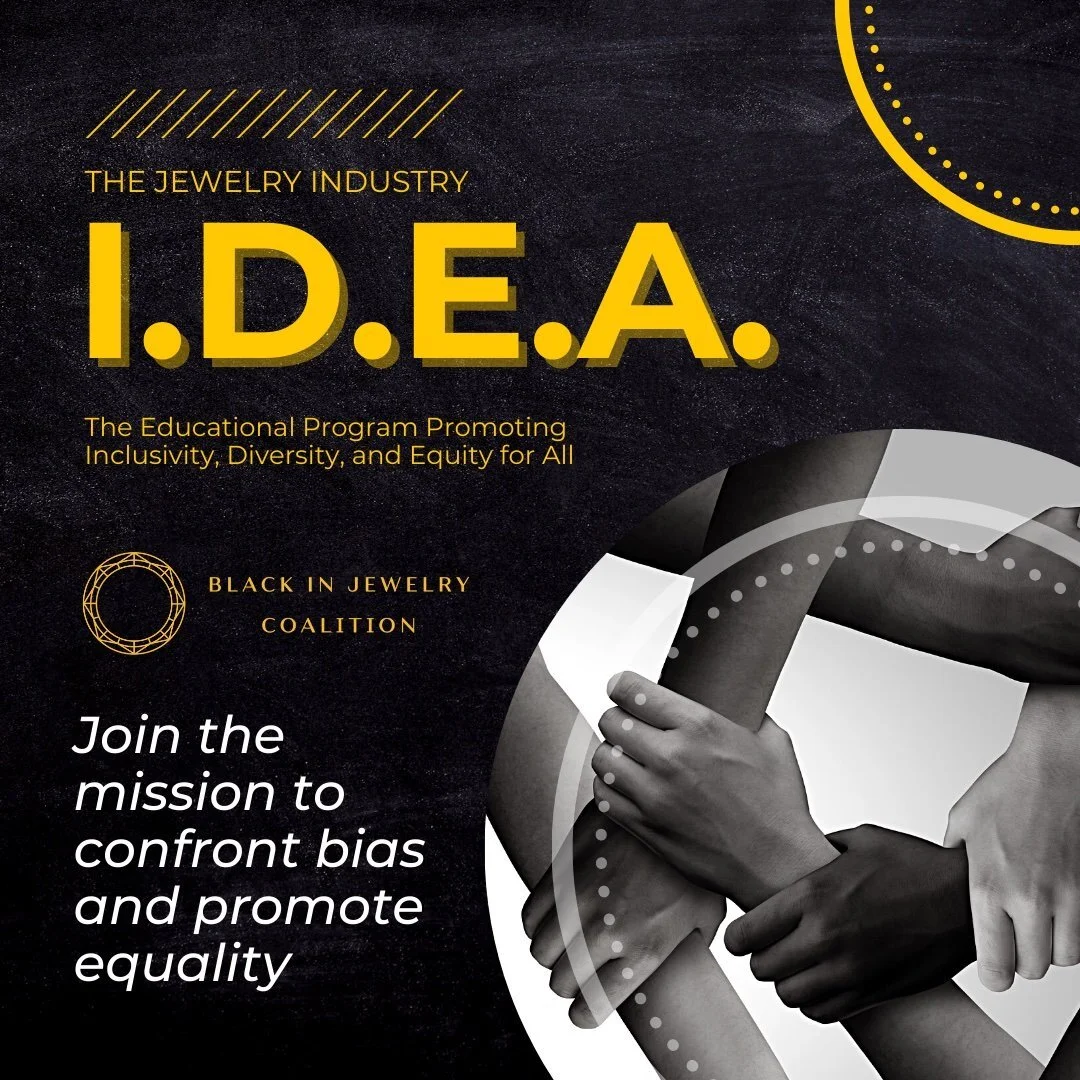
CB: I love that there’s really something for anyone, no matter who ends up looking at BIJC’s website or becoming a part of it. Now, we can jump into talking about this amazing initiative, I.D.E.A. (Inclusion, Diversity, and Equity for All)—it’s a two-part training module that is going to be offered for free on the BIJC web platform. Just so people know how easy this is: all people need to do to gain access is to register through BIJC’s portal, correct?
AD: Correct. You can register on our website, under Initiatives you’ll see the I.D.E.A. option. Upon registration, there will be a lot of reminders ahead of the I.D.E.A. events in January and February. The first session is being held on January 19th, and the second session is on February 16th. I know a few associations have already made it a mandatory training for all staff.
CB: That’s awesome, I was going to ask about that—would you like to see more companies make I.D.E.A. the minimum for their mandatory training?
AD: Yes! We’re definitely encouraging that. What’s great about this partnership with all the different companies and associations that are supporting this is that we have a lot of industry leaders that are already very behind this. Jewelers of America and American Gem Society have already told us that they have incorporated it into their mandatory training, and I’m aware of many other organizations working towards giving it this level of importance as well.
Graphic courtesy of Elyssa Jenkins-Perez/BIJC.
CB: That’s great to hear. You mentioned that one of the goals of this program is to make people aware of unconscious bias. It’s one thing to be aware of something, but another entirely to actually apply what you’ve learned to your daily life. We don’t want people to act like I.D.E.A. is a box that they checked off to prove that they’re anti-racist, and then move on and never think about these things again. What attitude shifts are you hoping to see take place after people complete I.D.E.A.?
AD: I think what’s important is for people to first realize that unconscious bias exists. For instance, a lot of associations may have a board that is not diverse and does not have enough representation. The other shift is inclusivity; as you are going through different levels of hiring, it’s important to realize that diversity is important. For those that are already in organizations, there may be a different level of access to capital. We need to have these important discussions to make sure that all people have access to capital.
BIJC is here to help people gain access, to give mentorship so that they can move up in the industry in all different fields. I’m looking to see more Black individuals at jewelry trade shows. I know I’ve been in the industry 13 years and have not seen that, and I’ve been the only Black person at different events too many times. There’s something wrong with that, and we don’t talk about it.
CB: Definitely. It’s crucial that everyone gets a seat at the table, and representation at every level, or we are not going to see the change that needs to happen. Access is huge—I don’t think many people ever think about that concept, but it is a very intrinsic part of how the jewelry industry has always functioned. I would love to see more diversity even within Ethical Metalsmiths, too—I’ll just put that out there!
On another note, it’s rare that we see such broad support from so many various jewelry industry organizations and companies. It speaks volumes for people’s desire for progress. How hopeful are you both about change coming from directly inside the jewelry industry?
AD: I think it’s interesting—I’m encouraged by the fact that 9 different organizations have gotten their name on this. The fact that BIJC has received a tremendous amount of support in the past year has also been very encouraging. At the same time, what is challenging is that whenever major events happen, everyone flocks to support—last year, everyone was asking “What do we do? How can we help?” That fades away after a while, no different than accessories and fashion. This is way more than fashion; BIJC has felt that people are tired of talking about diversity and the issues that exist. While we are encouraged, we feel that there is a continuous battle to get people to understand how important it still is. We didn’t fix anything, there’s no “band-aid” on this.

Graphic courtesy of Elyssa Jenkins-Perez/BIJC.
EJP: A lot of that is really leaning on the support of allies. The Black people in the industry are not the folks that are perpetuating these issues, and that’s part of why this training is needed. There’s a lot of unconscious and conscious bias out there, especially towards Black people.
We need to remind people that this is more than a moment. There are so many injustices that happen to our people, and if we can create a better place for future Black professionals, that’s our goal. We are glad that our allies are willing to work with us, and we are hopeful that people who take I.D.E.A. can come and listen with an open mind.
CB: Very well said. There’s always things for us to learn, even if you think “Oh, I’m already educated on this.”
EJP: Absolutely. I’m always trying to see how I can be a better ally towards other marginalized groups, too. During the Stop Asian Hate movement, I’ve been looking into how I can be a better ally for my Asian friends and Asian people in general. There are webinars you can attend, books you can read. Also with the LGBTQIA community, I’m constantly trying to figure out how I can be a better ally. Everyone should be doing that for each other. It’s not about doing it once and being like, “Well, now I’m done.”
CB: I hope we are able to keep the momentum that started in 2020 going, because we can’t resort to feeling helpless. There are things we can be doing, and things that need to happen. Just because you’re not a manager or CEO doesn’t mean you can’t effect change.
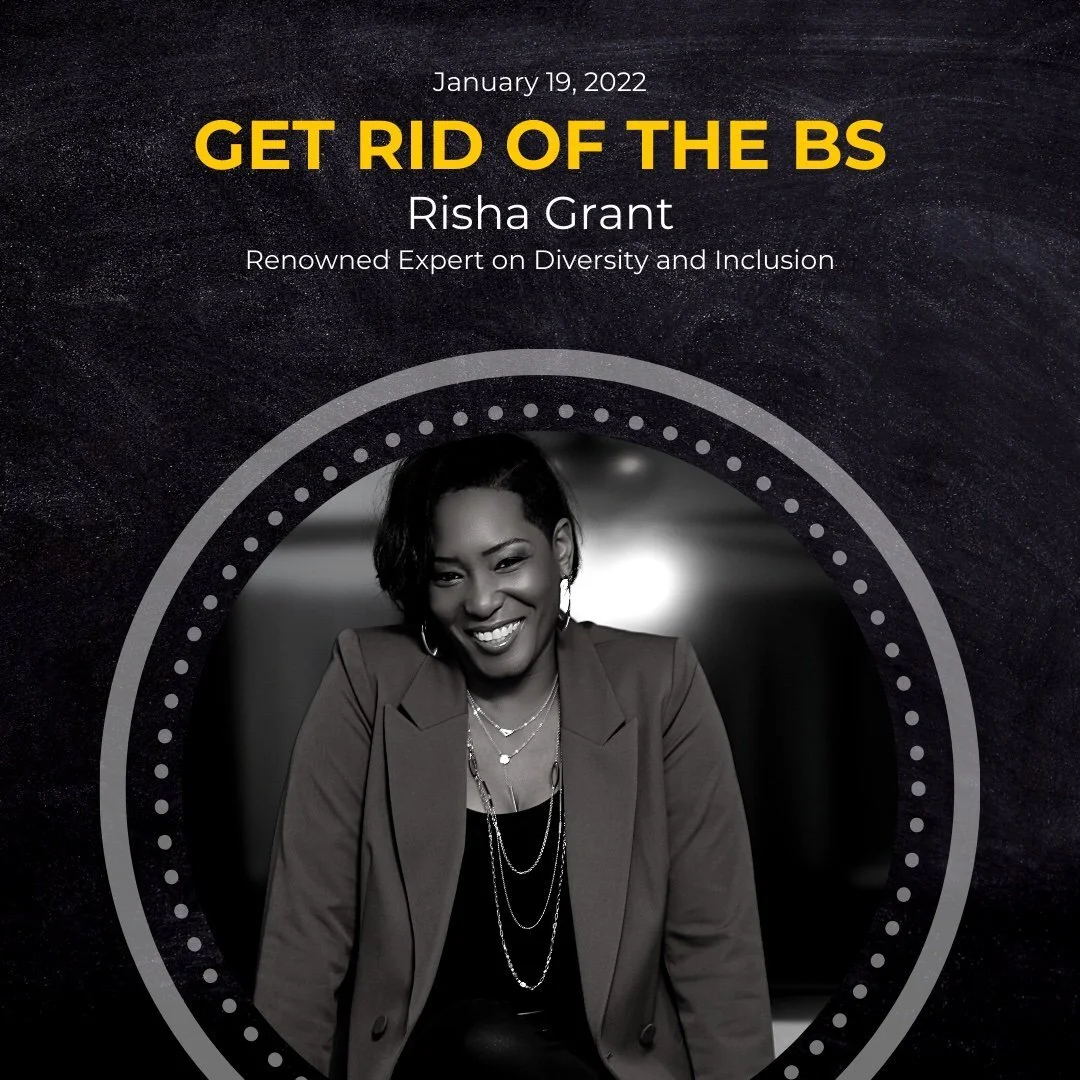
I’m really looking forward to the panel section of I.D.E.A. especially, because I think it will be really practical and powerful.
AD: Yes. I think the Panel portion of I.D.E.A. will help people see cultural biases that have existed. People resonate with other people’s stories, and this might allow them to reflect and ask, “Wow, have I done this?” and if they have, now they will be more cognizant of it. Unconscious bias is called that for a reason, most of the time people are not aware of the things ingrained in our minds.
EJP: Absolutely. This will encompass not only bias, but also microaggressions that many Black professionals have experienced in their time in the industry. For example, when you’re at the event and they assume that you are only the event staff, or that you are lower on the totem pole in your organization. Or, instead of saying a polite greeting, they just ask, “Is your hair real???” These are examples of things that need to stop happening.
Graphic courtesy of Elyssa Jenkins-Perez/BIJC.
AD: I think you said it well Elyssa—just people assuming that you’re not at a high level. The moment you say you are, people’s whole attitude towards you shifts. They actually want to talk to you now!
EJP: In the panel portion of I.D.E.A., we are also going to talk about how this affects customers, too. You should make sure your security is trained and they aren’t just following around the Black customers in the store. This training really can apply to every vein of the industry.
CB: I’m really hopeful that this training will enable every person to walk away having gained something from it. Annie and Elyssa, thank you both so much for making time for this conversation!
I really hope we can get more people signed up for I.D.E.A. through EM’s platform.

Chloe interviewed Jessica Hudson of The Nomad Jeweler on her latest collection that features ASM Colombian gold and Tahitian Kamoka pearls. Read the full article to learn more about Jessica’s story and why she chose to design with traceable artisanal gold and sustainable pearls.