

Nadine Marshall on her Gemstone Faceting Journey

The content of this article reflects the views of the writer, and not necessarily those of Ethical Metalsmiths. This article was written for The Source.
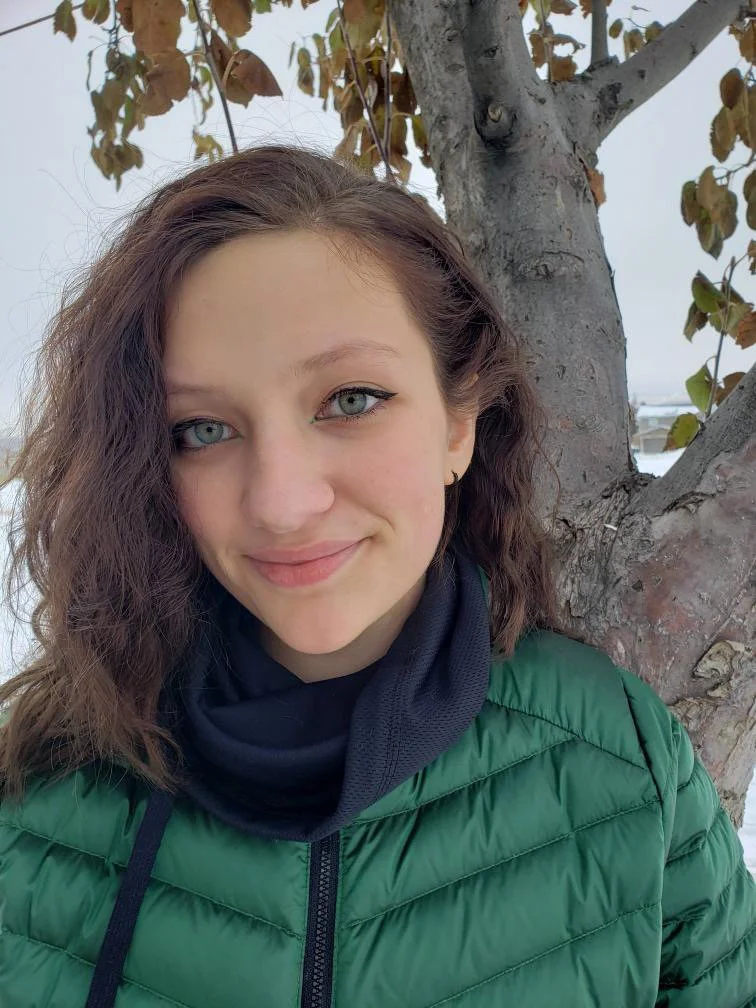
Headshot of Nadine Marshall. Photo courtesy of Nadine Marshall.
Chloe Beaumont: You started cutting gemstones when you were 12, which is remarkable. It’s such an unusual path that most kids that age are not even remotely aware of, let alone want to pursue. Can you share with our readers about how you began cutting at such a young age?
Nadine Marshall: Starting when I was four years old, my grandmother used to take me rock hunting, so that’s how I became interested in geology at first. As I got older, we were living in Southern Oregon and had access to a really good Rock Club in the area. I started going on more adventures around eight years old. My dad shared an interest in geology and would take me to the Rock Club where we could learn more about geology as well as gemology. That club had a Lapidary club as part of it. Obviously I was still too young to start learning, but that’s when I learned what faceting was and I started wondering if that was something I could eventually learn how to do. At that club, you had to be eighteen years old to start faceting, but I tried to learn as much as I could.
When we moved up to Washington, we joined another local Rock Club. A gentleman there made an announcement that he was willing to teach “anyone of any age” how to facet. I was the only kid that was there, so I don’t think his primary audience was children! I asked my dad if I could approach him and at least get his information. He was of course surprised that he had this little twelve year old girl approaching him who wanted to learn how to facet, but regardless, I got his contact information. Two weeks later, I started my first faceting lesson with him and I was just immediately hooked.
I was so fortunate to get the opportunity to learn, and lucky that my dad would stay with me the whole time, since I had to be accompanied by an adult. My parents were both so supportive of me and made the investments for me to be able to begin pursuing this.
CB: That’s really admirable that your parents supported you like that from day one. I think most parents can tell when their kid is really into something, and it’s not just a phase—I mean clearly; you are still here!
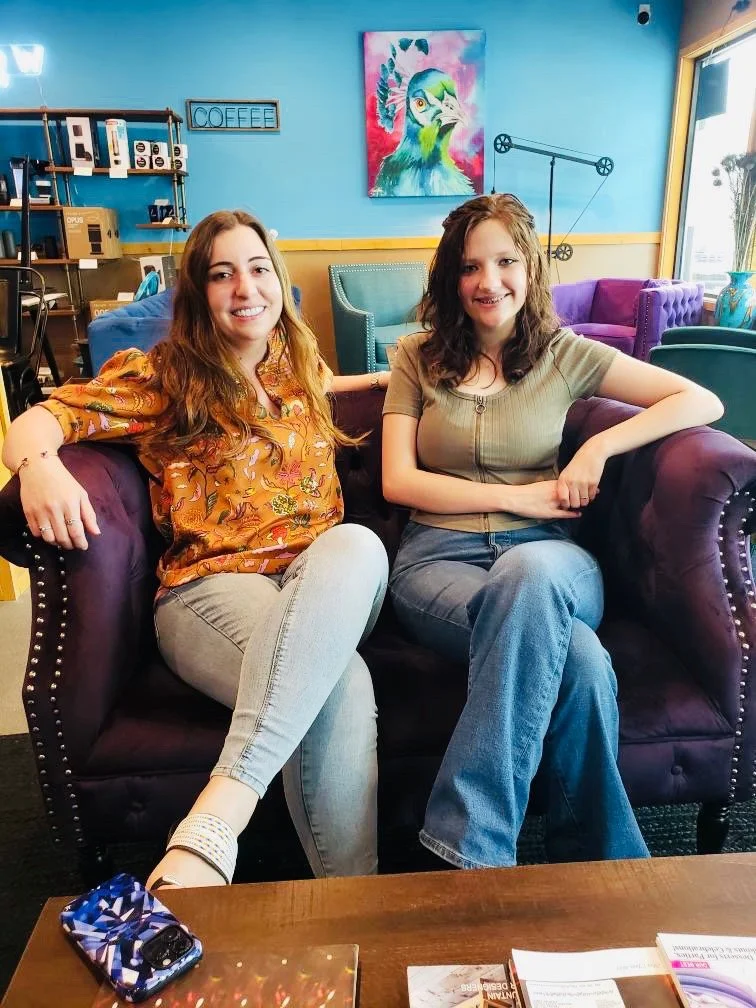
Caption: Chloe Beaumont and Nadine Marshall met up at a Washington cafe for an in person interview. Photo courtesy of Danielle Marshall.
NM: I’ve never really been someone who gets half invested in anything – I’m either in or I’m out!
CB: I very much relate to that. What do you most appreciate about the people in your life who helped you on your initial journey?
NM: First of all, I’m just so grateful that I was even granted the chance to learn. You have to be really patient to teach a twelve year old how to sit down and facet a gem! Not only that, but my dad had to sit there with us for four to five hours straight, twice a week.
Six months after I began lessons, my mom helped me set up a social media account. We started the #mygemjourney hashtag on Instagram to showcase and document what I was doing. Through that, I started getting connected to other people in the industry (neither of my parents are in the gem or jewelry industry) and learned about just how big it was. Most of my connections began online.
CB: Do you have a favorite type of gem to cut and if so, why?
NM: I love green gems – tsavorites are some of my favorites! Garnets are just really easy to cut because they are higher on the hardness scale, and they are very colorful and refractive. They don’t cause as many issues with chipping or scratching while I’m working, and I know that the polish will hold up longer overall. Green sapphire and green tourmaline are also favorites! Honestly though, it’s so hard to choose.
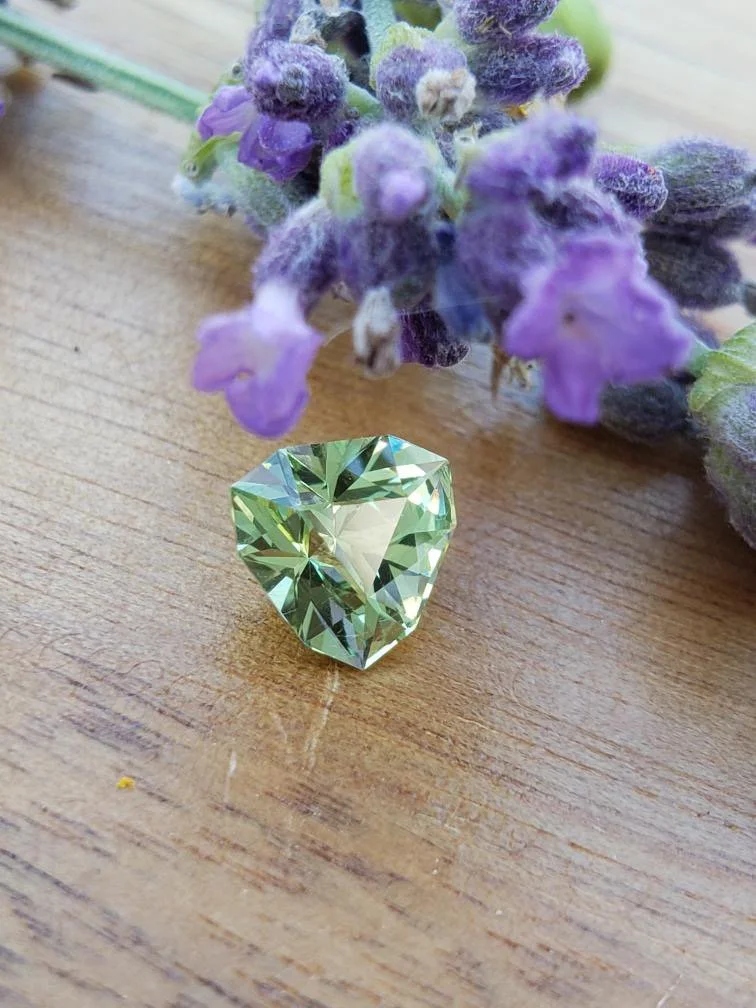
2.25ct Green Garnet faceted by Nadine. Photo courtesy of Nadine Marshall.
CB: Is there anything that you think most people don’t realize about the process of faceting that you’d like them to know?
NM: Outside the industry, a lot of people think that people who cut gems also make the piece of jewelry it gets set into. Of course sometimes that’s the case, but as we know, most of the time with faceters, that’s all they do. It does take quite different skill sets to do faceting versus bench jewelry.
When it comes to within the industry, one thing that people might not realize is that for a softer gem versus a harder gem, I need a different set of supplies. A lot of amateur faceters don’t realize that if you keep everything separate and organized, it makes everything a bit easier!
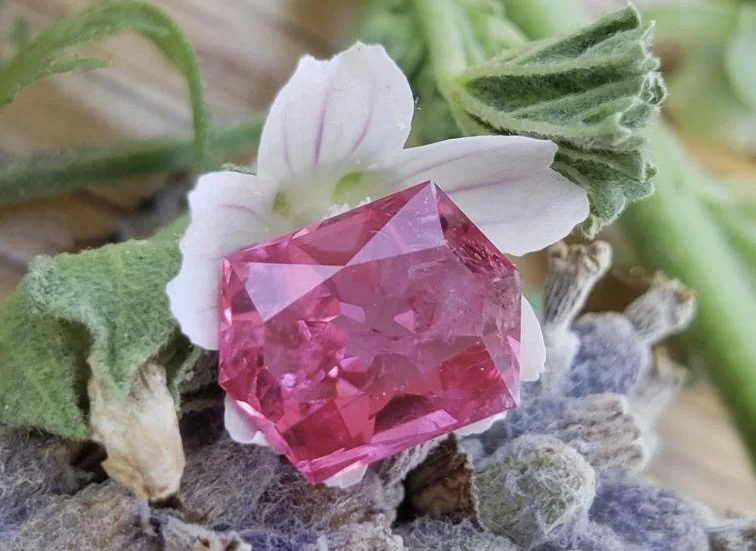
1.6ct pink Mahenge Spinel faceted by Nadine. Photo courtesy of Nadine Marshall.
CB: In all honesty, I’m still learning so much about faceting myself– a lot of us with retail backgrounds can spend years selling or designing jewelry and never really get exposed to that side of the industry!
How important is the country of origin to you when it comes to sourcing rough gems to cut? Are there certain ethical parameters that you consider, or are you leaving it open now since you are early in your career?
NM: If I can, I like to source US-mined rough so I can actually form relationships with the miners. That way, I can understand their process and determine if the rough is being responsibly sourced. I haven’t gone to other source countries yet, but I do facet gems from other countries. I do have specific people that I like to source from, and whom I trust, who go to the source countries themselves.
As I get older and hopefully get to see the mines in person, my process might grow and change a little bit. All my gems come with information cards that have the weight, variety, and country of origin. I fully believe that the more information you can provide, the better.
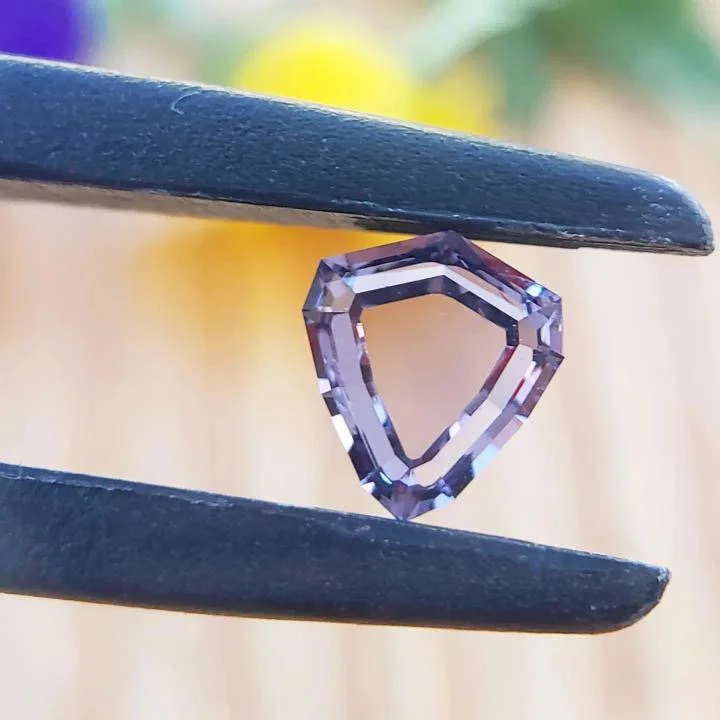
1.72ct Lavender Spinel faceted by Nadine. Photo courtesy of Nadine Marshall.
CB: That’s great that you are focusing on having as direct of a connection as possible with the gem-sourcing countries. Are there any other faceters that you look to for inspiration, or that inspired you when you were younger?
NM: To this day, there are so many people that I look up to as mentors. When I first started @ilovegreenrocks people were very generous and helpful. Some of those people are Anna Gilbert – I love her style of faceting — along with Nolan Spencer and Daryl Alexander. Both Nolan and Daryl helped me learn newer techniques pretty quickly.
Aside from the faceters, Shelly Sergent has been really kind and has helped me navigate the gem industry. My family and I really had no idea what we were getting into – and we still sometimes don’t! There have been so many people that have helped in smaller, more specific ways; I can’t list them all off the top of my head.
CB: I’m glad that many people have come alongside you to mentor you and give guidance. From your perspective, are there still resources that you feel are missing or gaps that mentors in the industry could fill?
NM: I think the biggest thing is helping young people realize that gemstone faceting is even an option or career path for them. If I hadn’t been involved in those Rock Clubs, would I have ever learned about faceting?
The second thing would be, once someone is involved, directing them towards (or giving them) resources to help them continue their journey. One of the things that was crucial for me was having access to people that I could ask questions. There are some things you can teach yourself or learn the hard way (which I have done!) but being willing to share information and walk people through things is huge.
Ultimately, once someone has the resources they need, they can go wherever they want to go with their career.
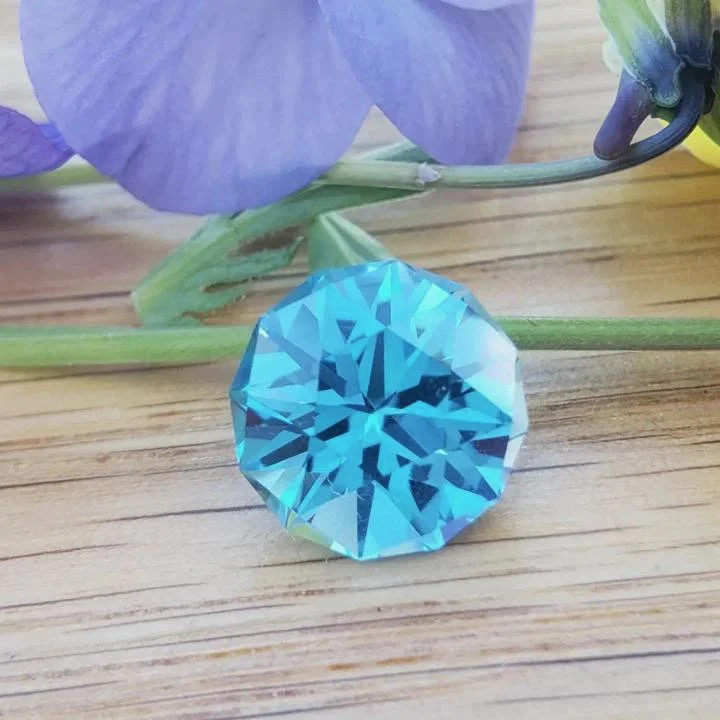
6.65ct Blue Topaz faceted by Nadine. Photo courtesy of Nadine Marshall.
CB: Very true! I know you’ve got your sights set on attending the Gemological Institute of America (GIA) after high school graduation! What are you most excited for?
NM: Well, I love science and GIA definitely combines science and gemstones. To be a good faceter, you have to understand refractive index, dispersion, etc. I’m really excited to keep learning about how gems form, what they are composed of, how to identify them – all of it. That’s what started my interest in gems in the first place, and continues to be my main passion. I would love to have a full understanding of what I’m looking at with each gem I facet.
CB: Awesome. I know you are going to do great. Nadine, thank you so much for your time and for becoming my latest “Illuminator!”
“We are a small team of passionate jewelry industry professionals and writers. We’d appreciate your support to grow our team and continue to be able to provide the best responsible jewelry content for years to come!”
Editorial Section
What to read next from The Source
Like what you are reading? Please help support our editors and writers today.

Interested in becoming a member?
Enroll in our Affiliate Program
Christina Miller’s Foundations for Sustainable Jewelry Practices
If you're interested in being a part of this incredible program, enroll today!
Something we rarely talk about to the extent that it is almost taboo is what happens with a break-in, burglary or even a hold-up: How do we deal with the aftermath?