

Ethical Jewelry Reality Check

The content of this article is the opinion of the writer and was written for The Source
On May 25, 2020, George Floyd was murdered by then-Minneapolis police officer Derek Chauvin. To say there’s been a dramatic cultural shift in the year since is just about the biggest understatement I could make. Everywhere you turn, businesses are now pro-BIPOC (Black, Indigeonous, + people of color), anti-racism, pro-LGBTQ+, Anti Asian Hate.
Within the jewelry industry we’ve seen a renewed and growing focus on ethical sourcing, especially with an eye to producer communities — typically BIPOC. Many of you reading this will have noted the sharp increase in webinars focused around the plight of the 40 million small-scale miners who supply much of what we use to make our jewelry, and perhaps you have even attended many of these events. This outpouring of concern is encouraging and clearly commendable in many ways.
But let’s get uncomfortable for a second:
Racism is not new, and colonialism is hardly new. Their effects are real, have been real, and are ongoing. As a member of the BIPOC community, and as a queer person, I can’t help but wonder…if we matter so much, where was all this support 2, 5, 10, or 100 years ago?
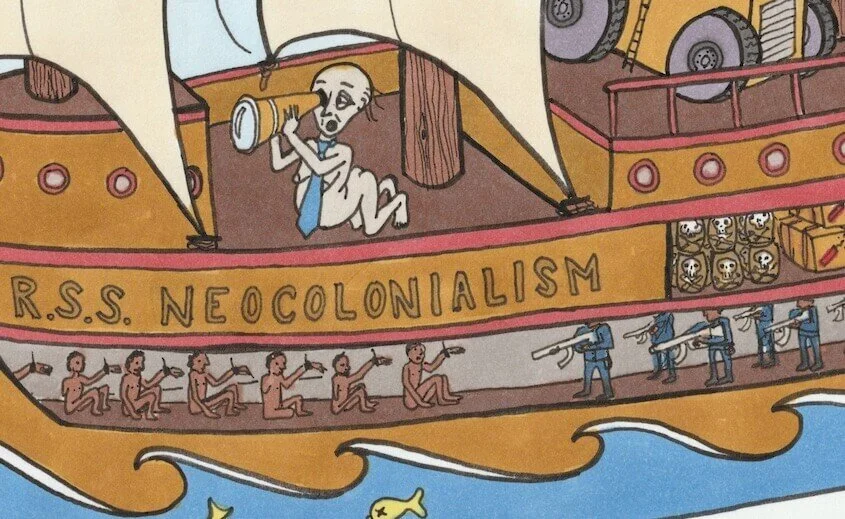
The jewelry industry is steeped in neocolonialist practices. Illustration by Alyssa Lown.
Why the sudden change of heart? Was Floyd really the last straw that shifted Roger Goodell’s position, for example? Or might there be a more sinister motivation at play?
Clearly, being “woke” is now in vogue — for corporations as well as individuals. And yes, there are plenty of upsides that come with this. It opens the door to difficult conversations, for example — always an important first step. But it is critical that we recognize the difference between heartfelt activism and an opportunistic marketing ploy.
Many of us know from our own experience, confirmed by studies, that Millennials and Gen Z will pay more for an “ethical” product. When large companies manipulate the narratives being fed to these concerned consumers — and cause them to believe they are buying something “ethical” which in reality it is not by any measure — we all lose.
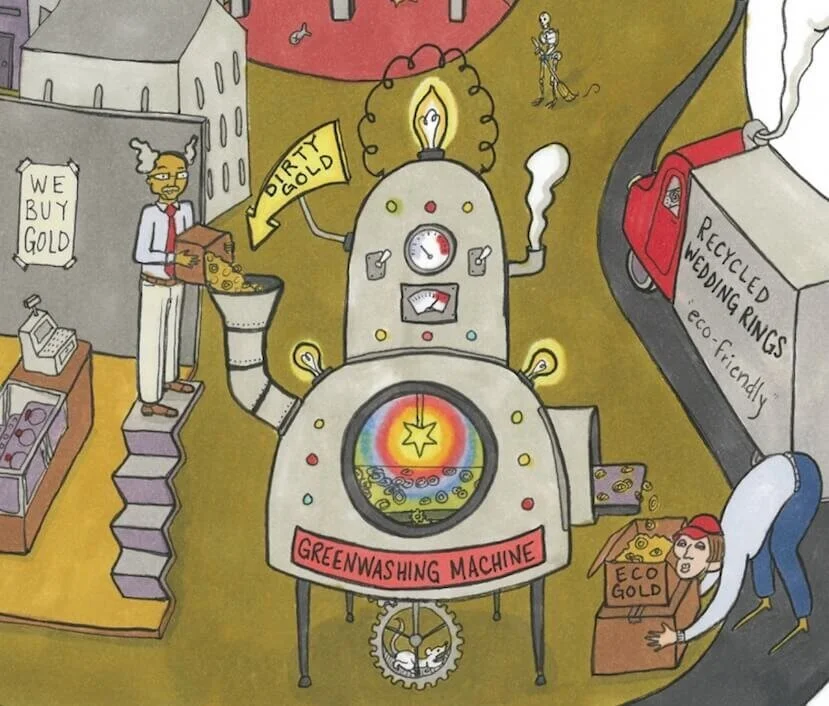
I believe that presenting recycled gold as the ethical solution is no more than greenwashing. Illustration by Alyssa Lown.
We are in the midst of the Anthropocene epoch, a mass extinction. Mining is a major contributor to the degradation of our global life support systems. So, let’s measure the true benefit in the jewelry sector:
When it comes to diamonds, the realities are often bleak. Outside of a few niche programs, diamonds remain as untraceable as ever. The foundation of “ethical” diamond assurance, the Kimberley Process (KP), continues to certify diamonds as “conflict free” — a term that does not account for human rights abuses, child labor, environmental impact, labor conditions, or a host of other concerns. Many prominent members of the industry have spoken out about the failures of the Kimberley Process, and several of the NGOs that helped found it pulled out years ago. The Kimberley Process Civil Society Coalition recently renewed its calls to re-analyze and reform the KP, though some would argue that we need a new path entirely.
Then we have the rampant abuse in the cutting and polishing industries. On this end, and in terms of environmental impact, lab grown diamond manufacturers do not fare any better than mining companies. They often (but not always) refuse to say where or how their stones were cut, and they require huge amounts of electricity to create their product. Many diamond-mining countries also rely on diamonds as a substantial part of their economy — something creating lab grown diamonds does not address.
When it comes to gold, plenty of concerns regarding both the environment and human rights swirl around large-scale mining (LSM). But often, our biggest concerns are with artisanal and small-scale mining (ASM) — the #1 contributor to global mercury contamination. Countless families across the Global South that rely on ASM scrape by on less than $2/day, and the solution offered by many is to choose recycled gold — which, as I’ve argued, has zero benefit to producer communities and leads to no reduction in mercury pollution.
According to my own research, 15 years since the birth of the ethical jewelry movement, maybe 25K small-scale gold and diamond miners are benefitting from programs designed to help them — out of 40 million. (And, 25K is a generous estimate!)
Despite the efforts of many, Fairmined Gold has not achieved broad market impact in America, even though it is a worthy initiative and more people are signing up to become licensees. Fairtrade Gold unfortunately never even got off the ground. In the UK, there are over 300 Fairtrade Gold jewelers. In the US, just one.
Meanwhile, almost every major jewelry brand these days is branding itself as “ethical” — based on some small program that is in reality a marketing project, a manipulated claim that deceives an uneducated public, or even based on nothing at all. (I’m not going to name names, but Google is your friend.)
So we might as well just throw in the towel, right?
Absolutely not! This is a reality check, not a “woe-is-us”-fest.
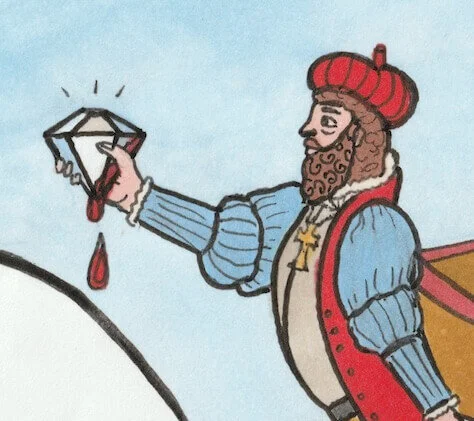
The same forces that drove Vasco da Gama to haunt the coasts of Africa in search of gold and slaves drive elements of the jewelry industry today. Illustration by Alyssa Lown.
Fairmined and Fairtrade Gold still have massive potential in the US — the second-largest jewelry market in the world. With consumer demands trending toward eco-friendly and socially-conscious, there is plenty of unrealized potential to tap into — and every Fairmined or Fairtrade Gold wedding ring makes the world just a little bit better. Plus, there are other certified ASM gold programs in development worldwide, some of which are designed to assist miners and mines that otherwise might have difficulty achieving Fairtrade or Fairmined certification.
First and foremost, we’ve got to work to uplift our brothers and sisters from exploitation — and, we’ve got to give them a viable alternative to mercury, which is destroying our planet. (Stay tuned for a future article, where I’ll delve into all of this!)
In my interview with jewelry designer Alexia Connellan, which took place almost a year ago, she noted that “Looking at American history, everything is really cyclical: it’s two steps forward, one step back…two steps forward, one step back — but it’s important to keep pushing.”
This is why I am pushing. In the wake of George Floyd’s murder, I saw the massive wave of protests. I even took part. But, returning to my earlier point — it’s hard to feel that everyone is genuine in their concern, when you’ve watched so many other George Floyds go by with hardly a remark. What’s different about now? Is performing wokeness just the hip thing these days? Or is there real sentiment behind this?
When it comes to the jewelry industry, we need to be realistic about the strides we’ve made — and the amount of work ahead of us. This labor requires a constant vigilance of the forces we are up against. Dismantling a colonialist supply chain hundreds of years in the making is not going to happen overnight, or without a fight. The capitalist world we live in does not ease the situation.
To the small jewelers reading this: few of us would call ourselves experts with all the answers. Colonialism runs long and deep. The oppression of impoverished BIPOC is a profound and systematically entrenched global phenomenon. There are a lot of powerful people and organizations making a lot of money to maintain the status quo. They will feed us scraps of hope to make us feel like everything is moving in the right direction. Do not be fooled. If they wanted to remedy these systemic issues, they would have been righted long ago.
If you’re reading this piece, I have to assume you care about ethics in jewelry. If you’re a member of Ethical Metalsmiths, surrounding yourselves with like-minded people looking for genuine solutions to difficult problems, that is an incredible first step. But we’re not going to get any further with pats on the back.
We’ve got to keep pushing. But more importantly, we’ve got to keep re-evaluating where and how we push. If we want real change, we must address the underlying structures that prevent us from benefitting producer communities.
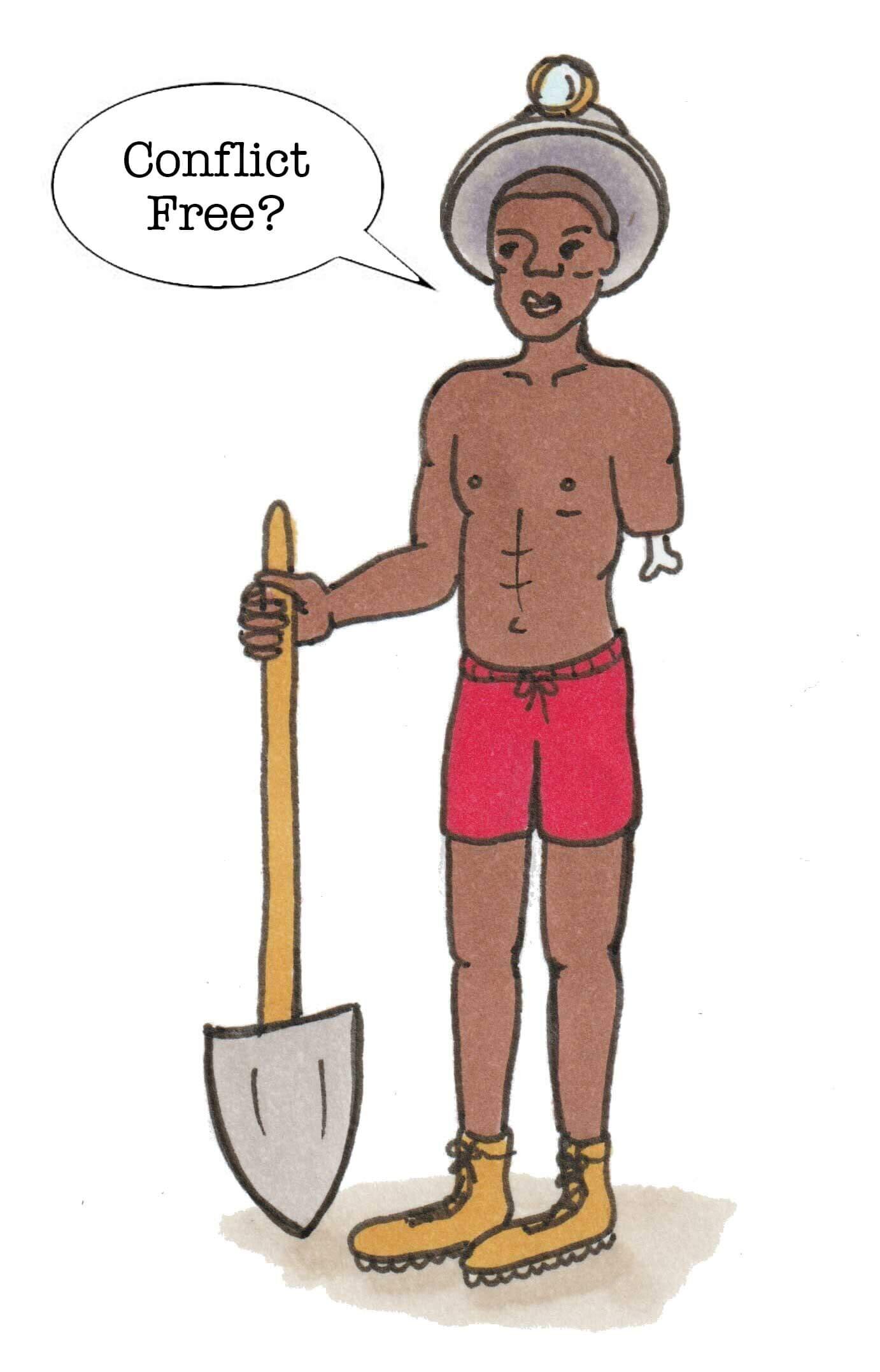
Many in the jewelry industry would agree that the term “conflict free” is a farce. Illustration by Alyssa Lown.
We could start by finding ways to get ethical ASM gold into the market at a viable price. 6% over spot would undercut the recycled gold price structure and allow for huge momentum.
Germany just formally apologized for the genocide of Herero and Nama people, which took place between 1904 and 1908 in what is today Namibia, and was driven by the diamond trade. Perhaps some day we will see some restitution for the 3.7 million people who died in diamond-funded wars during the ‘80s and ‘90s. But so far, not one person in the jewelry sector has been held accountable. Instead, we have the Kimberley Process’ term “conflict free diamonds,” a kind of denial which should be torn down like monuments to confederate generals.
We need a new definition that reflects the reality on the ground, and we need to demand traceability and accountability.
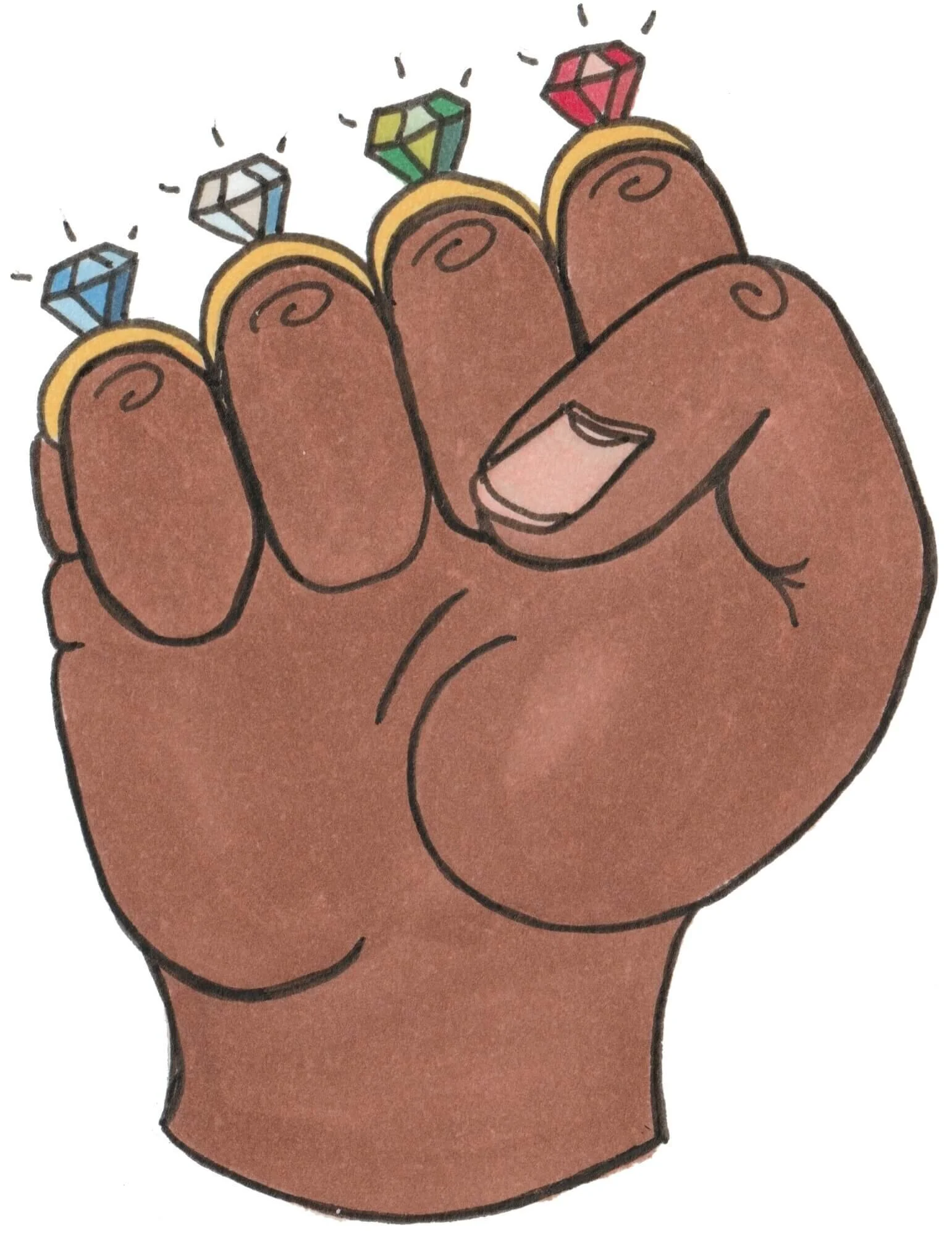
Illustration by Alyssa Lown.
As I write to you, I am the newest writer here at The Source, heading a new section entitled “Excavations: Unearthing Ethical Jewelry.” My goal is to challenge you, whoever is reading this, to stay vigilant, stay strong, and stay focused. The death of George Floyd offers us a new opportunity for progress. But we have a steep climb ahead.
Are you a member of Ethical Metalsmiths looking for ways to get involved?
Consider joining our newly-formed Action Coalition: an initiative where we tackle the real-world problems facing our industry.
Email mail@ethicalmetalsmiths.org for more info.


What do beekeeping and fish ponds have to do with diamond mining?