

Meet Nihma Oduniyi, Founder of The Lagos Jewelry School
The content of this article is the opinion of the writer and was written for The Source
Meet Nihma Oduniyi
Nihma Ibironke Oduniyi is the founder and current Creative Director of the Lagos Jewelry School in Lagos, Nigeria. Nihma studied at Central St. Martins College of Arts in London and the London Jewelry School and went on to launch her own design company, ION Jewelry. She also recently helped start the Pan African Jeweller’s Association (PAJA).
Note: Due to the time difference between Lagos and the US, this interview was not done live, but I hope you enjoy reading about Nihma’s impressive jewelry journey!
The following conversation has been edited for content and clarity.

Nihma Oduniyi at the jeweler’s bench. Photo courtesy of Nihma Oduniyi.
Chloe Beaumont: How did you first become involved in the jewelry industry?
Nihma Oduniyi: I've always been intrigued about jewelry since my childhood because my mum loved to adorn herself with it. I assumed it was made by special machines, just to grow older and discover that it was made by humans! I just knew I had to learn how to make it as well!
CB: What was your time at Central St. Martins in London like, and what is one of your top takeaways from your time there?
NO: I loved every moment of my time at Central St Martin's London. It marked the beginning of a new chapter in my life and I made sure I soaked it all in. I learned about different approaches to tackling jewelry design and the business of jewelry making, which was a whole new world for me.
CB: How many students currently attend the Lagos Jewelry School? Can you talk about your typical student (age range, background, do most end up starting their own businesses or getting hired in the field)?
NO: We currently have 6 students and have trained over 70 students to date. Our youngest student was 21 whilst our oldest was 40 at the time. On average the age groups of people that have passed through our school falls between the ages 27-30. Most of our students already earn a living from beadmaking, so they are coming to LJS (Lagos Jewelry School) to upgrade their skills. For those who had no previous knowledge of any form of jewelry making, about 50 percent have since gone off to set up their own businesses.
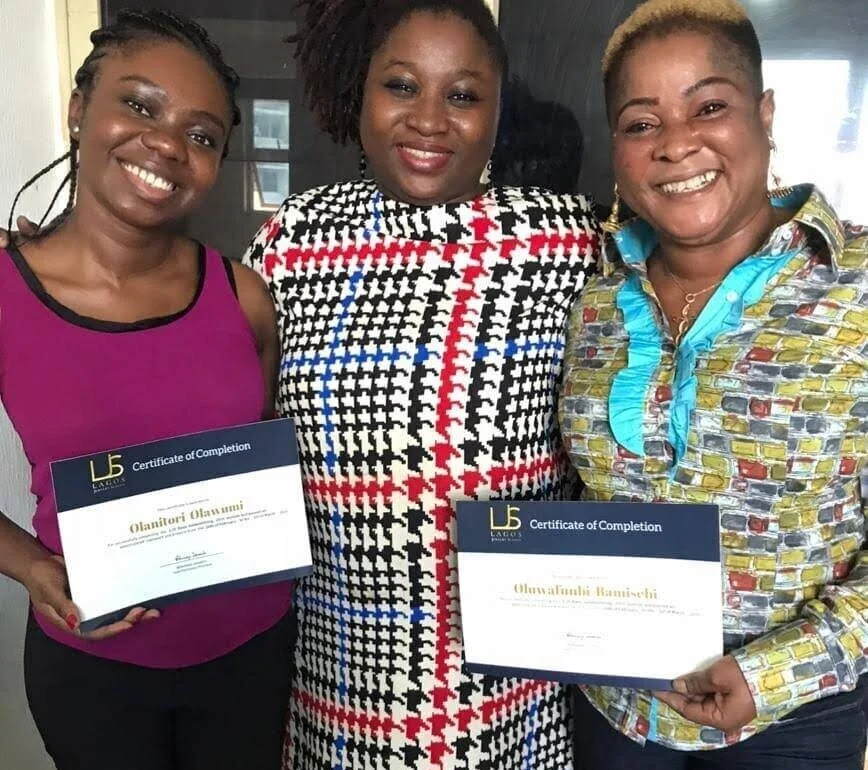
Lagos Jewelry School Graduates. Photo courtesy of Nihma Oduniyi.
CB: What inspires you the most about your students, as Creative Director? What do you enjoy most about your role?
NO: I’ve been blessed with students with various creative points of view different from mine, which serves as a source of inspiration for me. So I love to pick their brains and discuss design ideas for personal projects.
“As the Creative Director I get to meet different people with unique talents which I always marvel at. I love that I am there to help mold and develop their unique creative views and bring their dreams to reality.”
CB: What is the jewelry industry like in Lagos, Nigeria, specifically? What are your hopes for the local industry going forward?
NO: The jewelry industry here in Nigeria consists mainly of talented bead-making practitioners and a lot of upcoming modern goldsmiths, the older generation of goldsmiths who mostly now focus on mass jewelry repairs, a small population of gemologists and lots and lots of imported finished-jewelry entrepreneurs.
The jewelry gospel is spreading and we are now seeing a new crop of goldsmiths and gemologists, which is beyond great, considering the fact that Nigeria is a bedrock of natural resources such as gold and gemstones. My hope for the forthcoming years is that we would be able to create a viable market for our homegrown jewelry made from precious metals and gemstones that are all mined and cut here in Nigeria.
CB: Are most of the stones you use for ION Jewelry mined in Nigeria? Can you talk about your decision to use mostly Swarovski crystals in your designs---was that a choice made from an ethical point of view?
NO: Currently 90 percent of the gemstones used in my jewelry pieces are mined within Nigeria, and cut here as well. My choice of Swarovski crystals came from a unique design point of view. To be honest, I had no idea that Nigeria was rich in natural gemstones deposits until 5 years ago, and I've been a jeweler for over 10 years now. So my decision of using Swarovski crystal was born out of the need to create unique and fine jewelry quality pieces. There has been a transition from Swarovski crystals to Nigerian mined and cut gemstones in the past 4 years. My choice of using Nigerian mined gemstones is the one made from the ethical point of view.
CB: I saw that you are the co-founder of the Pan African Jewellers Association. What was the catalyst for you co-founding this organization, and what are your association’s top goals?
NO: Yes! Covid-19 came and the dynamics of everything we knew changed; it made us look inwards and ask questions. This led to the realization and decision for us to create a network of African Jewellers where we could all come together, collaborate and find new ways to develop and also launch the African jewelry market to the rest of the world. It’s no news now that Africa is blessed with natural resources such as raw precious metals and natural gemstones and it’s about time for us as Africans to make use of these resources to help develop our various communities and nations.
Our organization’s top goals are to meet these United Nations Sustainable Development Goals:
SDG 1 No Poverty
SDG 4 Quality Education
SDG 8 Decent work and economic growth
SDG 9 Industry, Innovation and Infrastructure
SDG 12 Responsible consumption and production
As well as our own more specific goals:
To create awareness for the African Jewelry and gemstones industry
To claim a global market share
To facilitate trainings and have a resource hub for our African jewelry and gem professionals
CB: I recently learned that metal casting, specifically bronze casting, originated in Benin, which neighbors Nigeria. Do you find it ironic that metalsmithing has had an extremely long history in West Africa yet most people have no idea about that, and consider the most prestigious metalsmithing schools to be in western countries?
NO: Yes, I do think it's quite ironic that a lot of people have no idea about this. I was one of those people 10 years ago, which was why I ended up at Central St Martin's as well. This is one of the reasons Lagos Jewelry School was set up--to create awareness of our capabilities here in Nigeria.
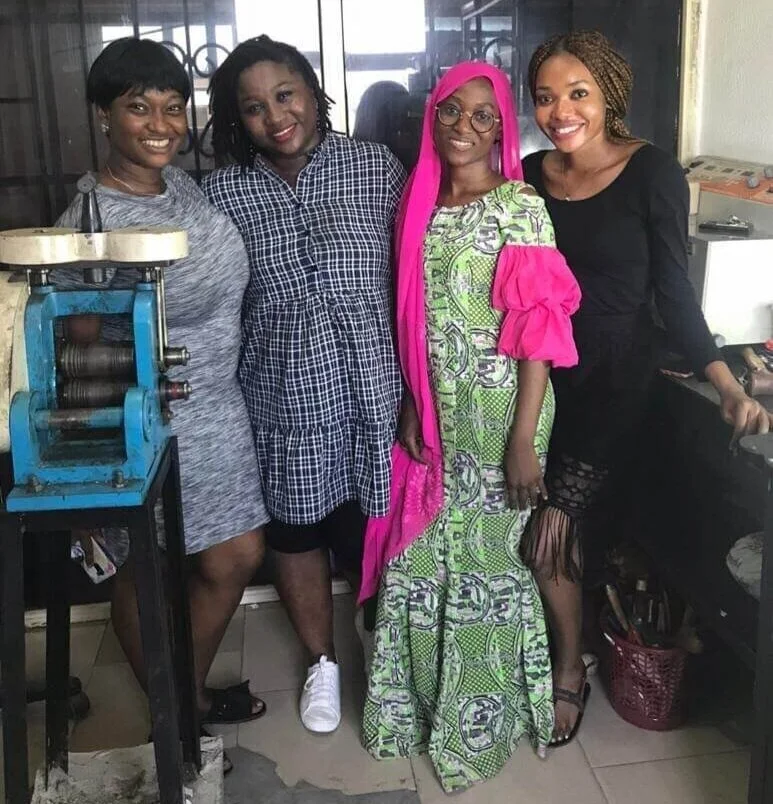
Visiting the Lagos Jewelry School. Photo courtesy of Nihma Oduniyi.
CB: What would you want our readers to know about the legacy of Nigerian design and metalworking that you are continuing? What are your favorite things about Nigerian culture (these can be related to art or not)?
NO: My aim is to help preserve the Nigerian style of how jewelry is worn. I also intend to ensure the various ethnic heritages and cultures are represented.
One of my favorite things about Nigerian culture is our love for celebrations. With celebrations come the utilisation of all available forms of art, music and fashion, including jewelry.
CB: As the Nigerian jewelry industry grows and gains importance in the global market, how would you like to see American consumers and jewelry industry members engage with this market?
NO: I would like to encourage American consumers and jewelry industry members to source finished products from our markets rather than just buy the rough gemstones from us. The American jewelry industry members can encourage our own home-grown cutters by buying their cut gems--and yes, we have equally good cutters, I can testify to that!
CB: Are there any local mining, cutting, or designing initiatives besides your school and your jewelry company that people can also support?
NO: Yes, we have quite a number of local mining and cutting facilities scattered nationwide. We are currently collecting data to develop an accessible directory of key players in the jewelry making industry here in Nigeria.
CB: Nihma, thank you for your wonderful answers and for being an “illuminator!” I look forward to that directory coming out and continuing to support the Nigerian jewelry industry.
Editorial Sections
What to read next from The Source


Something we rarely talk about to the extent that it is almost taboo is what happens with a break-in, burglary or even a hold-up: How do we deal with the aftermath?