

Susan Wheeler of Responsible Jewelry Transformative

The content of this article is the opinion of the writer and was written for The Source. *Please Note: Susan Wheeler and Jessica Hudson are currently on the Board of Ethical Metalsmiths.
The Responsible Jewelry Transformative and Chicago 2022
Chloe Beaumont: How did Virtu Gem first get started?
Susan Wheeler: Jessica Hudson, Monica Gichuhi and I started Virtu Gem together on our own without any outside funding, but we were able to get a grant from the World Bank. Monica had been planning a conference in Zambia, around which Jessica had been planning a mine tour. So that’s how we all connected! It’s completely collaborative between the three of us.


Pictured left to right: Susan Wheeler, Monica Gichuhi, and Jessica Hudson. Photo courtesy of Virtu Gem.
CB: The Chicago Responsible Jewelry Conference has become one of the most anticipated events in the responsible jewelry movement. I’m so excited for this year’s conference to be in-person! Are there any speakers or topics that you are most excited about?
SW: Yes- I’ve been having a lot of interesting conversations lately! Roy Maconachie is a researcher in Sub-Saharan Africa and is a Professor of Natural Resources and Development at the University of Bath. He produced a documentary called “Voices from the Mine” on diamonds in Sierra Leone that really explained the supply chain challenges and inequities from the digger all the way to Antwerp. It’s a short film that shows how the two are really disconnected from knowledge of each other. He’s been waiting 2 years to show this film to the jewelry industry on a full sized cinema screen; it has only been shown previously at the United Nations.
We are going to have a Diamond Panel talking about what can be done to improve the ASM sector. Brad-Brooks Rubin, who works for the US State Department in the Office of Sanctions Coordination (read Chloe’s interview with Brad HERE) is a co-keynote speaker and he will address sanctions against Russia, the magnitsky list and sanctions throughout the world that we need to be aware of.
Rowen Watson, who works for the US State Department in fighting wildlife trafficking, has also just confirmed, as well as Andrea Jose Castro, who will be flying to Chicago all the way from Peru to speak on the Gold panel! (Read Christina’s interview with Andrea Jose Castro HERE).
Cristina Villegas will be talking about two new gold sources, Jen Marraccino of Pure Earth will be talking about Madre Dios gold mine, and Fairmined will be featuring designers who entered the Fairmined Challenge. Women miners from Columbia, Zambia, and Sierra Leone among others are among the experts expected to travel to Chicago.
CB: Virtu Gem has helped 8 different mines across Zambia, Malawi and Kenya implement the Craft Code. Could you explain what this certification is and how it helps the miners?
SW: The Craft Code is a certification that is meant to meet miners where they are. It can help the miners get access to markets and buyers. Some buyers don’t like to buy from artisanal and small scale mines which cannot easily become RJC-certified (Responsible Jewellery Council), but if they ask for some certification, we can present the Craft certification. Each of the 8 mines where we implemented CRAFT were different from each other in scale and experience and I learned so much from all of the miners. We talked about environmental practices and how to bring women into the mines. We didn’t have to worry about child labor or conflict areas; we picked easy, legal mines that were members of associations, so they had some support on how to do things well.
We actually had to adapt Craft to gemstone mining, as it previously had not been created for that. I was impressed by the environmental awareness the mine owners had. They’ve been living off this land for generations and it’s a part of their family history, so they often know much better how to care for their local environment than outside corporations that come in.
CB: I’ve absolutely loved seeing the final National Gem Cut designs for all three countries, and it is wonderful to see cutting in the source countries being highlighted. Could you tell us a little more about this initiative and how it came about? Are these gem cuts going to be for sale on Virtu Gem’s platform in quantities or are they more one-time pieces?
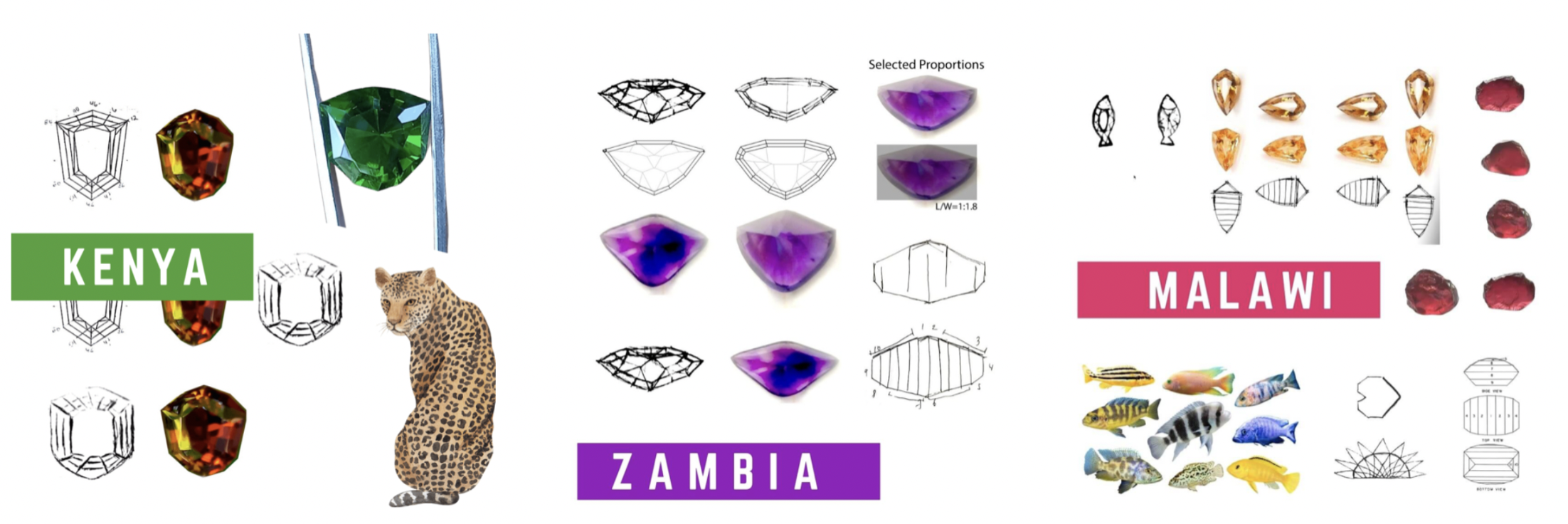
The National Gem Cuts for Kenya, Zambia and Malawi. Photo courtesy of Virtu Gem.
SW: So the National Gem Cut competition will be open to all designers, and if you like, say, the Kenya Cheetah-head cut, you can get that in any gem that Virtu Gem sources from Kenya. You could do an aquamarine cheetah-head or a tsavorite one, but, for example, you couldn’t get it in emerald, since we don’t currently source any facet-grade material from Kenya. If you wanted emerald, you’d have to get an Eagle cut from Zambia.
We are going to have different parts of the competition such as “Best Use of multiple gem cuts” and we’re really excited about it. It was such a fun project to see these cuts be developed, and we had over 60 gem cutters take part.

Speakers and gem dealers at the 2019 Chicago Responsible Jewelry Conference. Photo courtesy of Susan Wheeler.
CB: I’ve heard several people mention the Marange Women’s Alliance to me, but I’ve been wanting to ask you specifically about it and what it does.
SW: Well, I started talking to the Kimberley Process Civil Society Coalition (KPCSC) years ago, telling them that they need to talk to the jewelry industry and bypass the diamond industry. I think they’d been told (probably on purpose) that the diamond industry and the jewelry industry were one and the same. Working with KPCSC and Human Rights Watch, we put together a symposium to have actual conversations with victims of human rights abuse in Marange and from civil society in Lesothos. We had Human Rights Watch interview some of the women of Marange, with their faces blurred for their safety.
That’s how I came to meet Billie, who has been a long time community monitor working with the Human Rights Watch reporting from Marange for quite a while. I assisted Billie and the current leadership to form a Community Based Organization supported by the Responsible Jewelry Transformative (RJT). It’s called the Marange Women’s Alliance which is now over 60 women strong. Every Tuesday they have a chat over Whatsapp; today’s was on the effects of children and environmental justice in mining communities. The women completely run these Tuesday Talks, and the audience is geared towards their members. Even the fact that they have the Whatsapp group is huge because Marange is such an isolated place – the women can’t visit their friends who live in other villages. It’s like living in a militarized state of control.
CB: I can’t fathom what that is like and what their day-to-day situations are. It’s horrifying to hear about the atrocities taking place in Marange. I don’t know how much they share in their chats, but I’m sure it has been hard for them to deal with all the time.
SW: Yes. The women members of MWA have felt empowered because of their ability to communicate with each other from village to village and because of their connection to the outside world and their supporters in the jewelry community. If a woman in the group needs to go to court, such as when elders and women were arrested for protesting and were taken to court, the Marange Women’s Alliance bring snacks to court and go there for moral support. We pay for them through the RJT nonprofit, as well as pay for data credits so that all the women have continued access to Whatsapp. RJT also funds their transportation fees to get to court, and we’ve also done care packages for women such as a young girl who became pregnant after being a trafficking victim.
I have a picture of Billie sitting next to another woman who had just lost her home. I think their ability to foster community and peer-to-peer support is one of the most powerful aspects of this.
CB: Are all these women in the Alliance somehow affected by the mining sector?
SW: Yes, they are tied to the mining sector in ways I don’t think either of us could ever fully understand. Some of them have lost their land, livelihoods, clean sources of water, freedom of movement, basic human rights.
CB: It’s kind of mind-blowing that Zimbabwe is going to be vice-chair of the Kimberley Process, and these diamonds are still accepted in the market.
SW: It’s very intentional by the diamond industry. I was shocked at the deaths of 12 people in the Congo River Basin due to toxins being spilled allegedly from the Catoca mine in Angola, which is partially owned by ALROSA (the Russian diamond mining company). The bodies floated to the surface of the water and the water turned red because of the toxins, and people didn’t seem to care at the time.
CB: That’s why it’s so important that we have things like the Chicago conference, where we can talk about it and educate ourselves on so many issues, but also potential solutions, in the jewelry industry.
SW: There have always been a lot of initiatives that have started at the Chicago conference, such as mining equipment drives for TAWOMA (Tanzania Women Miners Association) and AWEIK (Association for Women in Extractives and Energy in Kenya). Of course, you know that early ideas about Moyo Gems also happened during Chicago. The Responsible Jewelry Transformative just was designated a 501c(3) right before Covid started to help be an umbrella for some initiatives, such as the Chicago Responsible Jewelry Conference, the grant and initiative component of Virtu Gem and the Marange Women’s Allinance with many ad hoc initiatives in between.
CB: Susan, thank you so much for your time and for being my latest Illuminator! I’m looking forward to seeing you in Chicago this November!
For more details on the Chicago Responsible Jewelry Conference 2022 (Nov 4-5th) click HERE.
Editorial Section
What to read next from The Source

Something we rarely talk about to the extent that it is almost taboo is what happens with a break-in, burglary or even a hold-up: How do we deal with the aftermath?