

Jewelry Journeys with Emily Phillippy
The content of this article is the opinion of the writer and was written for The Source
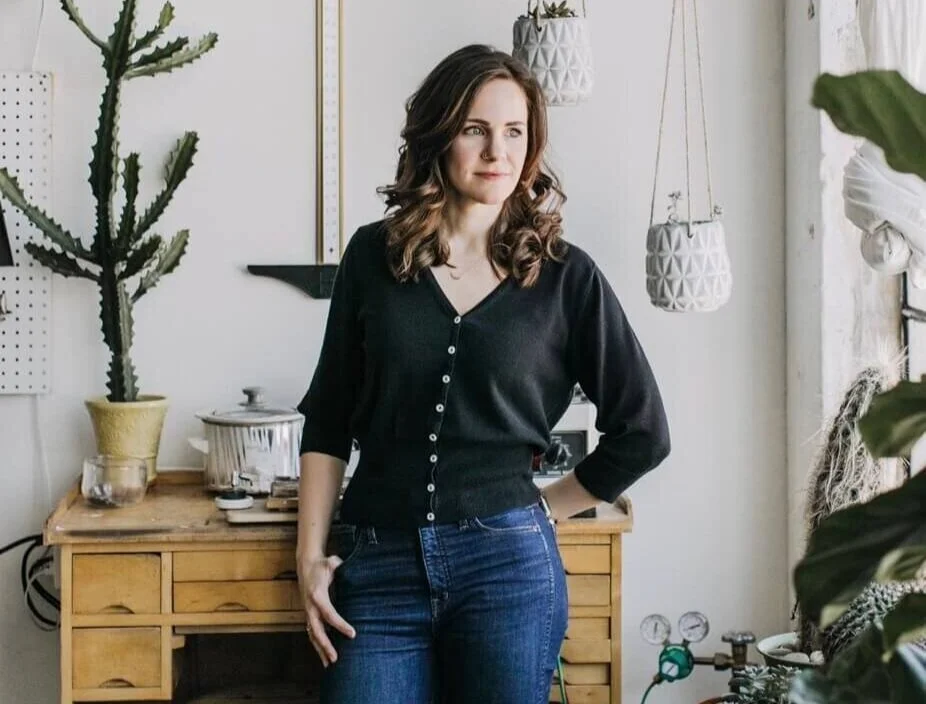
Designer Emily Phillippy in the Emily Chelsea Jewelry Philly showroom. Photo credit: Emily Chelsea Jewelry.
The following conversation has been edited for content and clarity.
Meet EM member Emily Phillippy: the owner of and designer behind Emily Chelsea Jewelry, a Philadelphia-based jewelry brand committed to social responsibility, environmental conservation and equality.
Emily received her Bachelor of Fine Arts from Tyler School of Art in 2011, helped launch and develop the Jewelry Glossary Project since its inception in 2017, and recently won the Equally Wed Award 2020 for “Best LGBTQ+ Inclusive Jeweler.” Emily Chelsea Jewelry uses 100% recycled precious metals or Fairmined Gold, and diamonds and colored stones that are either recycled or can be traced back to responsible sources.
Full disclosure: Author Chloe Beaumont was an employee of Emily Chelsea Jewelry.
Chloe Beaumont: When did you know you wanted to start a jewelry business? Was it in college as an art student, or even before that?
Emily Phillippy: I was probably a sophomore or a junior in college. I could never find jewelry that I wanted to wear, so I would just make it, and I started to take on little commission jobs and projects while I was still in school. Even after I got my first job, which at the time I thought was my dream job, I remember asking someone, “What do you do when you get your dream job at twenty-one?” They replied, “Find a new dream.” After that is when I set out to create my own business.
CB: You are a big champion of LGBTQ+ rights and inclusion in the jewelry industry. Can you talk about when you first learned about the challenges LGBTQ+ people face in the jewelry and wedding industry?
EP: A lot of my closest friends are part of the LGBTQ+ community. I started to see it through their eyes. I had been an advocate of LGBTQ+ rights in general for the longest time, but I felt like my eyes were really opened when I went to a conference about inclusivity and non-tradition in the wedding industry. This was in 2018 or 2019, not too long ago, yet I was the only jeweler present. At a wedding conference! It was mostly photographers, caterers and officiants. They had a panel of LGBTQ+ couples, and one of the couples had said that it felt like they had to come out all over again when they planned their wedding, because of how many times they were asked, “How did he propose?” or just people generally assuming the wrong pronouns or that they were having a traditional wedding.
I then sat down with one of the co-founders of Equally Wed, and asked her, “
“As someone who isn’t part of the LGBTQ+ community, how do I advertise and market myself towards this community without coming across as a fake?”
She told me that as long as I was genuine about it, it wouldn’t come across as fake. I asked, “So I can be loud about it?” and she said, “Definitely! Please do.”
From then on I started putting it all over the place that I was an LGBTQ+ ally, advocate, supporter…it changed everything. The numbers of couples that travel to come work with us is crazy; we have clients coming down from Massachusetts next weekend. We’ve had couples drive up from Virginia. It’s all because they really just want to feel accepted and supported.
CB: I feel like you going to that conference probably helped you find the message that you wanted to convey, as well as strength in your voice to share it.
EP: Definitely. Also, what made me realize how incredibly important it was was the fact that I was the only jeweler there at the conference.
CB: Engagements are such a big part of the wedding industry, and since jewelers are always tied to engagements that does surprise me too. You are really on the forefront of the jewelry industry, and designers in particular, being inclusive.
Emily Chelsea Jewelry was awarded Winner of the 2020 Equally Wed Award. Photo credit Emily Chelsea Jewelry.
EP: I’ve always prioritized ethics in my business, and I think in the EM community, being an ethical jewelry business is usually seen as focused on responsible sourcing from miners and cutters. Which are important, but I also view ethics in consideration to how a business runs and its practices. Do you have fair pay and benefits? A healthy working environment? What is your relationship like with the jeweler in town? Are you considerate of all types of clients?
CB: The back end of the supply chain is so important, but you’re right we also can’t neglect the other side of our businesses, the front-facing side, if we are going to claim that we are a truly ethical business. You clearly have thought about every area of your business well, which can be overwhelming for some people.
EP: I’m sure I am neglecting some areas, but I also think that’s just part of the journey. We can’t be everywhere at once and do all things. I think that it’s great how there are advocates for specific issues out there (which there are so many of). The more I grow and learn, the more issues I feel I can take on and address.
CB: Right. No one jewelry business is perfect and when it comes to responsibility, there is room for growth for everyone in the industry. As long as we are all on the path towards becoming better, and continually encouraging each other in ways that we can grow, that’s the goal.
Can you name 3 things that other jewelry retail stores or jewelry designers could start doing today to be more inclusive?
EP: First, be vocal about it. You can do it very easily by adding a statement to your website that says, “We are inclusive of all couples.” Another thing you can do is add your pronouns on your email signature. That is something that needs to become normal, and it’s not right now. The last thing would be, start stating your pronouns when you introduce yourself. For example I would say, “Hi, my name is Emily and my pronouns are she and her.” That’s not a reflex that I have quite yet, but I would like to.
“Not assuming gender pronouns is huge; stop referring to your jewelry as having a gender, because jewelry can be worn by anyone.”
CB: Those are really practical steps. From there, someone can work more and more towards making anyone who walks into your store or studio feel welcome and accepted.
EP: Some of these you can do overnight, but some do take more practice than others. It’s like the founder of Equally Wed told me, people will automatically be able to tell whether you are being genuine or not. It’s the biggest piece of advice I’ve received. Clients can definitely tell if you are just doing it to capitalize on their community.
CB: What has the response been like from your clients on you being an LGBTQ+ ally jewelry designer, and what would you share to convince another jewelry store that being an ally to the LGBTQ+ community is worth it despite any pushback or negativity they may receive by doing so?
EP: The biggest compliment I received from a client was when I had my Dancing With Her magazines spread out on a coffee table here in our studio. (Dancing With Her is a big LGBTQ+ wedding directory.) A lesbian couple saw the magazines on their way out, and exclaimed, “Oh wow, I’ve never seen a coffee table covered with magazines that have couples that look like us!” That is my goal; to make an LGBTQ+ couple feel seen and included.
Another response that comes to mind is from a client from Maryland who emailed me saying, “I just wanted to thank you for making me feel so welcomed and accepted in your shop because I didn’t feel comfortable when I went to other jewelry stores.” So, that confirmation of knowing that I am creating the atmosphere that was my goal feels really good.
In terms for my advice for other jewelers—one concern that I had in the beginning was that if I marketed myself towards the LGBTQ+ community, then I would only attract LGBTQ+ clients. That has not been the case at all. I still get cisgender/heterosexual couples who aren’t part of the community at all, but who are also allies. Some of them have family members who are in the community.
CB: It’s cool that when you are genuine about accepting everyone, it’s reflected back on you in turn; everyone comes to you because they all know they have a place here.
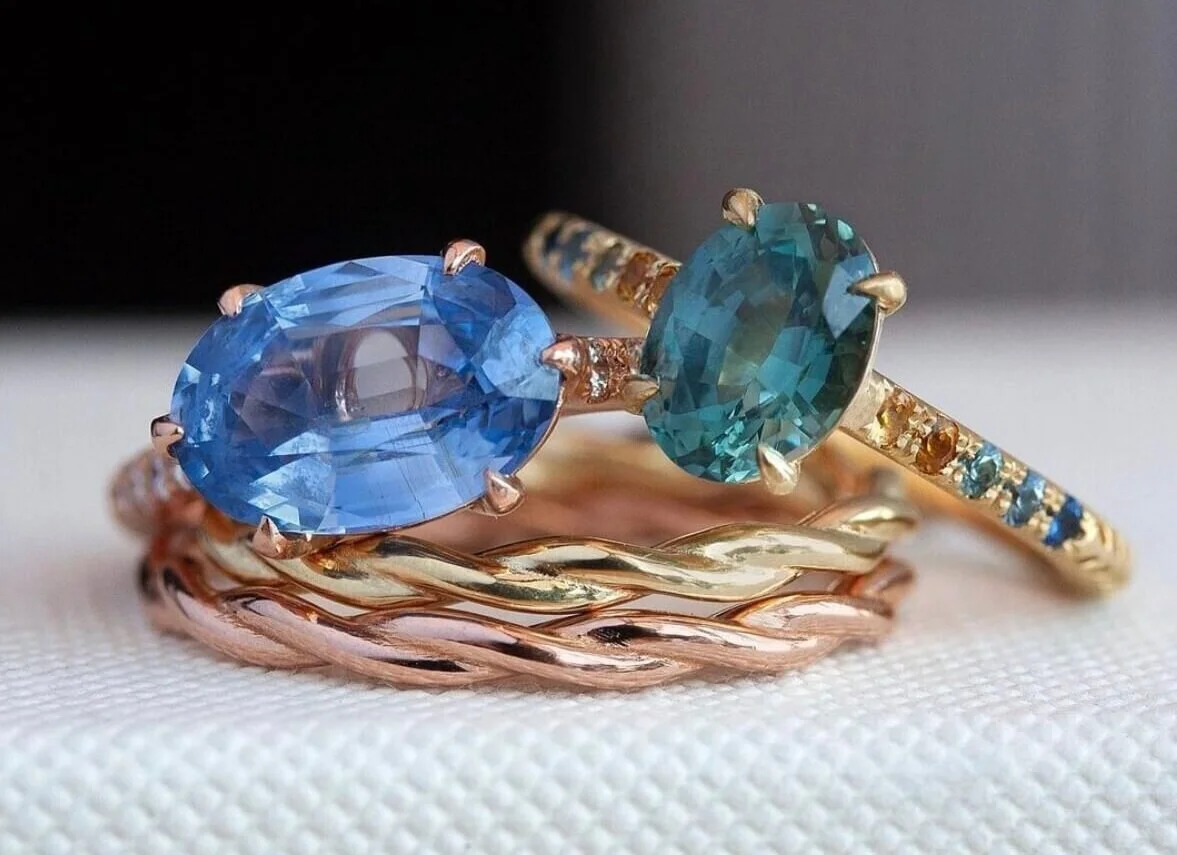
Two sapphire engagement rings, designed by Emily Phillippy. Photo credit Emily Chelsea Jewelry.
To pivot a bit, I want to talk about greenwashing in the jewelry industry because it is such a huge problem right now especially, as brands are constantly trying to win over conscious consumers who shop their values.
What, in your words, does greenwashing look like in the jewelry industry specifically? Can you give some examples for people who might be unfamiliar with the term?
EP: Greenwashing looks like jewelers who are advertising their stuff to be “ethical” “responsible” or “sustainable” without their product actually living up to those standards. One example is stating that your diamonds are “conflict-free.” Honestly, it is old news that “conflict-free” means nothing. If you are still promoting that, you haven’t taken the time to update yourself on that issue and understand why those words hold no weight. I’ll be gentle on people who use “sustainable” because that has only recently been addressed by the Jewelry Glossary Project. Sustainability is technically impossible when you are mining a finite resource.
“Someone not being able to answer further questions, or say any more past the buzz words, is a big red flag. If a jeweler or designer can only tell you, “Well, it’s responsibly sourced” and that’s it, that’s not enough.”
Also, just because you know where a stone or gold came from does not make it responsibly sourced. We can no longer just go off of someone’s word on a certain claim, but unfortunately for the most part that is still where the industry is at. It’s socially acceptable now to push past the initial, “Oh, well, my supplier said it is” type of answers. If you’re not pushing past that as a supplier, you could be at risk of greenwashing because you’re not doing any work to go deeper for answers.
CB: If a consumer suspects greenwashing is happening, what is the first question they should ask the jewelry company or supplier?
EP: The first question I would ask is, “Where is this from?” What’s important is for the jeweler to first be able to answer that properly. If they say, “Oh, you don’t have to worry about that here” or “We work with all honest people” that is your first red flag. If they state the country it’s from, that’s a good sign. Unfortunately, it does take doing your own research to know what countries you can expect to have better standards, and which countries you can expect to be more wary of and want to dig deeper into. The US, Australia and Sri Lanka have better standards. If they say it’s from Nigeria, Madagascar, or Tanzania, it could be worse, but for the consumer that’s hard to know. Simply googling “mining industry in X country” can help a lot.
Also, when you are asking about jewelry, don’t just ask about the gold. Gold is pretty easy for most jewelers to get recycled, but what about the tiny diamonds? Make sure you ask about all parts of your jewelry. It’s better for a jeweler to be honest and tell you that the gold is not recycled, than to try and hide where they got it from.
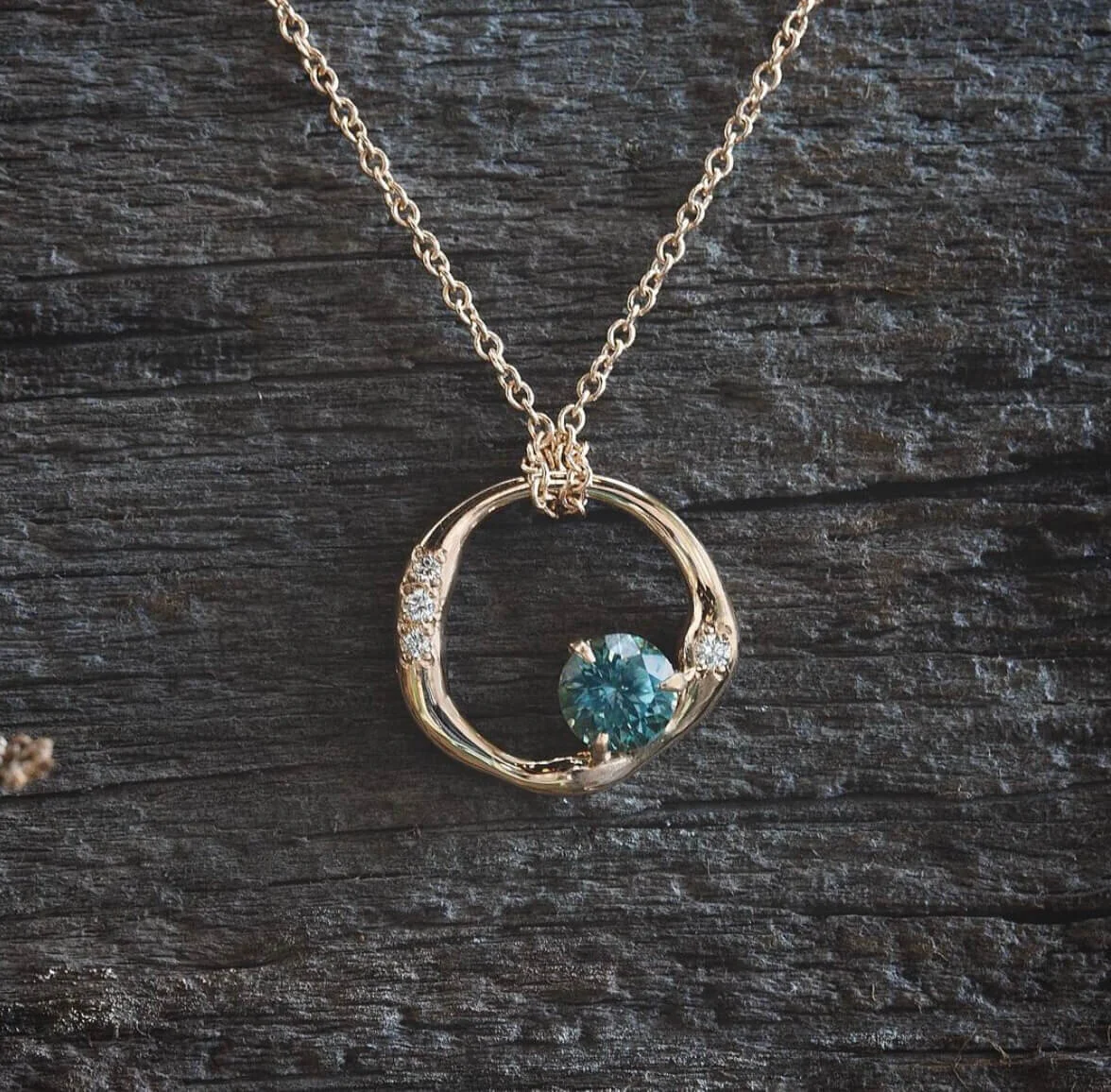
Necklace containing recycled diamonds and gold and a Montana sapphire, designed by Emily Phillippy. Photo credit Emily Chelsea Jewelry.
CB: Consumers having the courage to really ask these questions is what we want, right, to get jewelers worldwide to realize that consumers do care about this information and that they value transparency above all.
EP: Yes, and even if the answer a consumer gets is confusing, or they need to go home and do more research before deciding whether or not to work with them, that is ok. That consumer helped the responsible jewelry movement by showing the jeweler they really cared. Even if that jeweler didn’t have an answer, hopefully in the future they would.
On the jeweler and supplier side, Jared Holstein (who currently serves on EM’s advisory council) has reminded me that sometimes it takes us actually buying from or working with someone first, so we’ve started to build that relationship. People are willing to give you more answers and more of their time when you have invested in them and what they are doing.
One thing we talked about a lot with the Jewelry Glossary Project was the difference between people being misguided vs being misinformed. One feels intentional; one doesn’t. You don’t realize when you’re misinformed, and it’s not always people being malicious.
CB: How did you initially get involved in the Jewelry Glossary Project? What were some of the challenges you and your team faced when building definitions?
EP: It got started at the first Jewelry Industry Summit in New York, as an education initiative. I joined because I felt like education was really essential when you’re in the jewelry industry. One of the conversation topics started with “We’ve got to teach jewelers how to be more responsible and how to use recycled materials” but we quickly ran into the realization that we didn’t know how to educate people because we didn’t have a consensus on what terms like “recycled” even meant!
Next thing we knew, the Jewelry Glossary Project was born. The biggest challenges we ran into, and why it has taken us so long, is that we were very conscious to get rid of opinion in our definitions. We poured over word after word within the definition to make sure we were using correct words to even explain the term.
CB: In a way, you are getting into that legal mindset of having to nail down the definition of a word that has serious ramifications behind it. I mean that’s what lawyers do, I know because my dad is one! But where are all the lawyers for the jewelry industry?
EP: Right, and another big thing is fighting common acceptance or usage of a word. “Conflict-free” is taking on a new meaning. The original meaning did not mean “entirely free of conflict” it meant “does not fund civil wars or terrorism in X country.” There’s a difference, but a lot of people just throw the term around without knowing that because it’s become so common to do so.
CB: I think it’s really important that people consider the terminology they are using and don’t just pick and grab at any words or phrases simply because they feel or sound good.
EP: My personal view when I was a part of the project was, maybe by the end of defining all of these terms, we will discover (as an industry) that we shouldn’t actually be using certain ones at all, because they don’t apply to what we are trying to say. Maybe we can’t call jewelry sustainable, and I’m fine with that!
CB: What is one change you are glad to see happening right now in the industry, and what is one change that you want to see in the future?
EP: There was a recent article in National Jeweler about consumers turning towards post-consumer recycled diamonds. I didn’t quite realize that was a full-on trend, but the fact that it’s in a major publication tells me it is, so I was really excited to see that. One thing I hope to see in the future is more data and evidence-based sourcing. Having evidence to back up your claims, and more third-party verification.
CB: What’s your favorite thing about being a part of the responsible jewelry movement?
EP: It’s a small community. Actually, I don’t love that about it in that I wish more people were involved, but it’s been a community that is so supportive and friendly. When I first got into the jewelry industry, it didn’t feel very welcoming or friendly. Then I found EM and all of the sudden felt welcomed, made friends, and people wanted to share their suppliers and sources with me! Part of the reason it’s like that is because we are all working towards the same goal, so it’s not very competitive. We all want the same things. That’s really my favorite part.


Something we rarely talk about to the extent that it is almost taboo is what happens with a break-in, burglary or even a hold-up: How do we deal with the aftermath?