

Artisanal Mining and Regenerative Agriculture with Brian Cook
The content of this article is the opinion of the writer and was written for The Source
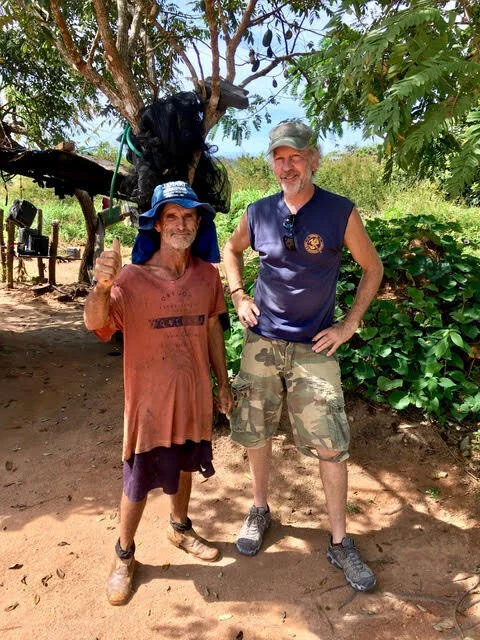
Brian Cook and a miner from the Brazilian Amazon. Photo courtesy of Brian Cook.
Brian Cook: Interview with Chloe Beaumont
Brian Cook is the co-founder of jewelry company Nature’s Geometry, which he runs with his wife Kendra and daughter Quendi, whom are also designers. Brian also owns Pyramid Mine in the state of Bahia, Brazil; a rutilated quartz mine. He is working on establishing regenerative agriculture in the local village to provide a parallel source of truly sustainable income.
Chloe Beaumont: Let’s start with my favorite first question: how did you enter the jewelry trade?
Brian Cook: Well, I have a background in Geology and a lot of prospectors in my family. I truly believe it’s in my DNA to have this insane need to find rocks! I was studying Mineralogy at Santa Rosa Junior College and was really serious about my studies. My professor took notice of this, and asked me if I wanted to use a lab in the back to learn how to make thin sections of minerals. It also happened to have a large rock collection—including a labradorite that I was mesmerized by. I ended up taking that labradorite to my friend’s lapidary and he taught me how to cut my first stone. So that’s how it started!
CB: You’re based partly in Tucson, Arizona and partly in the state of Bahia in Brazil. What initially brought you to Brazil, and what was it like to be there when the original Paraíba tourmaline was discovered?
BC: After I had met my wife Kendra, an exchange student from Bahia, Brazil, in high school I spent the summer and fall as a firefighter in Idaho. I then saved up and flew to Brazil. We got married on that trip and eventually had kids. After our family had settled in the States, I began more trips to Brazil on adventures to go find stones and crystals. I would even cut my university classes to do that! (I had told my professors from the get-go that I was not there just for a degree but to truly learn geology.)
Lo and behold, that’s what I did. I had one year left of school when a grassroots exploration company asked me to become a partner with them and move to Brazil. I said yes, we packed up everything and took the kids down and started the company. We were mainly focused on gold exploration; at the time there was a big gold rush in Brazil.
Turns out, the Amazon is not a fun place to look for gold! Around 1987, my partner and I decided that we wanted to focus our exploration in northeast Brazil instead, which was one of the least-explored areas of the country. It’s also a semi-arid climate, so you can actually see the rocks pretty easily. I told my wife Kendra, “I really want to show you the Interior, let’s go on an aquamarine hunt!”
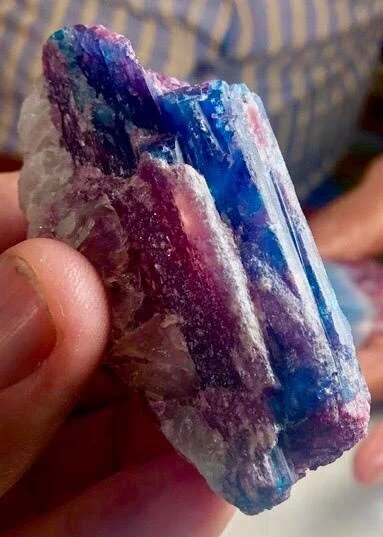
Paraíba Tourmaline. Photo courtesy of Brian Cook.
After we went on a cruise through the interior looking for aquamarine pegmatites (which are widespread) I ended up running into one of my suppliers on the way back. He said “Wait! You’ve got to see this!” before dumping huge piles of this electric, crazy, almost-fake-looking gemstone rough out onto a white plate. I mean, this mineral made an impression on me on a cellular level.
I asked the supplier, “Where is this stuff from? Who found this?” He told me the name of the person who found it. I tracked Heitor down in a small town in the Paraíba state and knocked on his door. Keep in mind at this time, there were zero foreigners in the area, even zero people from Minas Gerais! This was the outback Wild West, essentially.
So this guy opens the door and confirms he is who I was looking for. I asked him if he had any stones, and he said no and his face became clearly downcast. I noticed a gun laying on his bed in the background. For some reason, Heitor invites me in. He started telling me what was going on at his mine: it had just been taken over by invaders. I asked to see his paperwork for his claim of the mine; it all checked out. After hearing his story, I became determined to help him.
Meanwhile, Kendra and I moved our family to California, so I brought back some of these unknown mineral samples with me and took them up to GIA in Santa Monica. Upon seeing them, everyone started freaking out. Nobody could believe it, and suddenly it impressed on us how truly important it was to verify the Brazilian who discovered this mineral.
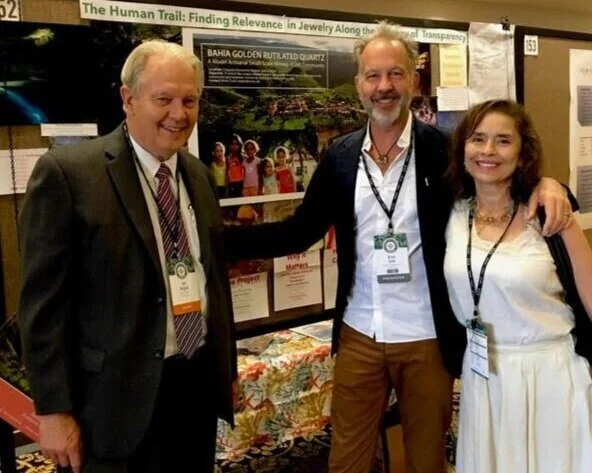
Brian and Kendra Cook and Dr. James Shigley, Distinguished Research Fellow, GIA. Photo Courtesy of Brian Cook.
In 1990, Paraíba Tourmaline showed up in Tucson. There were men with big signs claiming they had discovered it.
I was the only person at Tucson that knew the truth, that these people hadn’t discovered it, but that they had stolen the mine from its rightful owner, Heitor.
Demand for this new Paraíba Tourmaline was off the charts. In a matter of a week, it went from being $250 per carat, which was considered high at the time for a tourmaline, to re-selling at $2,500 per carat. That’s how much of a stir it caused. In the meantime, Heitor had been getting threatened.
CB: Was Heitor ever able to reclaim the mine?
BC: It took him until 2018 when he was finally able to. All those years of turmoil, strife, invaders, threats, and foreign companies trying to get in on it. It took the Brazilian federal government that long to finally declare that indeed, the only rightful claim was Heitor’s.
CB: That’s unbelievable. It’s so fortunate that you were there to meet him, hear his story, and continue in the fight with him to reclaim what was rightfully his.
BC: It definitely affected me in every area of my life. For many years, my kids would hear all these stories after I got back from Brazil about the latest developments. Wild things kept happening, so much so that I’m convinced someone could turn the story into a screenplay.
It had taken Heitor 7 years of exploring before he even hit any Paraíba tourmaline. 35 meters below ground, in one of the most rugged areas of Brazil that had no energy or water. Literally kilometers of shafts, drifts, galleries, and tunnels were hand-dug with candlelight!
CB: Wow. To think that if he had never started digging, this stone would still be undiscovered. What about the rutilated quartz—was there just as strong a demand for that stone?
BC: Yes! I had been out to this super remote village, again in northeastern Brazil, since before I was aware of Paraíba tourmaline, actually. The Paraíba craze distracted me from the rutilated quartz for quite a while! Sourcing and selling rutilated quartz in the ‘80s had been supplemental income for my family, and a way for us to maintain our relationship with Brazil. Kendra and I purchased some land out there which is the site of our Pyramid Mine today.
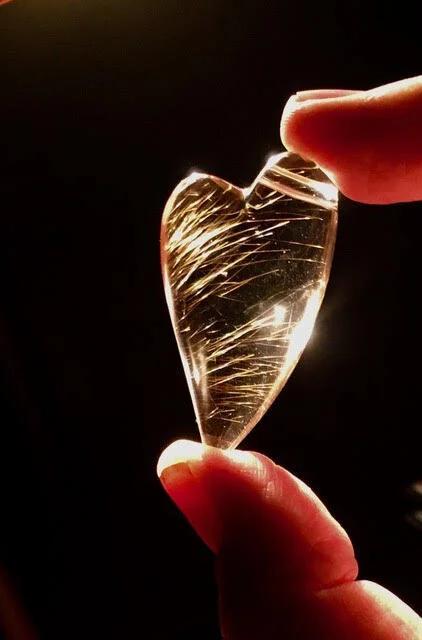
Rutilated Quartz heart. Photo courtesy of Brian Cook.
CB: I’ve read and heard a bit about your goals for sustainable development in the area and working with the locals to get them as involved as possible. I’d love to hear more about that!
BC: Of course. Yes, I had these ideas of working with the community from the beginning. My plans—or initiatives, I guess you could call them—are really just regular things one can do to help an artisanal mining community. It’s key to add more value to their product. I want to create a lapidary workshop and bring in and train people in stone cutting—a great opportunity for women. There are women miners, but they are a small percentage of the 500-3000 miners total. Usually the women will go through the “tailings” whenever a gemstone pocket is found and mining begins, and they still partake in the auctions that happen where they get to sell whatever they have found.
Mine safety is huge, as well as transparency and doing things legally. When we opened Pyramid Mine (by the way, the legalization of the claim took 12 years because I refused to bribe any Brazilian authorities) we were then able to help the other mine and landowners eventually legalize and formalize their claims. Mining had been going on for ages in the area, but all of it was technically illegal.
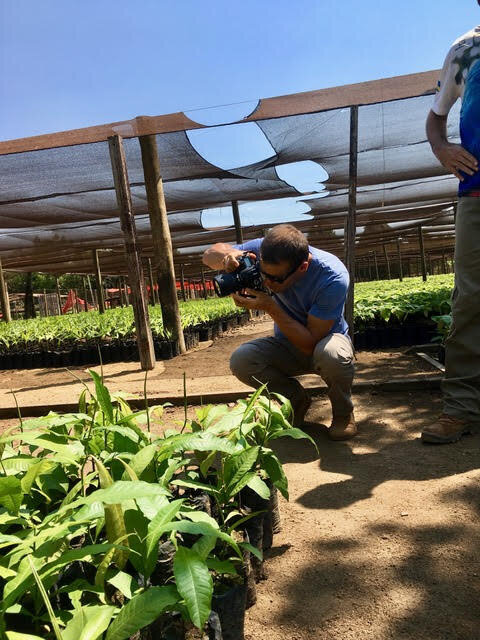
Rio Terra tree nursery for reforestation and agro-forestry in Rondonia, Amazon. Photo courtesy of Brian Cook.
One of the things I’m most focused on is finding a parallel source of income for the community alongside the gemstones. That’s where agriculture comes into play; I’m very into regenerative agriculture because it not only builds the strength of the soil, but it is also a big carbon-sink so it’s great for the environment. I want to create a garden that utilizes the best techniques and then teach the locals those techniques. Another goal is to make gardening part of the curriculum for the local school children nearby.
CB: Wow, that would be amazing. How has Covid-19 affected the mining community there?
BC: Due to Covid, a lot of the mining families are struggling right now, but we’ve partnered with the Crystal Clear Collective to help get food out to them. Jill Erwin, the founder and owner of She’s Lost Control, has been a great partner and has been raising lots of money over in the UK.
The money raised right now is being split between food packs and face masks for those in the mining communities.

Brazilian Miners with Covid-19 relief food packs. Photo courtesy of Brian Cook.
I think lots of people don’t realize that miners sometimes go months and months without finding anything, and therefore not having any income. That’s another big reason that growing cash crops would be a benefit to the area—it is income that would continue to come in until the next wave of valuable quartz is found. Mining is not forever; someday those stones will run out and so the goal is to establish another environmentally friendly, replicable way to make money.
CB: I am really glad that you are making this point about the need for truly sustainable livelihoods.
The word “sustainable” gets thrown around a lot, but there is debate of whether we should even be using that term in relation to the jewelry or mining industry at all.
BC: Yeah, mines are not sustainable! A mine might have a 5, 10, 30, or 100-year lifespan of production, and then when it runs out, the surrounding town collapses.
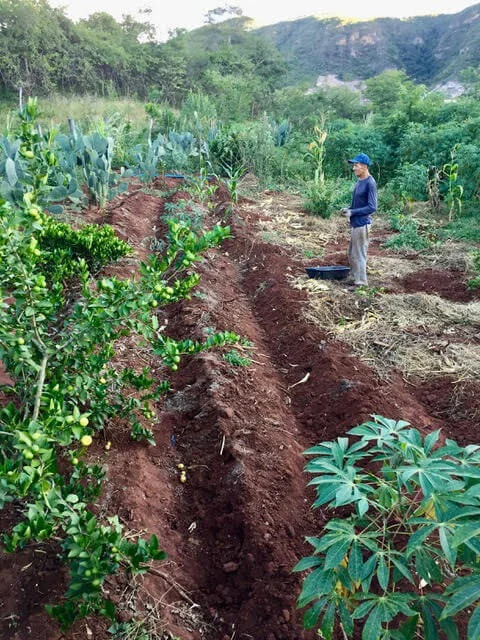
Regenerative agriculture in Remedios, Bahia, Brazil. Photo courtesy of Brian Cook.
Another goal of mine once the lapidary and garden are up and running is to build a Bed & Breakfast-type facility where foreigners and other Brazilian nationals can come stay. This could serve those interested to experience the land and people. I’ve had so many requests for this and people asking me “how can we come visit?” so this would be a great thing to have.
CB: I would totally come stay there! Once people hear your story and about the work you are doing there, I bet they are going to want to come too, to witness it and perhaps even take mental notes for their own initiatives.
BC: That’s the hope! I also want it to be open to Brazilian and foreign researchers. There are so many incredible plant species that could be developed and studied there; it’s one of the rarest biomes I’ve ever seen.
CB: I love that. Keeping a stream of people going there, even those outside the jewelry trade, only serves to raise awareness about what these mining communities are going through and hopefully it would help to improve their quality of life.
It would be so easy for you to go to this remote village, source stones, make some money and come back to the US. The fact that you’re willing to spend so much time, effort and resources to truly partner with the miners is very admirable.
BC: My goal is to “inspire by doing.” I’ve been on this path for 15 years and I haven’t gotten nearly as far as I would have liked because it’s all been just me. Since Jill jumped in with her contributions, it has made a big impact! Just yesterday, in fact, the mayor of the mining village hosted an entire event around the distribution of the masks and food packs. I don’t know if he was inspired or shamed, but he and the mine cooperative decided that they would add to the donations and partner in the distributions. The Mayor, Djalma, and the president of the co-op, Junior, are doing a good job and will make good partners as we go forward. It’s nice to see other people’s giving having a ripple effect.
CB: I hope it only continues! Brian, thank you for being an Illuminator and for sharing your journey and adventures with us!
What do beekeeping and fish ponds have to do with diamond mining?