2021: Khajornsak Nakpan
Emerging Artist Award
The 2021 Emerging Artist was chosen from the applicants to the So Fresh + So Clean student exhibition and awarded $1000.
Jury
Project Chair and Lead Juror: Sarah Parker
Guest Jurors: Susie Ganch, Brian Fleetwood and Madison Manning
Artist Bio
Khajornsak Nakpan
PhD Candidate, Program in Design, Silpakorn University, Thailand
I was born in an average income family. I grew up with a name given to me by the late King Bhumibol, the highest blessing of my life. My ability and experience in art as a designer led me to a balanced and harmonious living path, which teaches me that everyone is equal. “Contemporary jewelry” is my mean. I wanted to create something which generates happiness from within my root. I began to study a material that seems simple and can be found anywhere, like soil, compared to myself. I synthesised it to create a new and innovative material that is environmentally friendly. I then used it to create an item that responds to basic human needs. Once used, it can degrade naturally. The innovative material represents a philosophy in which lives harmoniously to be safe from every changing future.

2021 Emerging Artist Khajornsak Nakpan
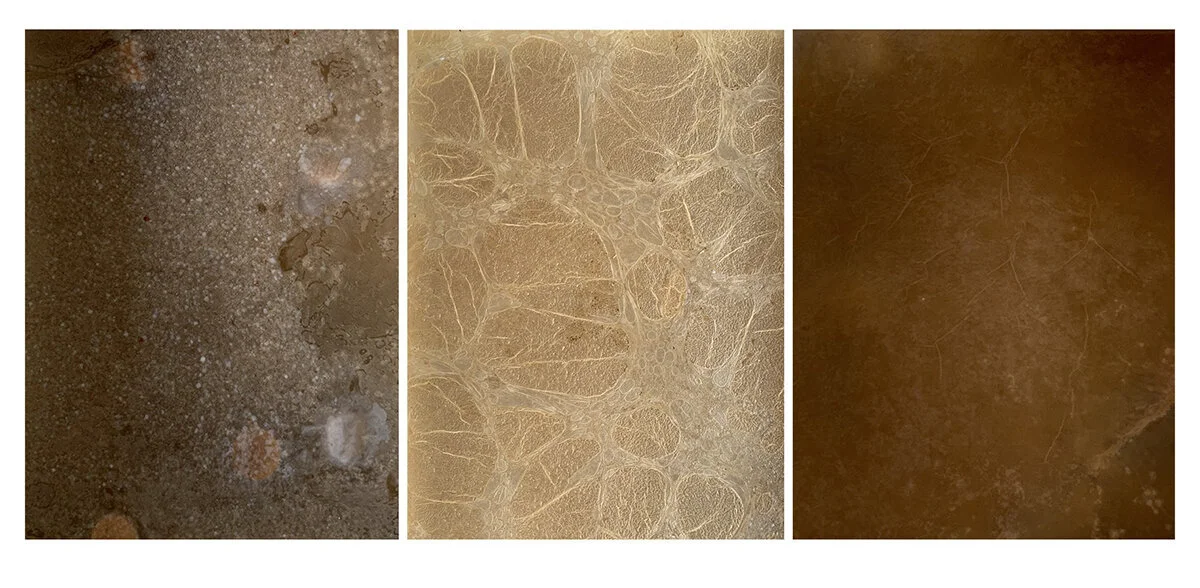
One of Khajornsak’s widely known works is “Innovative Synthesized Melanin from Soil as Biomaterial Substitute to Create Body Ornaments for the Future”. The research builds upon a study on abundance and changing qualities of soil. It is part of an experiment to create a artistic substitute material by synthesizing natural fibre and melanin from good bacteria to cellulose sheets. The process is a clean technology and produces zero waste. Result is a textile substitute material, which is human, and nature friendly. The material is an innovation which can drive an investment on environmental friendly art and design business. The entire process from designing to production focuses on using the clean technology to reduce pollution, maximizing nature resources, and decreasing dependency on imported materials.

Khajornsak Nakpan, Studio image
Emerging Artist Video. Run time: 4 minutes.
Khajornsak Nakpan, Studio image

Khajornsak Nakpan, Studio image
Bio Melanin Cellulose as a textile substitute


Based on rational thinking, the aesthetics approach is divided into the concrete and the abstract in the scientific design process. The concrete dimension of the development process considers the source material (which is soil) and the resulting bio-fibre. I felt two soil components: its physical qualities (mass, friability, and colour) and characteristics (elasticity and water solubility). Soil is rich in minerals, and it is the foundation of life. The abstract frame of this creation is directly linked to the physical qualities of the precursors used and the production process. Accordingly, the development process highlights various concepts that underlie this creativity: rootedness, foundation, birth, growth, strength, and life.
Therefore, I wanted to explore further the concrete and abstract meanings of soil, including honesty, truth, nature, and simplicity, which imply a life cycle. I want to design a collection of body adornments from this innovative material to enhance its aesthetic appeal to reflect these ideals. An amplituhedron, a mathematically calculated geometric shape introduced by Arkani-Hamed and Trnka (2014), was used to represent earlier concepts. This shape explains the relationships between particles, which are the minor units of a living system. It also allows for the calculation of relationships, which are the basis of quantum philosophy.
Moreover, several researchers worldwide have found that bacteria from soil can produce melanin. The final material contained melanin pigments with hues comparable to human skin tones. The hope is to develop a creative aesthetic that represents the concept of self-esteem, showing the philosophy and beauty of the effects of color on human skin. A collection of Body Adornments result from its color in a positive self-image and a sense of security, which will enhance people’s future aesthetic values.
a Series of Chada


This is ‘a Series of Chada’ project. It is a pilot project to integrate scientific and artistic knowledge to innovate and add value to materials through a creation of jewelry. It plays with locally available resources. It makes use of Streptomyces, bacteria found in soil, and synthesizes it to create cellulose fiber and melanin which is a biological material. The material is then used to create a ‘chada,’ a headdress used to indicate and represent status of the wearer. The works “Chada Din” and “Shadow of Chada” combine the simplicity of soil and the elegance of chada. It is a contrast of something common can represent nobility. The work “Humble” aims to represent an act of paying highest respect. The aim is to create an awareness when we must symbolically wear a headdress which indicates our status, position, and nobility. It is a reminder of the essence of being human. Where there is light, there is shadow. The material symbolizes equality.
Innovative Synthesized Cellulose from Mold


The next project I am interested in is exploring the “mold”. I like the idea that it grows from something which is dead. It can be used to demonstrate life cycle – a circle of living, pain, survival, and disintegration. It embraces the meaning of memory through a piece of jewelry, an object which carries its duty and holds sentimental value until it no longer does. What remains of it is just a memory and its meaning which lasts forever.